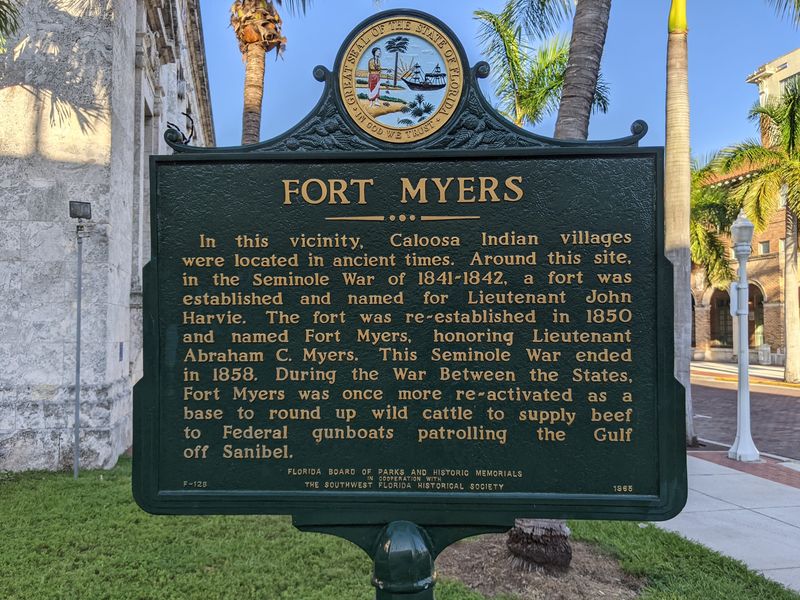
The following contains excerpts from a May 23, 2020, article by Cynthia Williams in the Fort Myers News-Press.
In Fort Myers, in 1868, the fort that had housed U.S. troops during the Civil War just past, and in the Seminole War before that, lay in ruins. One early settler’s daughter recalled that when they were planting trees on their property just northeast of the intersection of Fowler and Second streets, they kept “coming up with bones.”

In 1941, W. Stanley Hanson wrote in a letter to Florida Heitman, “You and I, being among the genuine ‘old timers,’ know that there used to be a cemetery at the site … I have seen Indian remains and beads dug up at both places in my long sojourn in Fort Myers.”
Thomas A. Gonzalez, in his book, “The Caloosahatchee” (1932), spoke of “an old cemetery was buried a large number of U.S. soldiers, who died here during the war with the Seminoles,” and states further: “Among these soldiers was Captain W.H. Fowler, 1st Artillery, whose grave was handsomely walled up. Captain Hendry proposed to name the new road Fowler Street, in honor of this officer.”
The first documented evidence of the existence of this fort cemetery surfaced in 1886 on a subdivision plat that located “US Cemetery 1851” between First and Second streets within the James Evans homestead.
In 1888, the Fowler and Second street section of town was being platted for homes. Citizens felt that, in all decency, the bodies had to be removed. A short time later, contractors were certain they had completed the task.
However, an archaeological report, titled “A Century of Burial Removals at the U.S. Military Cemetery at Fort Myers (8ll1758): Historical and Archaeological Perspectives,” published by the Florida Archaeological Society in 1993 following the excavation of the remains of 22 more bodies in the Second and Fowler streets location, states that: “The removal of 55 burials in 1888 and the rediscovery of 20 of these burial features in 1993 can hardly account for the number of individuals once interred in the cemetery. Considering that the fort was used in 1841-1842, 1850-1858, and again in 1864-1865 during the Civil War, the potential for the burial of a large number of soldiers must be assumed. Additionally, the presence of civilians, as well as Seminole prisoners, increases the potential number of burials many fold.”
The 1996 FAS report concludes that “ …the graves of the soldiers, civilians, and prisoners who died during the decades spanning the creation of Fort Harvie in 1840 through the close of Fort Myers at the end of the Civil War remain lost beneath the streets of Fort Myers.”
Read the full story at the link on this page.
This article originally appeared on Fort Myers News-Press: From the Archives: The bones beneath Fort Myers streets
Reporting by Fort Myers News-Press / Fort Myers News-Press
USA TODAY Network via Reuters Connect