Florida has thoroughly etched its name in spaceflight history, with a strong argument to be made that a region in the state dubbed the “Space Coast” is the rocket launch capital of the U.S.
In 2025, the Sunshine State made history with 109 rocket launches – a record it’s on track to shatter once again in 2026. That’s why it’s no surprise that on any given week, you can expect multiple spacecraft – both with and without astronauts aboard – to take off from Brevard County.

And to support such a flurry of activity, Florida needs plenty of launch pads.
That’s where the Eastern Range comes in. The swath of area extending from the Florida mainland encompasses the Kennedy Space Center and the neighboring Cape Canaveral Space Force Station, where both rocket launches and military missile tests are supported.
Between the two launch sites, several launch service providers like Elon Musk’s SpaceX and Jeff Bezos’ Blue Origin are able to get their rockets off the ground from several available pads.
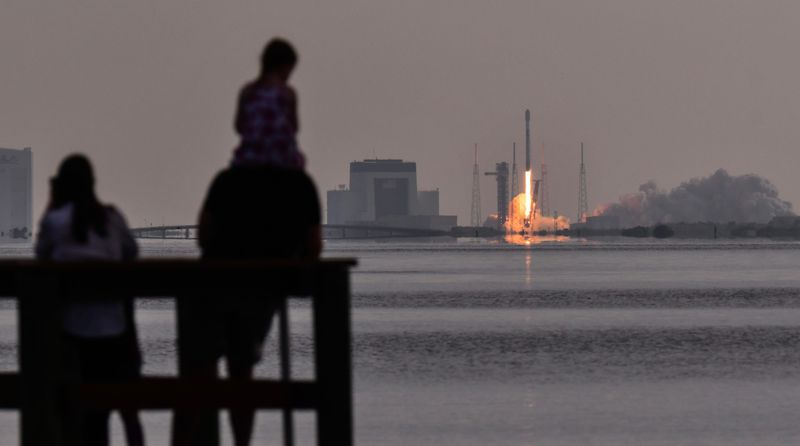
Here’s a look at the launch complexes, or pads, in Florida, as well as which rockets lift off from each location.
What is the Kennedy Space Center?
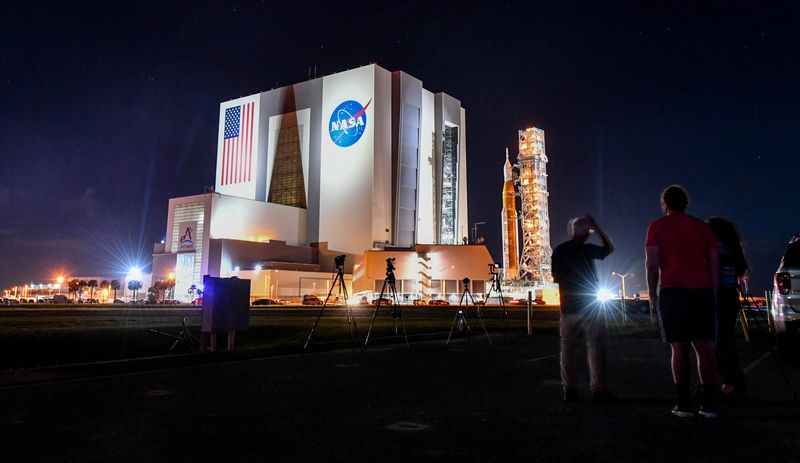
Located on the east coast of Florida on Merritt Island in Brevard County, the Kennedy Space Center is NASA’s primary spaceport where a majority of the space agency’s missions get off the ground.
The Kennedy Space Center, often abbreviated as KSC, was envisioned to meet President John F. Kennedy’s goal of getting to the moon under NASA’s Apollo program with launch pads to support launches of the Saturn V rocket. While three were planned, budgetary constraints made it possible to construct two: pad 39A and pad 39B.
Throughout the decades, the pads have powered a number of iconic missions – from NASA’s Gemini program of the 1960s to the shuttle program of the 2000s.
These days, they’re most prominently where SpaceX launches astronauts to the International Space Station atop its Falcon 9 rocket under NASA’s Commercial Crew Program. KSC is also home to NASA’s Artemis moon program, which is using its Space Launch System rocket to return Americans to the lunar surface for the first time since 1972.
Launch Complex 39A
At the Kennedy Space Center, perhaps no launch site is more iconic than Launch Complex 39A, where the majority of NASA’s Apollo moon missions got off the ground – including the groundbreaking Apollo 11 moon landing. The location is also where the first and last launches of NASA’s space shuttle program occurred 30 years apart.
Now, it’s home to SpaceX, which leases the facility.
But because SpaceX has construction underway at 39A ahead of a highly anticipated Florida debut potentially by the end of 2026 of SpaceX’s massive Starship – the world’s largest rocket – activity at the launch pad has been reduced. However, the site supported a launch of SpaceX’s Falcon Heavy rocket at the end of April.
Launch Complex 39B
The less-prolific Launch Complex 39B a little further north may be less prolific, but it’s also seen its share of historic missions – including one Saturn V launch on the Apollo 10 mission in 1969.
In fact, 39B is now the home of NASA’s 320-foot Space Launch System rocket used on the agency’s Artemis moon campaign.
The first Artemis mission lifted off Nov. 16, 2022, as an uncrewed test flight of both the SLS and NASA’s Orion spacecraft, which traveled around the moon and back before making a splashdown in the Pacific Ocean. The next Artemis II mission in April 2026 looked nearly the same, except this time four astronauts were aboard Orion for the first crewed moon mission in more than half a century.
The Artemis III mission slated for 2027 would also launch from the site, sending a new crew of astronauts to Earth orbit to test Orion’s docking capabilities with both Blue Origin’s and SpaceX’s lunar landers.
What is the Cape Canaveral Space Force Station in Florida?
The Cape Canaveral Space Force Station is located southeast of the Kennedy Space Center and Cocoa Beach in Brevard County, Florida.
Operated by the Space Force’s Space Launch Delta 45, the station is part of the Patrick Space Force Base. Though the station is a military installation, a variety of commercial launch companies have operations at the location – including, once again, SpaceX.
While the station is home to several launch pads, below is a look at the four that are either the most active, or most critical to U.S. spaceflight ambitions.
Launch Complex 37
Previously home to United Launch Alliance’s Delta Heavy, the long-dormant Launch Complex 37 is being repurposed to give SpaceX a second location in Florida to launch its Starship rocket in the years ahead.
Standing at 407 feet tall, the latest model of Starship – known as Version 3 – could be the iteration to finally reach orbit as SpaceX continues to develop and test the world’s largest rocket for missions to the moon and Mars.
To date, Starship has only launched from SpaceX’s Starbase company town and headquarters in South Texas. But SpaceX’s plans would provide three launch pads in Florida: one with Launch Pad 39A, and two more at Launch Complex 37.
Launch Complex 40
Launch Complex 40 is primarily used to launch SpaceX’s Falcon 9 rocket on missions to deploy batches of the company’s Starlink broad internet satellites into its constellation in low-Earth orbit.
SpaceX has also been the launch provider for three missions contracted by Amazon to deliver Amazon Leo satellites into a newer orbital constellation.
Significantly, though, the complex 40 supported in February a rare human spaceflight, with the launch of a mission known as Crew-12 sending four astronauts to the ISS.
Launch Complex 41
Launch Complex 41 is the home of the United Launch Alliance, a joint venture between Boeing and Lockheed Martin.
Like SpaceX, the Colorado-based launch service provider, often abbreviated as ULA, has also been paid to launch Amazon Leo satellite missions using its Atlas V rocket.
The same launch pad is also now used to fly ULA’s next generation Vulcan Centaur rocket, which launched for the fourth and most recent time in February.
The United Launch Alliance has also launched one crewed mission from the location: the first crewed test flight of Boeing’s Starliner capsule, which NASA is hoping to certify along with the SpaceX Dragon to transport astronauts to space. While the 2024 launch of the Atlas V rocket went off without a hitch, that mission infamously ended in failure when the Starliner encountered issues that prompted NASA to return the astronauts on a Dragon instead.
Launch Complex 36
Launch Complex 36 became part of a major news story at the end of April when the rocket that launches from the location exploded in dramatic fashion.
Blue Origin, the spaceflight company founded in 2000 by billionaire Jeff Bezos, invested $1 billion to renovate the site to launch its towering New Glenn rocket. Standing at 322 feet tall, the New Glenn rocket has launched on three missions since January 2025 – all to varying degrees of success.
But on May 28, a New Glenn rocket erupted into flames and sent literal shockwaves across Florida while Blue Origin was preparing it for its fourth launch. The mishap dealt a huge blow not just to Blue Origin, but to NASA, which is relying on New Glenn to deliver lunar landers to the moon in the years ahead for both uncrewed and crewed missions furthering the objectives of its Artemis campaign.
Contributing: Rick Neale, Brooke Edwards, Jamie Groh, FLORIDA TODAY
Eric Lagatta is the Space Connect reporter for the USA TODAY Network. Reach him at elagatta@usatodayco.com
This article originally appeared on Florida Today: From KSC to nearby Cape Canaveral, your guide to launch pads in Florida
Reporting by Eric Lagatta, USA TODAY NETWORK – Florida / Florida Today
USA TODAY Network via Reuters Connect
By Eric Lagatta, USA TODAY NETWORK – Florida | USA TODAY Network