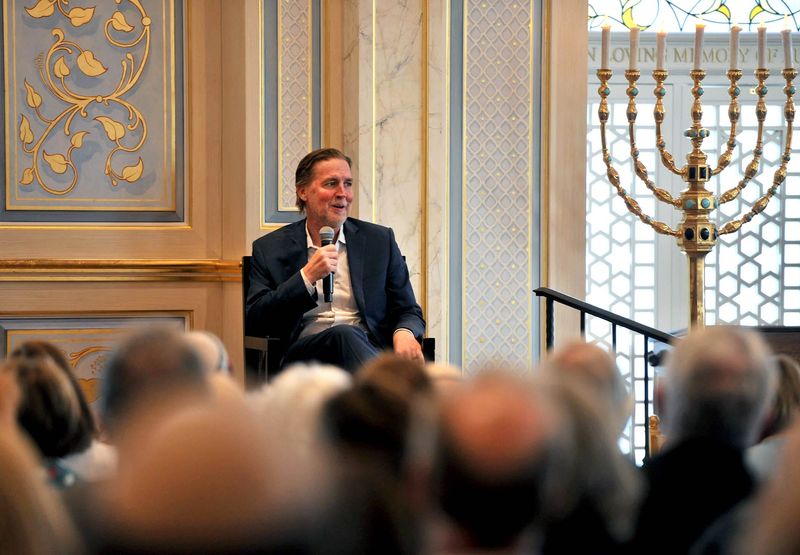
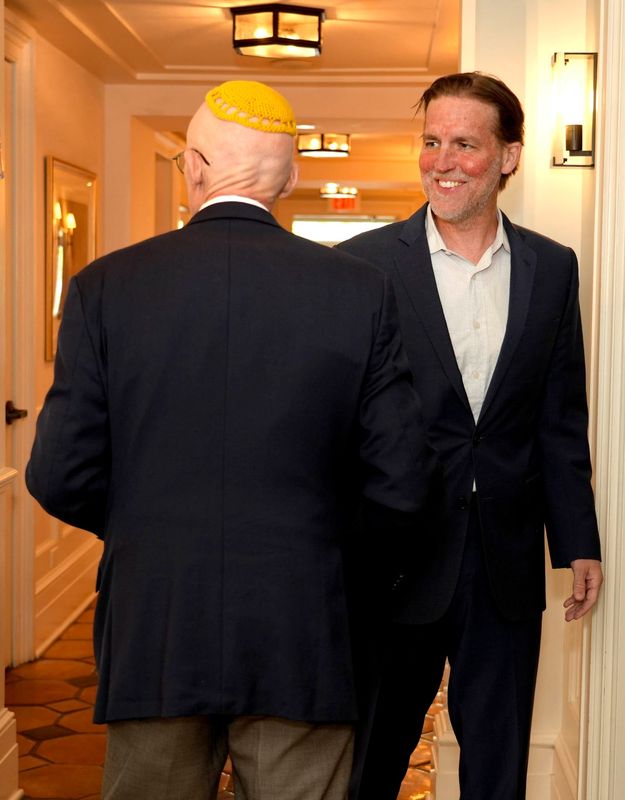
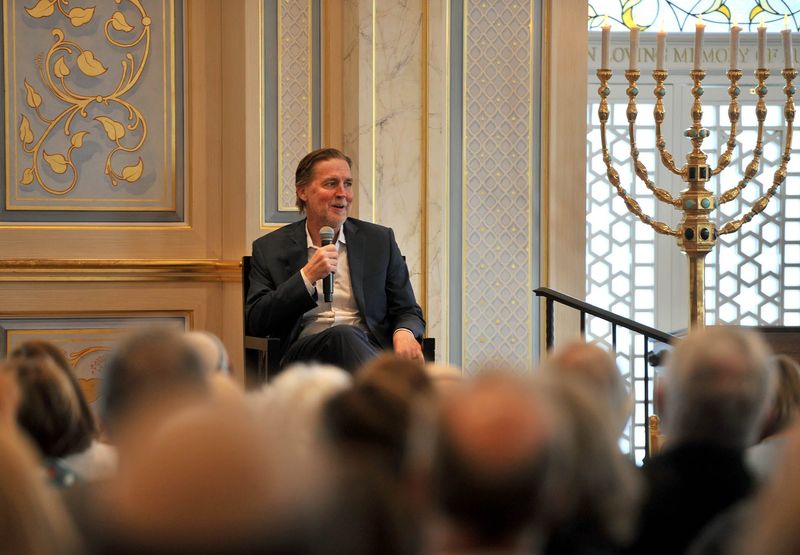
Former U.S. Sen. Ben Sasse told a Palm Beach Synagogue audience that Americans need more discipline and restraint, warning that digital distractions are chipping away at shared cultural experiences.
Sasse is a Nebraska Republican who served as president of the University of Florida after spending more than seven years in the Senate. He appeared at the synagogue as part of the Levy Forum, a speaker series that brings public figures and writers to Palm Beach to discuss social and cultural issues.

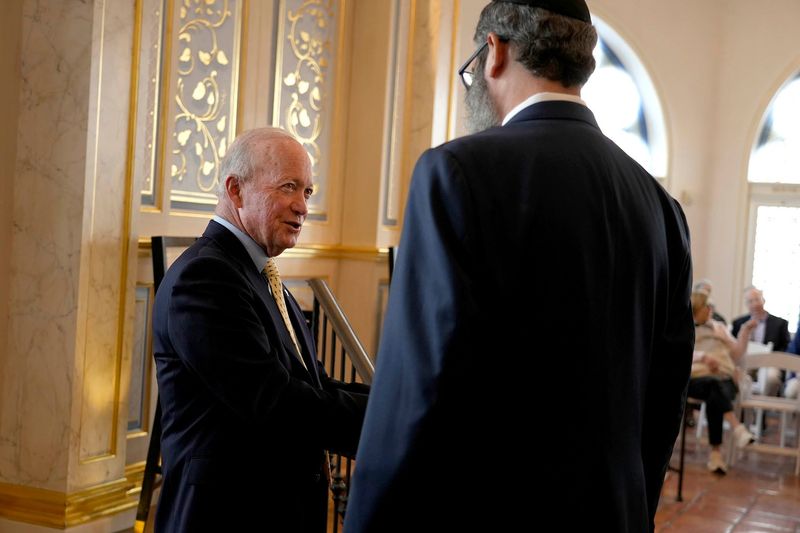
In a discussion moderated by former Indiana Gov. Mitch Daniels, a longtime friend, Sasse said American democracy depends on “self discipline, self restraint and self control” rather than government force. The system, he added, depends on a balance between citizens and government.
“The people come first, and dignity comes first, and government is a shared project,” he said.
Sasse served in the senate from 2015 to 2023. He headed UF from February 2023 through July 2024.
Sasse was diagnosed with stage 4 pancreatic cancer in December. Since then, he as spoken publicly about focusing on life’s priorities, including how people spend their time and attention.
In response to a question about artificial intelligence and new technology, he said modern technology is reshaping how people pay attention and interact. He pointed to how much computing power is now carried in everyday devices.
“This is one of the most interesting times to live in all of human history, to live at a time when you can have supercomputers that have the reach that we have,” he said. “Just think about what these things are. I am dumb enough to carry three of them. This has more (computing) capacity than gymnasium-sized supercomputers, mainframes at MIT in the late 1950s and early 1960s that won the Cold War.”
The conversation also touched on generational change, with Sasse saying institutions often fail to prepare young people for adulthood and responsibility.
“The failure of our institutions right now is they demand way too little from 16- and 18- and 20- and 22-year-olds,” he said. “We presume a passivity — that is super unhealthy — about people who are meant to go and build and do and hunt and conquer. You are not going to have your full fluid intelligence at 22, but you’ve got a passion and energy that we all know we don’t have at 52, 72 or 92. And so we need adulthood to come earlier.”
Daniels led a wide-ranging conversation that included political polarization, fiscal policy and artificial intelligence.
Americans no longer share many common cultural experiences, Sasse said, citing fragmented media and the decline of mass-audience programming. He pointed to the growth in media options over time and said that shift reduces what people share in common.
Referring to the ever-expanding media landscape, he said: “I think we all kind of know that the net effect of that is arguably bad, because it means that, although I get to choose to watch whatever I want, it means tomorrow morning I don’t have anything in common with anybody else.”
Throughout the discussion, Sasse focused on the importance of self-governance and the habits he said help societies function without outside control.
He said those habits are necessary so citizens are not subject to “discipline, restraint or control imposed by others.”
Asked whether Americans in 2050 will be more or less free, Sasse said it depends on whether citizens rebuild habits of self-restraint and thoughtful discussion in a fractured media environment.
“If we try to navigate this moment with just a tribalism of anti-politics, we will definitely fail,” he said. “I am a policy conservative, but I am a tonal and dispositional moderate. It is not good enough for people at my right end of the political spectrum to say all the crazies are over there, and for people on the left to say all the crazies are over there.
“There have always been crazy people. What’s new is a media environment where we pretend that it’s (something) new on their side, and that there is nobody crazy on my side. America requires deliberation, deferred gratification, and the kind of self-restraint that says, ‘I believe in future gain from some present sacrifices.’”
Palm Beach Synagogue Rabbi Moshe Scheiner said he was impressed by Sasse, noting the former senator chose to attend despite his illness.
“He told me yesterday that 121 days ago, the doctors gave him three months to live,” he told the Daily News on April 16. “And he’s on a trial drug, and he’s just celebrating every day and doing the best he can. He’s an amazing human being.”
Jodie Wagner is a journalist at the Palm Beach Daily News, part of the USA TODAY Florida Network. You can reach her at jwagner@pbdailynews.com.
This article originally appeared on Palm Beach Daily News: Former Sen. Ben Sasse urges discipline, restraint in Palm Beach talk
Reporting by Jodie Wagner, Palm Beach Daily News / Palm Beach Daily News
USA TODAY Network via Reuters Connect