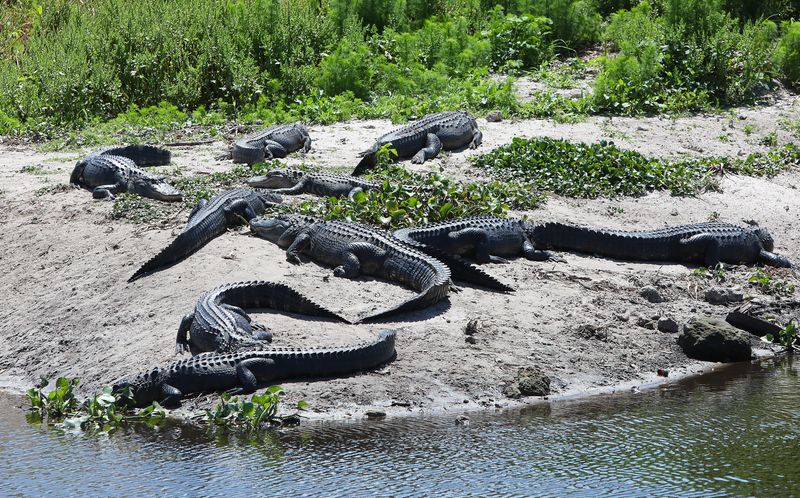
It’s generally assumed that any body of water in Florida has an alligator in it.
According to Florida Fish and Wildlife, they prefer freshwater lakes and slow-moving rivers and their associated wetlands, but they also can be found in brackish water habitats and occasionally even in salt water.

Seeing Florida’s alligators pop up in viral videos, on front porches, golf courses, in pools or at the beach while scrolling through social media is a common occurrence.
Alligators can grow very large. Female alligators usually stay under 9 feet long with larger ones weighing over 200 pounds. Male alligators typically reach up to 13 feet in length with some weighing more than 500 pounds.
About 1.3 million alligators call Florida home — but where do they live when they aren’t showing up where they aren’t welcome?
Here’s a list of the top five Florida rivers with the most alligators, including one near Venice and Sarasota, along with some safety tips.
What parts of Florida have alligators?
Alligators can be found in all 67 Florida counties.
How many alligators live in Florida?
An estimated 1.3 million alligators call Florida home.
To get a population estimate, Florida Fish and Wildlife conducts an annual alligator census at around 50 sites across the state by going out on airboats at night and counting the sets of red-glowing eyes seen on the water. The exact count is then used to calculate an estimated total population for that body of water and the state.
Largest Florida alligators on record?
According to FWC, the Florida state record for length is a 14-foot 3 1/2-inch male from Lake Washington in Brevard County. The Florida record for weight is a 1,043-pound (13 feet 10-1/2 inches long) male from Orange Lake in Alachua County.
How common is it to see an alligator in Florida?
Alligators are very common in Florida, with more than a million living in the state.
Each year, the Florida Fish and Wildlife Conservation Commission takes a census of 50 alligator-infested places in Florida to gauge how many alligators are living in the state. The FWC says it enlists the help of scientists and biologists who go out on airboats at night to count how many glowing sets of red eyes they see floating on the water.
Counting every gator is not possible, so the exact count and some math magic are used to estimate what the total population likely is for some lakes.
“Alligators occur in all 67 counties in Florida and can be found in practically all fresh and brackish water bodies and occasionally in salt water,” according to the FWC.
“Although exact population figures are not known, Florida has a healthy and stable population of about 1.3 million alligators of every size. This population estimate is based on an estimated 6.7 million acres of suitable habitat.”
Top 5 Florida rivers with the most alligators
Here is a list of the five rivers with the most alligators in the Sunshine State, according to an October 2024 post on A-Z Animals blog:
Safety tips: What to do if you see an alligator in Florida
Though Florida residents have learned to coexist with alligators, the potential for conflict always exists, according to the Florida Fish and Wildlife Conservation Commission.
The wildlife commission recommends people avoid feeding alligators and to keep their distance if they see one. “Swim only in designated swimming areas during daylight hours. And keep pets on a leash and away from the water,” FWC’s site says.
While they aren’t nonexistent, serious injuries caused by alligators are rare here. If you are concerned about a gator, call the nuisance alligator hotline at 866-392-4286 or visit myfwc.com.
Can you run away from an alligator? Running zig-zag debunked
Most native Floridians learn as early as preschool to run away in a zig-zag line if they encounter a gator, but this has been debunked. Gators can run fast on land, but only for short distances before they get tired. Simply run away in a straight line.
If you find yourself tempted to take a night swim in a lake, river, pond or any natural body of fresh water, just don’t. If the sun is down, the gators are out.
If you’re walking or relaxing beside a lake, pond or river with your dog or cat, keep them at least 10 feet away from the shore and on a leash.
This should go without saying, but never feed an alligator. You definitely don’t want this wild animal to associate you with food.
Can you shoot an alligator in your yard in Florida?
Don’t try to “take care” of any gators yourself. If you don’t have a permit to be hunting gators, you can’t shoot one. And, depending on where you live, just by firing a gun you may be breaking other local laws.
Under Florida law, it’s a third-degree felony to “intentionally kill, injure, possess or capture, or attempt to kill, injure, possess or capture an alligator or other crocodilian, or the eggs of an alligator or other crocodilian, unless authorized by rules of the commission.”
The Statewide Nuisance Alligator Program trappers relocate gators under 4 feet long and kill nuisance gators that are longer than 4 feet.
“Relocated alligators often try to return to their capture site,” according to the SNAP website. “They can create problems for people or other alligators along the way. If an alligator successfully returns, capturing it again would be necessary and likely more difficult the second time.”
This article originally appeared on Sarasota Herald-Tribune: Florida rivers with most alligators include one near Sarasota, Venice
Reporting by Kim Luciani, Lianna Norman and Jennifer Sangalang, USA TODAY NETWORK – Florida / Sarasota Herald-Tribune
USA TODAY Network via Reuters Connect