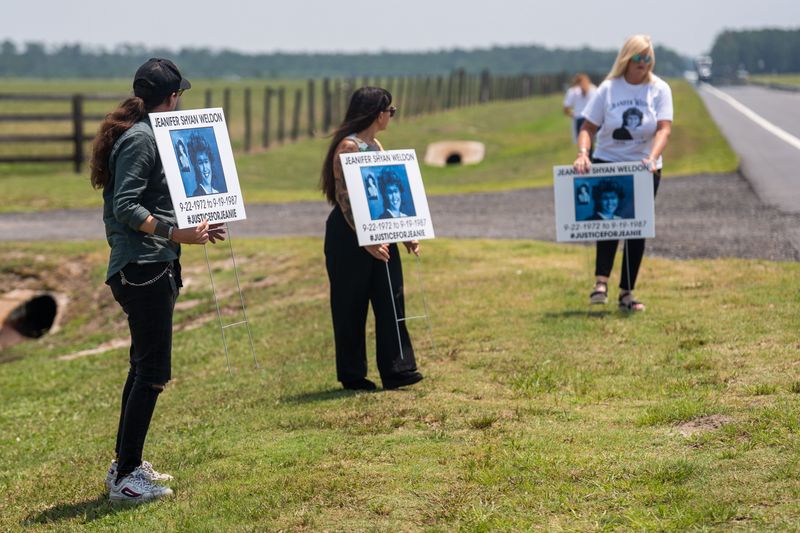
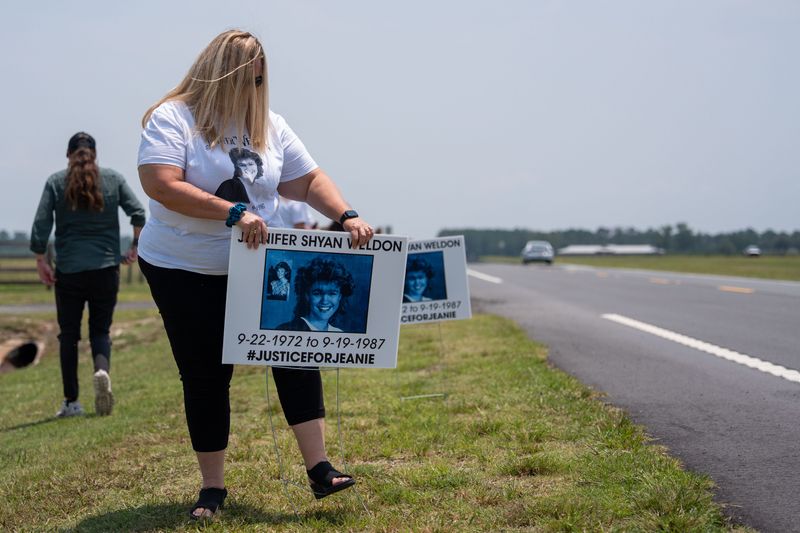
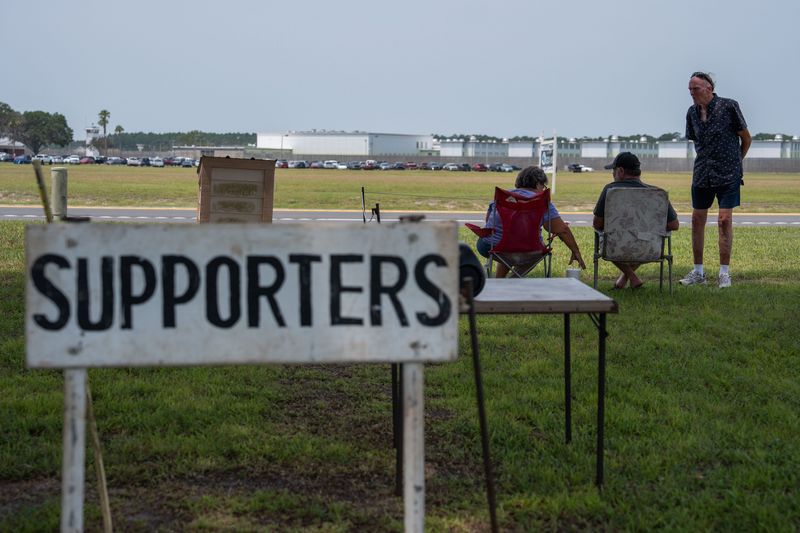
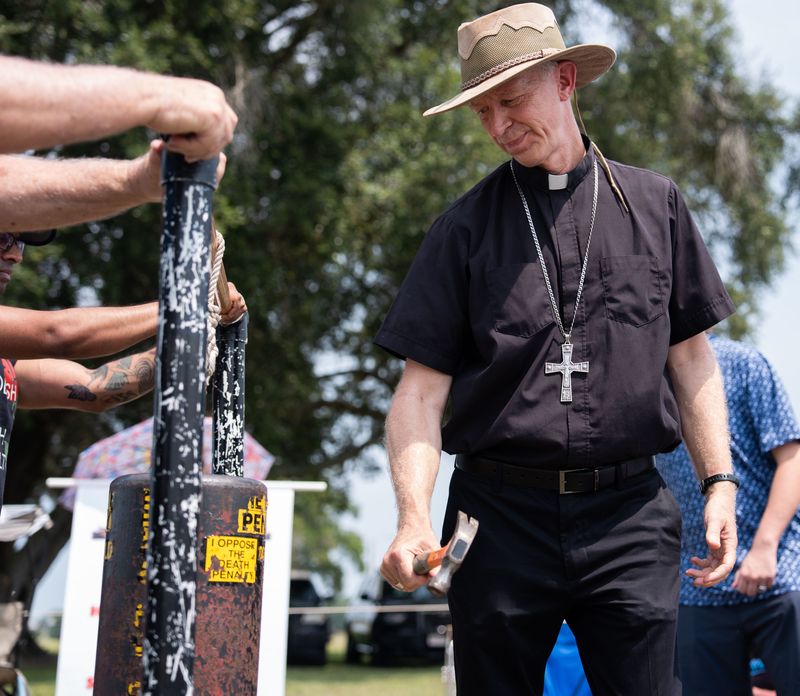
EDITOR’S NOTE: Tallahassee Democrat photographer Alicia Devine was in Raiford, Florida on the day that Florida conducted its first double execution in 60 years. In photos and videos, here is some of what she heard and saw.
Florida has put to death two inmates in what’s now the state’s first double execution in more than 60 years amid an aggressive death penalty push by Gov. Ron DeSantis.

James Duckett, a 68-year-old former police officer convicted of killing an 11-year-old girl in 1987, was executed by lethal injection at 1:19 p.m. on July 28.
About five hours later, Florida executed Dominick Occhicone at 6:13 p.m. for the murder of his ex-fiancée’s parents in 1986. At 80 years old, Occhicone became the second-oldest inmate ever executed in the United States and the oldest inmate ever executed in Florida, which is putting more elderly prisoners to death than any other state in the nation.
July 28 also marked the first time since 1964 that Florida has executed two inmates on the same day, according to an execution database by the nonprofit Death Penalty Information Center. The last time any state executed two inmates in one day was in 2017 in Arkansas, according to the nonprofit.
Florida’s rare double execution comes amid an aggressive push by DeSantis to put more inmates to death than the state ever has before. Of the 66 inmates executed in the United States since January 2025, Florida has carried out 31 of them – 47% – including Duckett’s and Occhicone’s, according to an analysis by USA TODAY. Since the start of this year, Florida has carried out 63% of the executions in the United States.
DeSantis has said he wants to give closure to families who have waited for justice sometimes longer than four decades.
But the Republican’s actions are drawing increasing criticism from death penalty opponents and observers who say the governor is being motivated by political ambition ahead of the 2028 presidential election and is “increasingly treating executions as routine instruments of political power,” according to a recent statement from Floridians for Alternatives to the Death Penalty.
The governor’s office hasn’t responded to a request for comment from USA TODAY about the allegations of political motives.
What was Duckett convicted of?
On May 11, 1987, 11-year-old Teresa Mae McAbee walked to a local convenience store to buy a pencil at around 10 p.m. in Mascotte, Florida, a rural city just west of Orlando.
James “Jimmy” Duckett, a 29-year-old rookie cop, was on patrol for the Mascotte Police Department. The married father of two sons was making his regular rounds when he spotted Teresa talking with a 16-year-old boy outside the store, according to court records.
Duckett has always maintained that he talked to Teresa and the teen, telling each to go home. But the boy and his uncle later said that Duckett put Teresa in his patrol car and drove off.
Teresa’s mother arrived at the Circle K around 11 p.m., looking for her daughter. The store clerk told her that Teresa may have gone with Duckett, and the mother began searching the area. When she couldn’t find Teresa, she contacted the police and later filed a missing persons report with the only officer on patrol at the time: Duckett.
The next morning, less than a mile from the convenience store, a fisherman found Teresa’s body in Knight Lake. A medical examiner later found that she had been raped and strangled, and was still alive when her attacker drowned her. Bodily fluid, presumably from the killer, was found on her underwear − DNA that was saved.
Duckett was charged with murder five months later. He was convicted and sentenced to death.
Duckett was supposed to be executed in March but won a rare temporary reprieve from the Florida Supreme Court pending new DNA testing. The tests were inconclusive, Duckett’s reprieve expired July 11 and DeSantis rescheduled his execution in a death warrant signed July 14.
It was the last of many decades of delays for Teresa’s family.
After witnessing Duckett’s execution on July 28, Teresa’s mother was able to get out one sentence before she began uncontrollably sobbing.
“I’ve been waiting 40 years to have him dead,” Dorothy Tula said in a quavering voice.
What was Occhicone convicted of?
In the early morning hours of June 10, 1986, an angry Dominick Anthony Occhicone Jr. went to the home of his ex-fiancée, Anita Gerrity, in the coastal community of Holiday, Florida, about 30 miles northwest of Tampa, according to court records.
As Occhicone knocked on windows and doors, he was confronted by Gerrity’s 66-year-old father, Raymon Artzner. According to court records, Occhicone smiled at Artzner as he shot him dead, then ran into the house and fatally shot Gerrity’s 62-year-old mother, Martha Artzner. Gerrity and her 10-year-old daughter were able to escape.
At trial, Occhicone’s attorneys argued that he was so drunk and filled with jealousy and rage that night that he was temporarily insane. Later, after Occhicone was found guilty of both murders, the jury voted 7-5 to sentence him to death and a judge agreed.
In 1997, 11 years after the murders, the son of the victims told the Tribune that he was frustrated with the delays in the execution.
“It’s frustrating,” Jim Artzner told the paper. “Justice has not been completed. … It has gone on for so long. When is it going to end?”
That was 31 years ago.
On July 28 after witnessing Occhicone’s execution, the Artzners’ loved ones told reporters that it was “the end of a long and painful journey.”
“The years since June 10, 1986, have been filled with sleepless nights, empty chairs at family gatherings, and those one-on-one conversations that were lost,” they said in a statement. “We have missed birthdays, milestones, and simple everyday joys that were stolen from us. The pain and grief is always there, it never goes away.”
Critics question ‘rush to kill’
For death penalty critics and observers, the double execution on July 28 is par for the course. They question why the state wanted to execute a “sickly” 80-year-old man who had a litany of ailments and argued that more time was needed to analyze the DNA in Duckett’s case.
“Gov. DeSantis’s secretive, self-serving pursuit of a record-setting number of executions ignores the trauma that carrying out two executions in a single day will inflict on prison staff,” Robin Maher, executive director of the Death Penalty Information Center, previously told USA TODAY. “His rush to kill an elderly 80-year-old man and a man who may be innocent only proves the reckless disregard with which he is making these decisions.”
DeSantis recently told ProPublica that meeting with the loved ones of victims reinforced his determination to see old death sentences carried out.
“There’s a saying: Justice delayed is justice denied,” DeSantis said. “We’re doing it to be able to bring justice to the victims’ families.”
Contributing: Alicia Devine, Tallahassee Democrat
This article originally appeared on Tallahassee Democrat: Florida’s first double execution in 60 years: What our photographer saw
Reporting by Amanda Lee Myers, USA TODAY / Tallahassee Democrat
USA TODAY Network via Reuters Connect

By Amanda Lee Myers, USA TODAY | USA TODAY Network