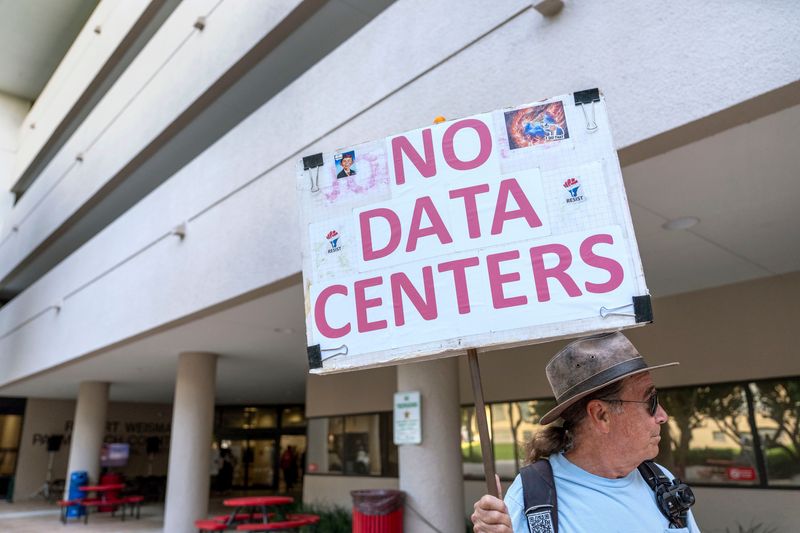
Escambia County has decided it doesn’t want large data centers.
Residents have raised legitimate concerns about electricity, water, noise and the relatively small number of permanent jobs these enormous facilities create. Escambia also doesn’t currently have the electrical capacity to simply plug in a hyperscale data center.

Those are good reasons for caution.
But before we close the door on billions of dollars in potential private investment, shouldn’t we calculate what we’re closing the door on?
Consider the Pensacola Bay Center.
Escambia County has already approved roughly $10 million in improvements to the 40-year-old facility. A recent feasibility study examined a broader event-campus concept costing approximately $189 million.
The study contains an impressive number: approximately $59 million in annual economic output once the proposed new event center and ice facility reach stabilized operations.
But economic output isn’t tax revenue.
The same study projects approximately $1.4 million per year in county sales and tourist-development taxes from those new facilities at stabilization.
That doesn’t make the Bay Center a bad investment. Entertainment facilities provide recreation, tourism and quality-of-life benefits that aren’t measured solely by taxes.
But if we’re willing to study those benefits before making a major public investment, shouldn’t we apply the same scrutiny before rejecting a major private investment?
Consider one hypothetical: a privately financed $5 billion data center in an appropriate industrial location.
Using Escambia’s actual 2025 property-tax rates, I modeled what such a project might produce. I did not assume all $5 billion would remain taxable. Computers and other equipment depreciate rapidly, and Florida permits substantial incentives for qualifying data centers. My middle-case illustration treats 48% of the total investment as average taxable value.
That produces approximately $32 million in recurring property taxes.
Not over 20 years.
Every year.
It could be higher. It could be lower. Only professional analysis of an actual project could determine the real number.
But consider the scale.
Escambia County’s General Fund is approximately $358 million. Our hypothetical $32 million annual tax stream is equivalent to roughly 9% of today’s entire General Fund.
That’s money for deputies and police equipment. Fire apparatus. Roads and drainage. Parks. Libraries. Emergency services. And our school district is actively recruiting bus drivers.
Thirty-two million dollars every year is not a number we should dismiss without examining it.
Neither should we ignore what a data center would cost.
A facility of this size would require enormous electrical capacity. Generation, transmission and substations would have to be built. Water and cooling must be addressed. Residential neighborhoods must be protected from noise and industrial encroachment. And Escambia should never give away so much in tax incentives that residents end up financing the infrastructure without receiving an adequate return.
Those are serious problems.
They are also questions that can be measured.
What if a developer were required to finance much of its own power infrastructure? What if large data centers were restricted to appropriate industrial sites? What if enforceable water and noise limits were conditions of approval? What if tax incentives were tied directly to measurable public benefits?
Maybe an independent analysis would conclude that a $5 billion data center isn’t worth the cost.
If so, say no.
But Escambia shouldn’t make a multibillion-dollar economic decision without first knowing the answer.
Commission an independent fiscal and infrastructure study. Calculate the electricity. Calculate the water. Calculate the infrastructure costs. Calculate depreciation and every proposed tax exemption.
Then calculate the taxes.
Escambia County doesn’t have to say yes to a $5 billion data center.
But before it says no, taxpayers deserve to know what no costs.
Run the numbers. Then make the decision.
David Johnson is an Escambia County resident and retired plumbing and construction tradesman with 36 years of experience in commercial building systems and infrastructure.
This article originally appeared on Pensacola News Journal: Do the math before saying no to data centers in Escambia County | Opinion
Reporting by David Johnson, Guest columnist / Pensacola News Journal
USA TODAY Network via Reuters Connect
By David Johnson, Guest columnist | USA TODAY Network