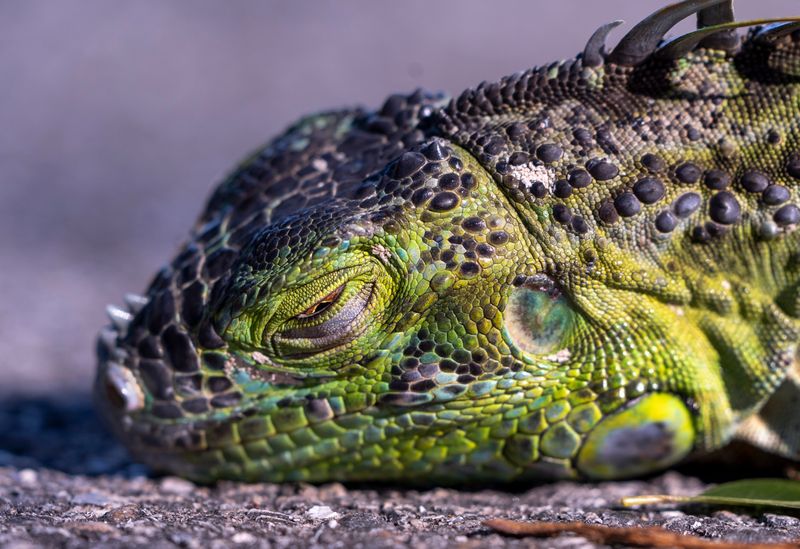
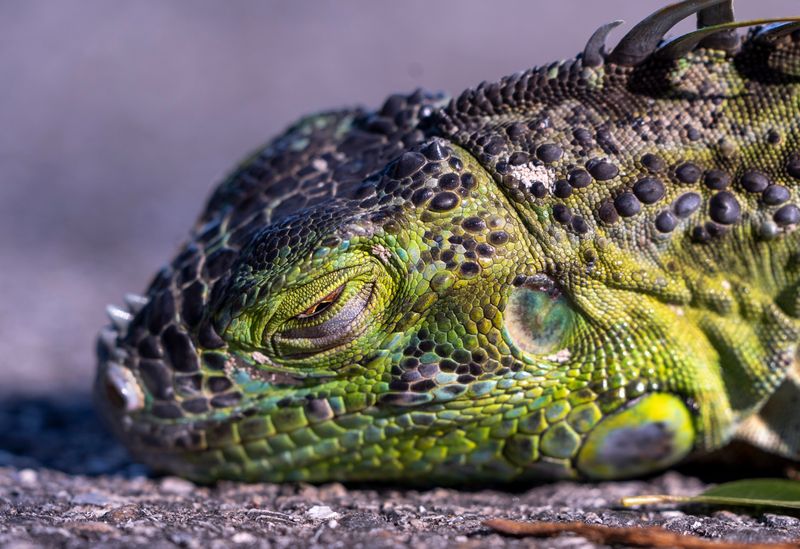
Plenty of Floridians know that when temperatures drop in Florida, cold-stunned iguanas can lose their grips on branches, fall from trees and then lie on the ground for a while, waiting to thaw out.
Now that the latest bout of cold weather in Palm Beach County has passed, iguanas are still falling from trees — but they are dead and decaying this time. Many could still be stuck in trees.

“Realistically, wildlife should take care of the dead ones, but they may end up starting to stink a little bit,” said Mike Kimmel, who goes by Python Cowboy on social media and leads guided iguana and Burmese python hunts.
Here are five things to know about dead iguanas falling from trees:
Why are dead iguanas falling from trees in Florida?
Green iguanas are considered an invasive species in Florida. They are native to Central America, South America and some eastern Caribbean islands which hardly ever experience freezing temperatures.
Iguanas can become temporarily paralyzed when temperatures dip below about 50 degrees. They can die if it gets too cold or if the cold hangs around for too long.
The ones that died in the early February cold spell are falling from trees as decay or predation sends them to the ground below.
How long will iguanas fall from trees in Florida?
At least for days, according to Michael Ronquillo, owner of Humane Iguana Control.
“The smaller iguanas can’t handle the cold as much as the older ones, so the smaller ones will start decaying first and falling from the trees,” he said.
How cold did it get in Palm Beach County?
Temperatures in Palm Beach County dropped to the coldest in more than a century over the weekend of Jan. 31.
The temperature at Palm Beach International Airport dropped to 30 degrees on Feb. 1, breaking the previous daily record of 36 degrees in 1909.
A second cold front followed and led temperatures to hover in the 40s. A gradual warming trend kicked off on Feb. 7.
Why are iguanas seen as a problem in Florida?
Iguanas eat landscaping, dig burrows in Florida’s flood control canals, leave droppings in swimming pools and damage infrastructure.
They are attracted to trees with foliage or flowers, most fruits and many vegetables, according to the Florida Fish and Wildlife Conservation Commission. Some dig burrows that can collapse sidewalks.
They can also transmit salmonella to humans through areas contaminated by their feces, according to the FWC.
What happened to cold-stunned iguanas dropped off to the FWC?
The FWC opened five locations where people could drop off cold-stunned iguanas.
About 5,200 cold-stunned iguanas were turned in on Feb. 1 and Feb. 2. Of those, 1,616 live iguanas were placed with permitted handlers to rehome or sell out of state.
The rest were humanely euthanized. Others went to an exotic leathers manufacturer.
Maya Washburn is a trending news reporter for The Palm Beach Post, part of the USA TODAY Florida-Network. Reach her at mwashburn@pbpost.com. Support local journalism: Subscribe today.
This article originally appeared on Palm Beach Post: Dead iguanas are falling from trees in Florida. 5 things to know
Reporting by Maya Washburn and Kimberly Miller, Palm Beach Post / Palm Beach Post
USA TODAY Network via Reuters Connect