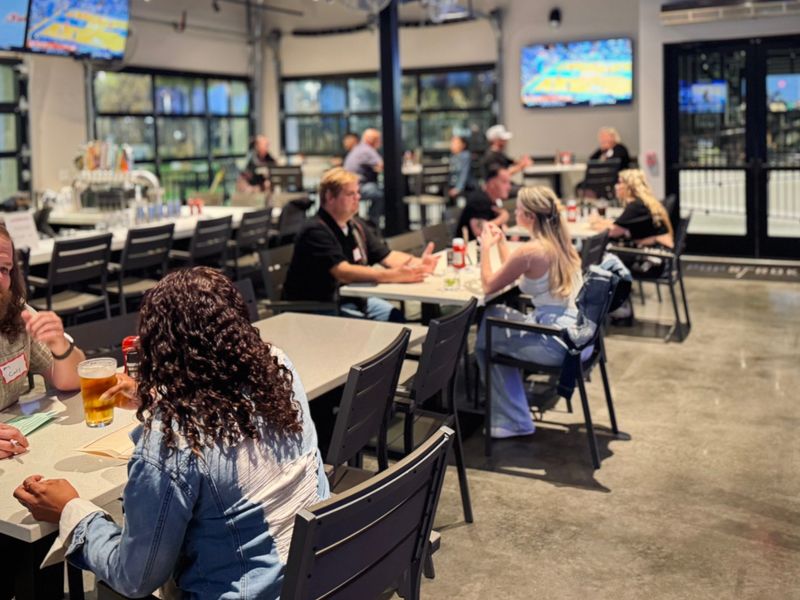
DAYTONA BEACH — On a weeknight in the city, name tags replace profile photos and first impressions are measured in minutes, not swipes. Around a scatter of indoor tables, strangers lean in, share nervous laughter and launch the type of rapid-fire introductions that feel somewhat radical in 2026.
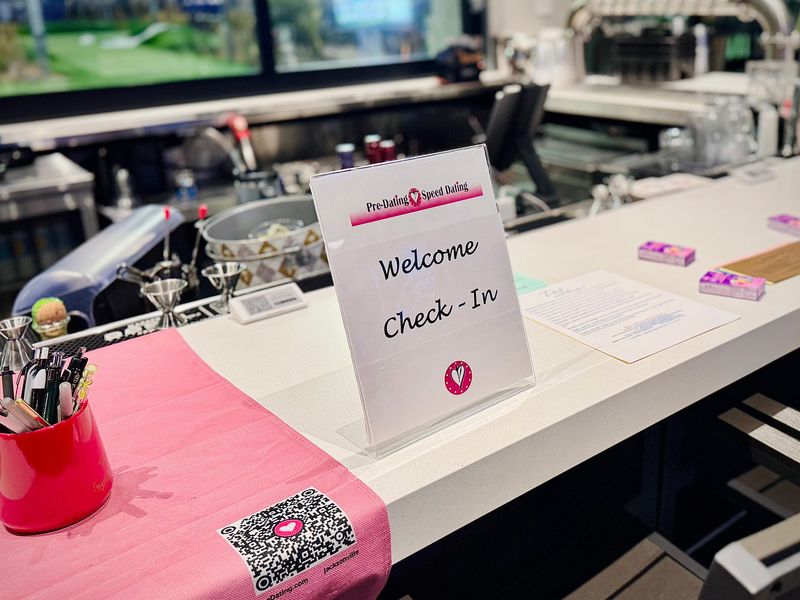
Welcome to Pre-Dating Speed Dating at PopStroke Daytona.

In an era defined by dating app fatigue — mindless scrolling, ghosting and algorithms that promise chemistry but don’t always deliver — speed dating seems to be making a quiet comeback. The question isn’t simply who might find a match, but whether the future of romance looks a little more familiar — face-to-face, eye-to-eye, with no filters to disguise us.
What is Pre-Dating Speed Dating?
Established in 2001, the national brand has hosted more than 38,000 speed dating events across the country, according to its website — each separated by age range and designed to connect potential matches through a rotation of mere six-minute “pre-dating” conversations.
Pre-Dating made its local return just months ago, hosting its first Daytona event since the pandemic, at PopStroke in January, drawing in more than 30 singles, followed by its most recent evening of rapid romance on March 3, where 16 singles, ages 49 and older, walked through the doors at 6 p.m., followed by a dozen more, ages 28 – 47, at 8 p.m.
“It was something to do. I don’t drink, I’m older and most of the bar scenes are younger people, so at least you get to mingle with your own age group here,” said Bruce Busto, 63, of Ormond Beach.
Single for a decade now, Busto echoed the sentiment shared by several attendees who prefer the transparency of meeting face-to-face — some noting the ironic truth that “social” media dating can feel rather antisocial when interaction is limited to a screen.
“I’ve never used dating apps, because they’re just too impersonal. It’s creepy, you know? It’s kind of very sex-oriented instead of like, ‘Do we like each other? Should we go out?’” he said, noting an “absolute” generational shift in dating culture.
“It seems to me like (younger generations) do all their courting online, and then you might engage in sex or something like that. That’s not how we roll at all,” he continued.
For Brittany Potesak, a single mom who attended the 28 – 47 group, the oversaturation of online options and carefully curated profiles has shifted expectations, making it harder than ever to find genuine connections.
“I feel like the app scene is still a hookup scene, and I’ve been ghosted a lot,” Potesak said. “I’ll be talking to them, and everything is fine, we’re chit-chatting, calling each other, FaceTiming and then it’s like ‘Oop, no,'” she continued. “… Everything is just different now. You have more of social media at your fingertips, so there’s more temptation out there … It’s so hard to find a good guy, because you have women everywhere now.”
What does ghosting say about a person?
Ghosting, however, isn’t one-size-fits-all, according to local mental health counselor Ellis Thomas, who co-founded his DeLand-based practice New Growth Care with licensed mental health counselor Mary Bernard in 2022.
“For some, breaking communication can be clear communication that the relationship is over and not working. But for others, being ghosted may trigger feelings of abandonment or betrayal,” Thomas said.
Having self-knowledge and clearly defined criteria can help reframe the experience, he continued, noting that if strong communication is a priority, being ghosted can be read less like a personal rejection and more as information that the person lacks the skills you are looking for in a partner.
These same individuals could lean more “conflict avoidant,” according to New Growth Care therapist Jolie Molina Maldonado.
“Sometimes people who shy away from conflict believe that they are disengaging completely. They are saving themselves and the other person the time and the effort of engaging in discourse,” she wrote in a statement to The News-Journal, noting different emotional backgrounds will accept and process these interactions differently.
“Depending on someone’s background, being ghosted can reactivate attachment wounds and trigger relational trauma reminders and appear to confirm pre-existing negative self-conception,” she wrote, a sentiment Thomas echoed.
“Human beings care so much what other people think about us, so we go into this dating pool where there’s (millions) on this app, and I want somebody to affirm or like me. But everybody is not going to,” Thomas said, referencing a “cast a large net” approach online, where individuals amass a wide pool of potential matches, choosing from those who respond or show interest rather than starting with defined standards and criteria — finances, sexual preferences, long-term goals, for example.
“If I start with what I like and what I want, there’s less fatigue because I’m asking those questions, getting answers and that’s the difficult part. People don’t like to set boundaries,” he continued.
“If I set a boundary with you, it might feel like rejection but its not, because it’s about me. Those boundaries that I set help me make decisions about which people I let into my life,” he continued. “… Now, instead of a million people (who) can reject you, it’s how many people within that million meet your criteria? Those are the only ones you have to care about.”
Changes in dating culture
Over the decades, dating culture has undergone a profound rewrite, with younger generations struggling to navigate the uncertainties of adulthood and a culture steeped in screens.
“In my experience, those who grew up more online, or spend more time online consistently, can have difficulty with in-person intimacy and vulnerability,” Maldonado shared in the same statement.
“If one becomes accustomed to engaging in disputes, sharing emotional moments or intimate closeness only through a virtual lens, in-person skills can diminish simply due to them not being used,” she continued. “When communicating largely online, one can take time to choose the right words and make multiple revisions from a safe distance, which is something in-person communication doesn’t typically allow.”
Today, the estimated median age for first marriages has increased to 30.8 for men and 28.4 for women, up from ages 23.5 and 21.1 in 1975, according to 2025 United States Census Bureau reports.
These changes, particularly among Gen Z (1998 – 2007), are often shaped by shifting priorities and fear of vulnerability, increased mental health awareness, and economic pressures, according to recent reports from Indigo Therapy Group — not to mention an inescapable online social landscape that seemed to only skyrocket during the stay-at-home days of COVID-19.
While popular dating apps like Tinder saw record-high swipes during the pandemic, a 2025 Forbes Health survey shows at least 78% of users recently reported dating app fatigue due to a failure to connect, constant disappointment and rejection.
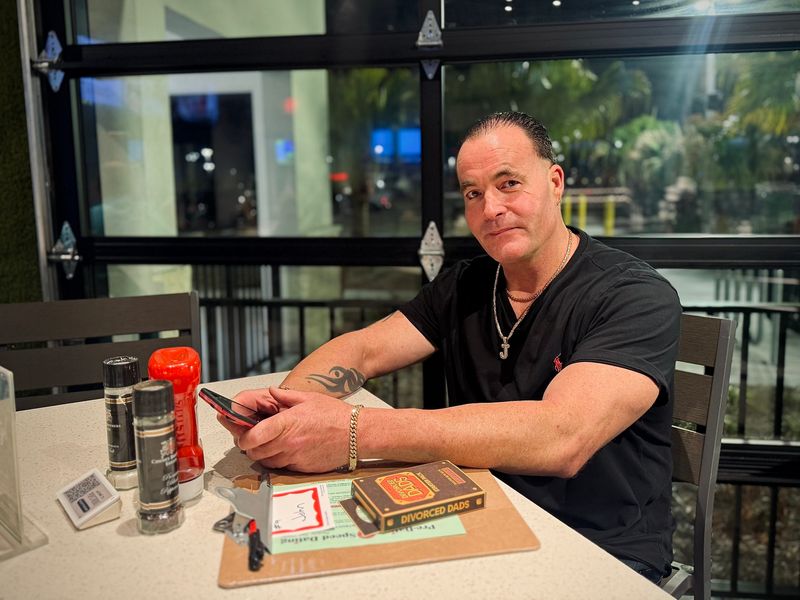
“I think that balloon has popped,” said John Greaves, 46, from St. Augustine, in regard to online dating.
“I’ve done the apps before, but I don’t like the way the apps are working. You’ll match with somebody, and you’d figure it’d be intimate conversations and everything. Then, the very next day they kick you off — blocked or ghosted — even though you left them with a good conversation,” he continued.
Single for two years now, Greaves’ goal, like many others, is to find his perfect match.
“I’ve been doing this for probably about six months now, so I feel it’s the better way,” he said. “I’ve met the most amount of women speed dating than I have in my entire life.”
In contrast to the swipe economy, where conversations are often recycled and first impressions feel manufactured, it seems face-to-face interaction might just be regaining its appeal among today’s singles looking for a reset.
Carolyn Anderson, from Ocala, joined attendees 49 and older on Tuesday — her first speed-dating experience after five years of being single and a long run of underwhelming online encounters.
“You don’t really know who you’re actually talking to (online); they can really give you a false image,” Anderson said.
“A lot of times, they don’t bother to ask you any intelligent questions or they’re inappropriate questions, because they’re not looking at you face-to-face, so they don’t have to be accountable … but here, people made the effort to come out,” she continued, noting what she believes is a surge in speed dating’s popularity. “I don’t know if it’s a trend right now or if people are just disillusioned with the apps and they’re migrating toward something more old-school.”
How does Pre-Dating Speed Dating work?
Admittedly, just showing up is often the hardest part — though coordinators take pride in the invisible details that transform what could feel awkward into something surprisingly low-pressure.
“I’ve heard all types of horror stories from other events where someone will show up and it’ll be 15 women and two guys. So, we make sure that it’s even, and that takes a lot more work than you would think, because it’s a rollercoaster ride,” between no-shows and last-minute signups, Pre-Dating Event Coordinator Ellen Manus told The News-Journal.
“… We monitor it daily to make sure that we have an equal gender signup … And they’ve paid for a ticket, so they’re serious about meeting someone,” she continued. “It’s not like online dating where you don’t know if they’re just killing time because they’re bored or if they actually want to meet someone.”
The Daytona Beach event drew more than 30 singles from Volusia County to South Texas, each leaning in for a quick conversation and leaning back to jot down a few telling details on their match cards — a profession, punchline or flicker of chemistry — to separate the sparks from small talk.
Once they’ve marked their selections with a simple ‘Let’s talk’ or ‘No, thank you,” participants are provided contact information for mutual matches the following day, as well as individuals who showed interest in them, should they reconsider.
“It’s really good for people that are shy, because most people, they walk into a room full of strangers and they are not going to be comfortable talking to people. Even if they’re outgoing, human nature is such that you look for people you know,” Manus said.
“… So, we’re facilitating these six-minute meetings so that you’re sitting across from someone new, but you’re both in the same position; you’re both nervous, and you both have the opportunity to chat with each other,” she continued. “My most common response at the end of the night is ‘This was a lot more fun than I thought it would be.’”
Does speed dating actually work?
Like most things in the world of relationships, it seems to be what you make of it.
“It is what it is,” said Donna Hagerman, 61, of New Smyrna Beach, on her way out. “I’ve gone on some dates and stuff but nobody — my philosophy is: I live a great life, so I’m trying to find somebody that will fit into that life.”
At the very least, it seems speed dating — like joining community clubs or attending other social events — can act as a low-stakes entry point, helping individuals to rebuild confidence in face-to-face interaction and loosen the grip of app-based dating, Thomas explained.
“Social skills are skills. If they aren’t practiced like any neural pathway, they tend to atrophy. The brain is often referred to as plastic, meaning that it can change … We can strengthen old skills, and we can create new skills,” Thomas said.
“… For those that are more isolated or have little in-person interaction, they’re going to have more difficulty meeting people in person. It’s simply not a practiced skill,” he continued. “… So, if you put some time into it, (social skills) may not ever become your strongest skill, but they can become a skill that’s not uncomfortable — a skill that helps you get to your goals.”
While Manus has given toasts at weddings that began across a speed-dating table, others walk away with no more than a few laughs, maybe a phone number, and a fresh perspective on modern dating.
“I don’t want to say I don’t care, because of course I’m somewhat hopeful. But if you have to force anything in a relationship, it’s not going to work out,” Busto said, turning in his match sheet. “Just go with the flow and have a good time. Don’t expect too much, and don’t expect too little.”
For information on future Pre-Dating Speed Dating events, visit pre-dating.com.
This article originally appeared on The Daytona Beach News-Journal: Dating apps in 2026. Why these Daytona-area singles are swiping less
Reporting by Helena Perray, Daytona Beach News-Journal / The Daytona Beach News-Journal
USA TODAY Network via Reuters Connect