After an impassioned hearing, the Collier County School Board resolved a dispute over teacher salaries.
At a night hearing on May 1, the board heard from the dueling sides on a months-long labor impasse before reaching a decision.

The board is scheduled to ratify the agreement on Wednesday, May 6. It will apply to the current 2025-26 school year.
Salaries are negotiated every year. Teachers have been operating under an expired contract, however, due to the conflict.
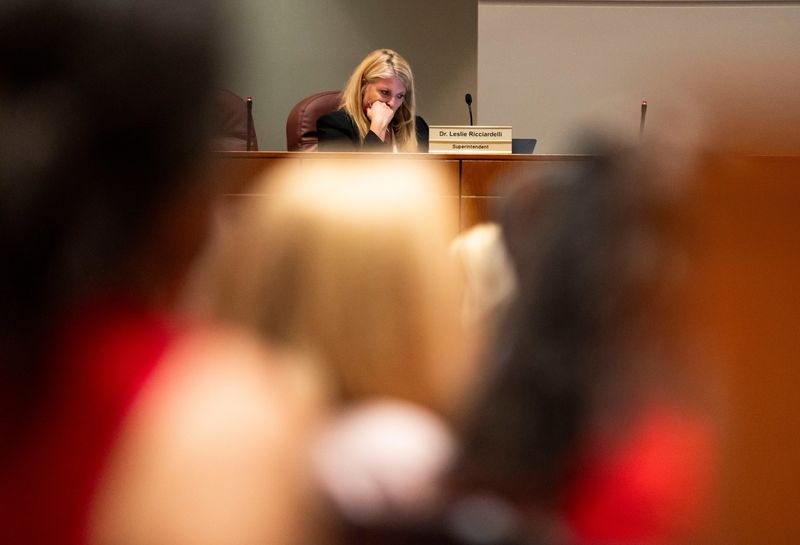
The school board voted unanimously to follow District Superintendent Leslie Ricciardelli’s recommendations for resolving the dispute. Her proposed increases are performance based, with:
Grandfathered teachers are those hired before July 1, 2014, who have what equates to tenure.
The cost of the pay increases would top $8.2 million.
At the more than two-hour hearing, likened to an appellate hearing, the public was not allowed to speak.
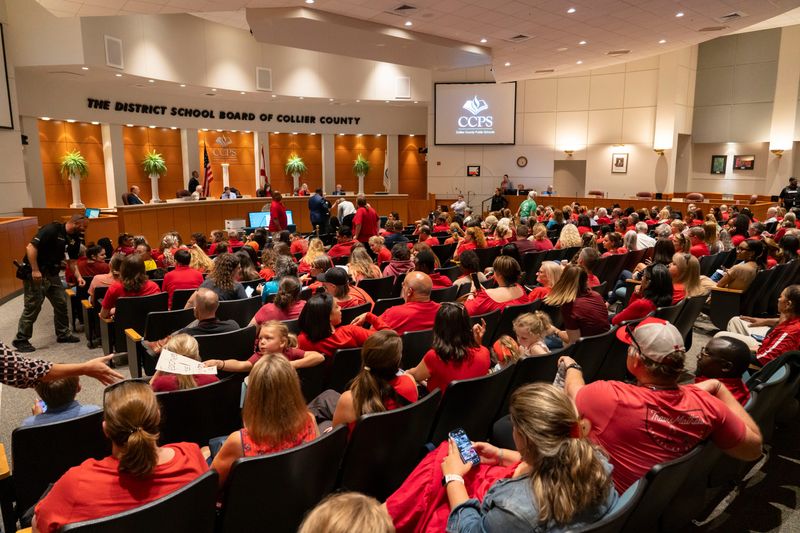
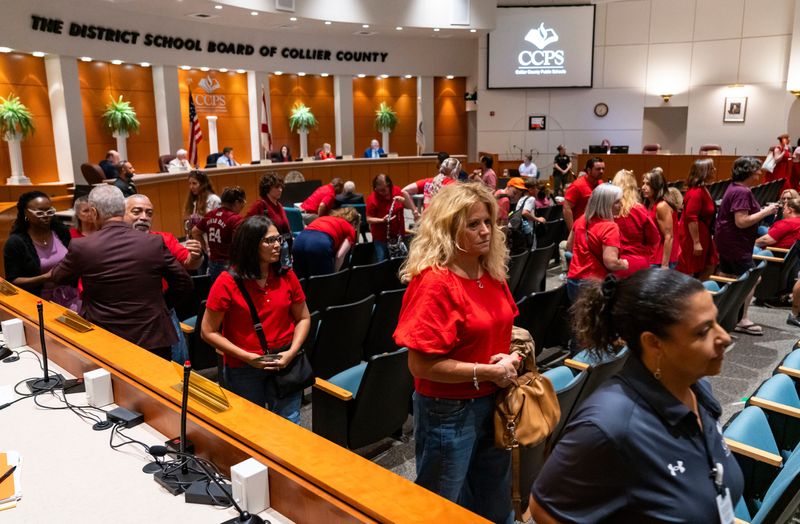
While they didn’t have the opportunity to speak, teachers turned out in force, wearing “Red for Ed” in a show of solidarity. The union’s signature color is red.
Due to the impasse, a Special Magistrate previously reviewed the evidence, and recommended salary increases that included roughly $1 million more for grandfathered teachers than the district’s initial proposal, but he otherwise supported the plan.
Superintendent Ricciardelli rejected the Special Magistrate’s recommendations on April 10, triggering a legislative hearing at which the school board was asked to make a final decision.
The board had four options: To accept the recommendations by the Special Magistrate, to accept the resolution offered up by the district superintendent or the teachers’ union, or to come up with their own compromise.
How did the hearing work?
The School Board limited arguments to 30 minutes on each side.
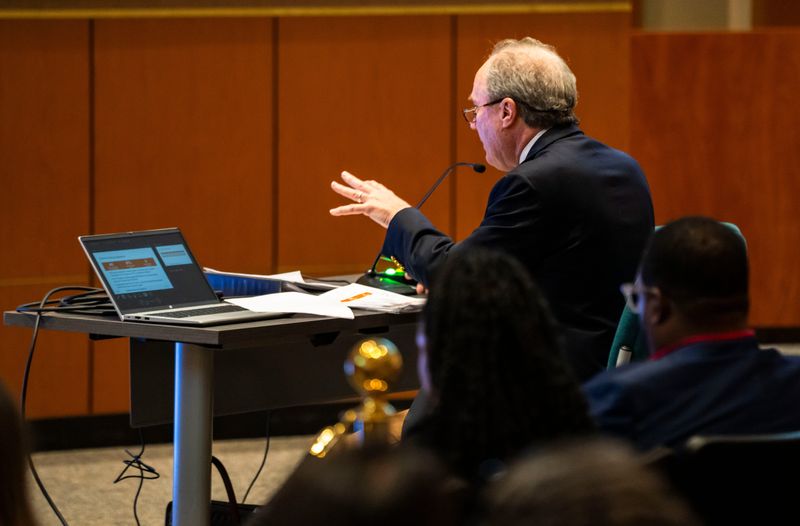
Mark Richard, a seasoned labor attorney representing the Collier County Education Association (CCEA), wanted a lot more time, but didn’t get it.
“I’ve done this for 46 years. This is the shortest amount of time that I’ve ever been given,” he lamented.
He asked for at least another 30 minutes, which would have given him an hour to make his case, including offering up testimony from his list of witnesses.
“It would mean a lot for the educators who are here and who are watching,” he said.
If capped at 30 minutes, he said, the time wouldn’t even equate to a “class period.”
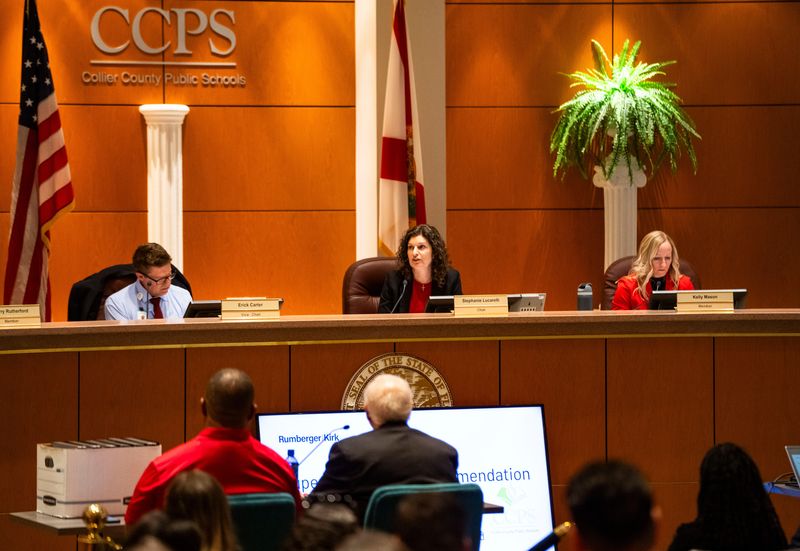
In reply, Stephanie Lucarelli, the School Board’s chairwoman, said that she knew Richard was a “fabulous attorney,” and she felt confident he could present his case in half an hour because it involved only “one issue.”
In a compromise, Lucarelli later granted Richard an extra 10 minutes for rebuttal before the conclusion of the hearing, giving him time to present more testimony — and to call up one teacher as a witness, who shared a personal story about how she’s struggled to make ends meet.
What did the school district’s attorney argue?
The district has consistently argued that it has demonstrated a commitment to compensation by raising starting teacher pay from $41,280 in the 2016-17 school year to $57,000 in 2024-25.
Leonard Dietzen, who represented the school district at the hearing, pointed out that the Special Magistrate “by and large, in the 90 percentile, ruled in favor of the superintendent and the district.”
The decision from the Magistrate came after two days’ worth of testimony from financial experts.
“We have to be fiscally prudent in an environment where Florida right now is in an FTE dumpster fire,” Dietzen said. “Every district is losing students. We’re no exception.”
In school districts, an FTE equates to a full-time student, and it’s primarily used to determine state funding, rather than basing it on a simple headcount.
In January, calculations showed that the district lost more than 1,100 students, and there could be “some additional bad news” coming soon on that front, Dietzen said.
He claimed that teacher salaries in Collier County are far above the state and national averages and emphasized that the School Board had invested $94 million in teacher salaries over the past six years.
“We started low 40s,” he said. “We are now well above everybody.”
The district ranks fourth in the stage for wages, and first in similarly sized districts, he said.
He asserted it’s wrong to claim, as the union does, that wages aren’t keeping up with inflation, with such big increases in salaries given over the last few years.
The district has lost $47 million to the state’s Family Empowerment Scholarship program for K-12 students, which is designed to provided more educational options, including private school tuition.
“That’s a number you can’t ignore,” Dietzen said. “It went up again this year $7 million.”
He said the district couldn’t afford “another $20 million that the union is asking for to go into this deficit spending.”
“To grant the union’s proposal would be 40 more percent to your deficit spending,” Dietzen said. “I think that would be financially imprudent.”
With such a big salary increase, he said the district might be left with no room to negotiate next year.
On average, teachers in Collier County earn $73,571.
What did the union ask for?
The CCEA represents roughly 3,200 educators currently working under a contract that expired in 2025. The union sought a $3,290 increase to the current $57,000 base salary.
At the hearing, the union’s attorney Mark Richard questioned some of the budget numbers presented by the district, saying they’ve been used to make it seem like the “sky is falling.” In fact, he said, budget projections have been off before.
He lauded the board for giving the raises they have in recent years, but pointed out that Collier County is still one of the most expensive places to live in the state.
“You do pay them more than most, and that’s one of the reasons they stay,” Richard said. “It’s like golden handcuffs.”
He said the district shouldn’t brag about being debt-free, if teachers “can’t even think about being debt-free” in this inflationary environment and often have to work second jobs to make ends meet.
He asked for the board’s wisdom and support.
He called up Kyle Arnone, the director of collective bargaining at the American Federation of Teachers, as a witness, who discussed the impact of inflation on average teachers’ salaries in Collier County. In 2024-25, the district dug itself out of a hole, but teachers’ purchasing power declined by an average of $1,500 in 2025-26, Arnone said.
He also contended that the surplus in the district’s general fund, or general fund balance, had increased at a far greater rate than inflation, or the increases in teacher salaries.
Corriene Vega, a science teacher at Golden Gate High School, shared how she’s been hurt by the district’s rising insurance costs, with four surgeries over the last few years. She said she’s struggled financially due to the rising deductibles and expensive drug prices.
“When you talk about my raise, you also need to take into account that 26% of my raise, because I did have medical issues that were unexpected, it went towards my insurance costs. So, instead of me being able to pocket the money that I was given as a highly effective teacher, it instead went towards the insurance.”
Ken Mouton, president of the teachers’ union, said if the district is debt-free and fiscally responsible, as the School Board has boasted, he didn’t understand why it couldn’t meet the union’s demands.
“Financial credibility is not built on words or labels,” he said. “It is built on follow through and until educators receive what they have earned and deserve that follow through remains unfinished.”
He argued the district had found a way to reward the superintendent and “now it’s time to show that same respect to the thousands of educators who make this district success possible every single day.”
“There’s no excuse not to invest in people who are responsible for our continued success,” Mouton said. “Show teachers that same commitment, show them that same respect and show them the money.”
School board’s discussions on teacher wages
Board member Erick Carter questioned Vega’s story about her rising health care costs. He pointed out that there aren’t any insurance premiums to pay, so premiums haven’t been going up.
“I don’t know if maybe she meant her deductible had increased,” he said.
He added: “So, the value of our insurance, I believe, is roughly $13,000 and teachers don’t have to pay that.”
He also questioned Arnone about his familiarity with the district’s budgeting, saying there is a lot of redundancy in the budget, which can be deceiving to outside observers, along with the carryover balance.
“What I want to illustrate to you is the tax neutral referendum that we did,” he said. “It took money out of capital and moved it into general fund. So, that’s why you will see growth in general fund.”
In the district’s efforts to become debt-free, he said it was “basically stealing from Peter to pay Paul, and “we used a majority of that money to help with raises for our teachers.”
“You’re saying that there is extra money,” he said. “I don’t see where it is.”
He said he didn’t want to be like other school districts in the state, forced to lay off teachers or cut programs, for a lack of funding.
Other board members asked questions about the testimony coming from both sides before offering up their own thoughts.
Lucarelli, the board’s chairwoman, said she wants to give teachers the maximum the district can give them, and that’s what she felt it had offered this year.
“The only reason that teachers haven’t seen anything yet is because the union and the district could not agree, and we are here,” she said. “No other reason than that.”
She said the superintendent had a “zero raise” over the last few years.
“There are assistant principals making less money than teachers,” Lucarelli said.
Board member Jerry Rutherford said teaching is “probably the most important occupation in our world.” However, he said, “sometimes, though, what we want to do is not what we can do.”
If the district is in a budget deficit situation, he said the recommended resolution by the superintendent would be the right choice.
Board member Kelly Mason said she never imagined the district would be in such a predicament with teachers’ wages after the aggressive raises that have been given over the past few years. She said what’s most important is to ensure financial stability.
“I want to ensure that nobody loses a job, that our students have athletics and arts, and music programs because we’re seeing that’s getting cut,” she said.
She added: “I want Collier County to be not just the No. 1 district in the state of Florida, but in the country.”
Board member Tim Moshier publicly thanked the superintendent for all she’s done over the last few years to increase teacher wages. He agreed that the district has to be more careful about its spending to ensure there are no layoffs.
Before the vote, Lucarelli concluded by saying that she’d heard a lot about teachers wanting to earn livable wages and to get paid what they’re worth, but it’s a national issue.
“It’s an unfortunate fact that overall society does not value what you guys do in the classroom every day,” she said. “And it’s not a situation that I think we’re going to solve here tonight in Collier County.”
She criticized the teachers’ union, saying she felt it was pitting “everybody against each other.”
Teachers express disappointment
At times, the teachers jeered and groaned at the comments made by the district’s attorney and by the school board. They raised doubled-sided paddles with a green thumbs up or a red thumbs down to express their support or objections to the points made.
After the vote, teachers booed, leaving the chambers disappointed.
Earlier in the week, teachers held a rally in their efforts to get a higher pay raise. At the time, Tristan Rosal, an East Naples Middle School orchestra chorus and musical theater teacher, spoke about how the district manages a nearly $2 billion-a-year budget. He pointed out that the district has the funds to provide “material things,” specifically that they can afford to put visual whiteboards in every single classroom and computers in the hands of every student.
“Yet, somehow, we have to fight tooth and nail in order to get a raise that’s less than the inflation rate. Make that make sense,” he said.
He added: “When it comes to the people, we always fall a day late and a dollar short.”
Rosal was born and raised in Collier and went through its public school system.
The conflict in Collier County reflects a broader economic crisis for teachers across the state.
For the third year in a row, Florida has ranked 50th in the nation for average teacher pay, according to newly released data from the National Education Association (NEA).
In the state, only Sarasota County has a higher starting pay for teachers than Collier County — at $57,500.
California offers the highest average teacher salary in the U.S. at more than $100,000, heavily influenced by its high cost of living.
Do you have an opinion about this topic? Write a letter to the editor and send it to letters@naplesnews.com and/or mailbag@news-press.com. Keep it to 250 words or fewer and include your contact info. Have more to say: Send a guest column of no more than 600 words.
Mickenzie Hannon is a watchdog reporter for The News-Press and Naples Daily News, covering Collier and Lee counties. Contact her at 239-435-3423 or mhannon@gannett.com.
Laura Layden is a senior business and government reporter. Reach her by email at laura.layden@naplesnews.com.
Please support local community journalism and stay informed about Southwest Florida news by subscribing to The News-Press and Naples Daily News; download the free News-Press or Naples Daily News app, and sign up for the daily briefing email newsletter, food & dining and growth & development newsletters here and here.
This article originally appeared on Naples Daily News: Collier County teachers win raises short of what they fought for
Reporting by Mickenzie Hannon and Laura Layden, Fort Myers News-Press & Naples Daily News / Naples Daily News
USA TODAY Network via Reuters Connect