If your child plans to play football, basketball, soccer or another high school sport for the first time during the 2026-27 academic year, state law mandates they have an electrocardiogram.
And there are only a few weeks left for some potential student-athletes to undergo an ECG screening that checks the heartbeat, records electrical signals in the heart and can diagnose irregular heartbeats, called arrhythmias.

Florida’s Second Chance Act takes effect July 1 and students—especially those who want to play fall sports: football, girls’ volleyball, bowling, cross-country, swimming and diving—must have a normal ECG in their files before they can even try out. The law applies to incoming ninth graders as well as 10th, 11th or 12th graders who have never played high school sports.
For some sports, tryouts, workouts and practices start in July.
Sudden cardiac arrest is the leading cause of death on high school campuses, said Jessica Landingham, Panhandle region heart screening director for Who We Play For.
The organization performs ECGs on high schoolers and partnered with organizations to hold community ECG screenings across the region.
Throughout the rest of June, Landingham will also conduct on-site ECG screenings at all Escambia County Public Schools and some Santa Rosa County District Schools’ high schools. Dates have not been announced, but she’s placing special emphasis on ECPS students.
“I was looking at our numbers for events we’ve already had, and my Escambia County numbers were lower than the other school districts,” she said, noting only a few hundred ECPS students have been screened.
An ECG is noninvasive procedure that takes about five minutes. Certified cardiologists analyze the readings and results are emailed to parents.
“For about 80% of sudden cardiac arrest victims, their very first symptom was sudden cardiac arrest. Out of 300 kids, you’ll find one is going to have an abnormal ECG that requires further cardiac workup,” Landingham said. “It’s a lot more common than people think, and I’m really glad it’s finally getting the attention it deserves.”
On June 13, a screening will be held at Coastal Luxury Wellness at 995 E. Nine Mile Road, Pensacola. Pre-registration is required at whoweplayfor.org but walk-ins will be accepted.
All of the screenings are $20 each, but financial assistance is available to those in need.
“We don’t want kids not getting screened because they can’t afford it. We don’t want money to be an obstacle because these are people’s lives we’re talking about,” Landingham said.
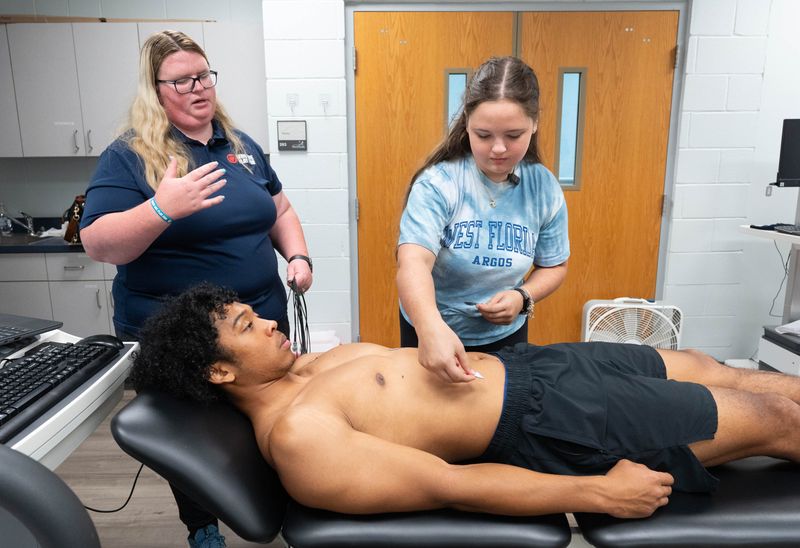
Some University of West Florida students in Ludmila Cosio-Lima’s exercise science course are also volunteering to help Who We Play For with the ECG screenings. Cosio-Lima, the university’s exercise science program coordinator and director of the ECG cardiovascular lab, teaches the students how to perform ECGs.
For Cosio-Lima, the daughter of a cardiologist and a former professional tennis player, helping Who We Play For with the ECG screenings is personal. She lost a friend to sudden cardiac arrest.
“When I was younger, I had one of my best friends to die on the tennis court of sudden cardiac arrest. So, I think it’s very important to screen young adults and young athletes in order to prevent a sudden cardiac death or an arrest,” she said.
Two conditions usually show up on abnormal ECGs, she said – hypertrophic cardiomyopathy or an enlarged heart or Wolff-Parkinson-White syndrome, a congenital heart defect where a child is born with a hole in their heart which causes a fast heartbeat.
An expert, Cosio-Lima said an abnormal ECG doesn’t mean a student can’t ever play sports.
Cosio-Lima said with treatment, “actually 95% of the abnormal (ECG) cases can go back to the field after a cardiologist sees them, including if they have Wolff-Parkinson-White.”
Cosio-Lima also said the Black athletes, along with basketball and football players, are more likely to have abnormal ECGs.
The students who volunteer with Who We Play For describe the experience as impactful. Isaiah Jones and Heidi Moon, graduate students in the exercise science program, said working with the organization gave them hands-on patient experience.
“There were a lot of kids coming and going. It was very interesting because a lot of them didn’t even know what an ECG was, so we had to inform them. Some were a little afraid of being shocked or poked, but we put them at ease,” Jones said.
A U.S. Air Force veteran, Moon agreed.
“The experience inspired me to do an internship at cardio rehab and help people with heart conditions get back to their normal lives,” she said.
Florida is the first state to mandate ECGs for student-athletes participating in Florida High School Athletic Association-sanctioned sports.
Passed during the 2025 legislative session, the Florida Second Chance Act is named after Chance Gainer, an 18-year-old Port St. Joe football player who collapsed on the field and died from sudden cardiac arrest in September 2024.
Returning FHSAA student-athletes are not required to have ECGs, but all student-athletes must also complete a sports physical. Band, ROTC, dance and flagline students are not required to have ECGs.
This article originally appeared on Pensacola News Journal: Clock is ticking for student athletes to get ECGs. Escambia is lagging behind
Reporting by Mary Lett, Pensacola News Journal / Pensacola News Journal
USA TODAY Network via Reuters Connect
By Mary Lett, Pensacola News Journal | USA TODAY Network