

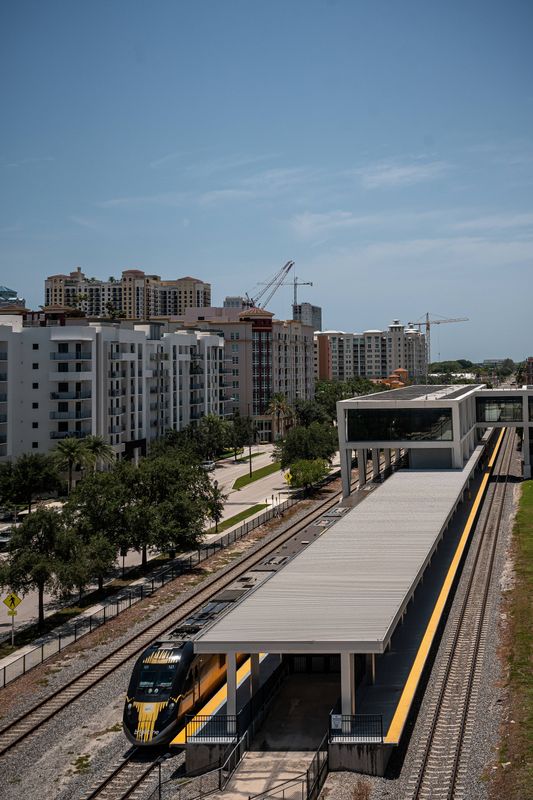
More than seven years ago, when real estate developer Diego Bonet was searching for land in West Palm Beach, he noticed properties near the newly-opened Brightline passenger train station.
The station had just opened in 2018, and the private rail system’s status as a modern passenger train in South Florida was in its infancy. But Bonet, knowing the value of public transit in other cities, bet on Brightline anyway.

In 2019, Bonet and his partners assembled the properties for an apartment complex. The next year, in 2020, the COVID-19 pandemic hit.
What followed was an unexpected surge of residents and companies to West Palm Beach. This migration created demand for new downtown office, shopping and residential complexes. And with the increase in population, traffic now is a daily nuisance in the city.
But Bonet and his partners are sitting pretty with their Brightline-adjacent project.
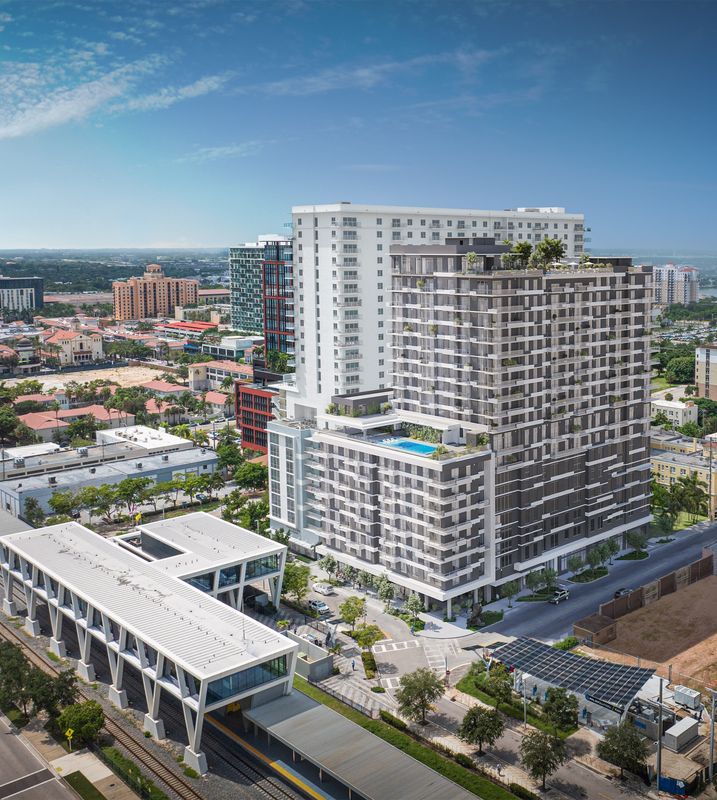
In July, they broke ground on their $165 million two-tower complex at 506 Datura St. The 21-story Alida tower will feature 181 luxury apartments, and a second tower will be a 112-key hotel under Marriott’s Tribute portfolio. The mixed-use project by developers LD&D and IGEQ is set for completion at the end of 2028.
The timing is serendipity, but the plan was there all along.
“It’s almost like winning the lottery for West Palm Beach,” said Bonet, LD&D’s managing partner.
In fact, transit-oriented development appears to be a winning combination for a county grappling with worsening roadway and highway gridlock despite a slew of improvements and upgrades in the first quarter of the 21st century.
Developers across the Palm Beaches have come to terms with the reality that solutions to the transportation impact of their projects need to be built into their blueprints, too. It’s a strategy, however, that in pockets throughout the county has launched with fits and starts, and met unexpected hurdles.
Developers eye gridlock, build solutions into project blueprints
That’s because of an age-old formula: New residential buildings, shopping centers … same roads.
Parts of Palm Beach County are growing with new construction projects, but ways to get around the county are not.
In downtown West Palm Beach alone, at least 10,000 new housing units could open during the next five years. Meanwhile, throughout the county, hospitals are opening or expanding, more office buildings are in the works, and even Nashville-based Vanderbilt University plans a graduate business school for 1,000 students.
The coming crush of traffic has some real estate experts worried about moving people in and out of cities.
“Holy cow, if you look at Miami and Broward County, are we in danger of meeting the same fate?” asked Rick Reikenis, a West Palm Beach engineer. “And what can we do now before traffic becomes unsolvable?”
To cope with the traffic, some real estate developers are deliberately planning projects near existing public transportation hubs, including Tri-Rail or Brightline stations. Others are weighing new ideas, such as a monorail.
The plans seem solid, but the county still is decades behind other parts of the country when it comes to efficient and lasting public transportation.
Brightline, for instance, already is facing a financial crunch.
In July, Fitch Ratings downgraded its senior bonds amid concerns Brightline could miss critical payments due in January, unless the private company finds fresh financing. It’s not yet clear how Brightline’s money issues could affect service in the future.
Meanwhile, Tri-Rail, South Florida’s publicly funded passenger train, recently won a financial reprieve under a new state budget that would give it up to $60 million in taxpayer cash, matching previous state subsidies.
Tri-Rail officials have said the commuter train will run out of money by the end of 2026 once federal COVID-19 relief money runs out. The state would like Miami-Dade, Broward and Palm Beach counties to eventually shoulder Tri-Rail’s entire budget, but South Florida officials say the costs will be too high without state help.
How did we get here? The recent path to clogged streets
Why is the traffic getting so bad? Changes in state laws are major factors, as well as continued demand for more housing, shops and offices.
Florida law previously required that roads have enough capacity for traffic. When roads weren’t capable of carrying more cars, real estate developers had to pay for road expansions or other improvements if the wanted approval for their projects.
In recent years, however, these requirements have eased.
Developers wanting to build new projects don’t have to fix roads already carrying someone else’s traffic. Instead, they only have to offer up a slice of money to municipalities for the traffic their own project will create, said Brian Seymour, a West Palm Beach attorney specializing in land planning.
In addition, municipalities also are permitted to handle traffic fees in different ways, in some cases allowing developers to contribute to a city’s pot of money for transportation issues. This includes alternatives to roads, such as bike lanes.
As a result, real estate developers may have a freer hand to build dense projects. But some also are realizing it is in their interest to fit their projects into the overall transportation puzzle.
Easy commute becomes sales pitch for luxury condo project
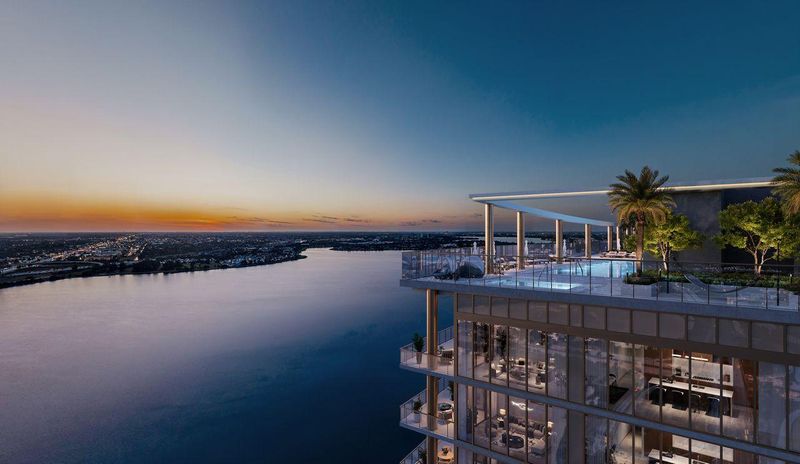
Developer Al Adelson is building The Berkeley condominium on the western edge of downtown West Palm Beach. The 193-unit condo features units ranging from $2.5 million to more than $12 million.
Adelson’s previous downtown project was the ultra-luxury Bristol condominium, which opened along the Intracoastal Waterway in 2019, just before the pandemic and the city’s migration surge.
“Ten years ago, I never thought about transportation because traffic was never an issue,” Adelson said. “Now in my opinion, it is the No. 1 issue in our city today. And every developer in the area is worried about traffic and transportation.”
That’s why The Berkeley’s sales pitch isn’t just focused on its posh amenities, such as a resort pool and spa.
The project also touts its location just off of Interstate 95 along Australian Avenue, near passenger rail systems and away from the city’s downtown traffic core.
New routes, technology could tame traffic tie-ups
Reikenis and other real estate and traffic experts are trying to figure out ways to move people within a city and also, between cities.
In addition to recently serving on the Downtown Development Authority, this former West Palm Beach mayor also serves as an external engineering consultant to Related Ross, the city’s major real estate developer.
Related Ross was among several groups that successfully lobbied state officials to help pay for the extension of Fern Street across railroad tracks to Australian Avenue.
This extender would remove an estimated 11,000 vehicles a day from Okeechobee Boulevard and Banyan Boulevard during peak traffic hours. The goal is to relieve traffic along Okeechobee Boulevard heading into downtown, as well as through the city to Palm Beach.
Jordan Rathlev, a Related Ross executive vice president, said one of the company’s major concerns is how to manage traffic with new developments. This includes Related Ross’ own projects on both the west and east sides of the downtown.
Technology, including the use of “smart” traffic signals, can improve the flow of traffic into and within the city, Rathlev said.
But technology has its own challenges. “What is it going to cost and what is the timeline?” Rathlev said.
So far, the most popular solution among developers is to build close to existing public transportation hubs. But things don’t always go as planned.
A mixed record of success for building near public transportation
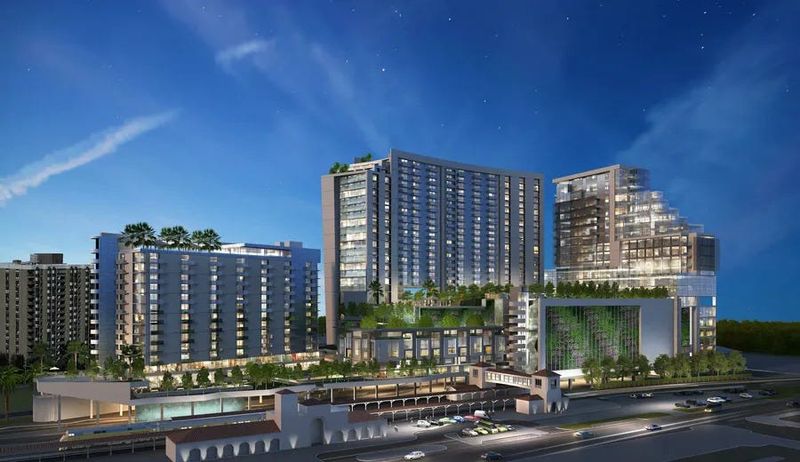
In 2012, the Transit Village investment group struck a deal with Palm Beach County to build a “transit-oriented development” around the Tri-Rail station in West Palm Beach.
The land is south of Banyan Boulevard, between Clearwater Drive and the CSX railroad tracks running parallel to Tamarind Avenue.
Transit Village would feature nearly 1,000 apartments, plus offices and a hotel, in four towers.
The goal is to boost public transportation by having people live or work near a hub for boarding trains in downtown West Palm Beach, switching from different bus routes, or between buses and Tri-Rail, Greyhound or Amtrak.
But the project has stalled amid a legal battle between Transit Village and Palm Beach County over terms of the sale.
Boca Raton’s appeal as public transportation hotspot
Related Ross’ West Palm Beach holdings were acquired well before the Brightline station’s opening. But public transportation now is at the heart of the company’s planned expansion into Boca Raton.
In 2025, Related Ross lost a bid to develop 30 acres of city-owned property, including Boca Raton’s City Hall. The project would have been built along Second Avenue, just north of Palmetto Park Road where Brightline also has a station.
But the winning bidder’s plan died after city residents mounted a vocal campaign, and then a voter referendum, against redevelopment of the city-owned property.
The anti-growth sentiment made an impression on Related Ross, which instead pivoted to buying an existing project next to public transportation.
The company now is under contract to buy the Boca Raton Innovation Campus, the former IBM complex known as BRiC. The complex is next to the Tri-Rail station, just west of Interstate 95.
BRiC is approved by the city for more than 1,000 new residences, plus shops, medical offices and even a hotel.
Related Ross isn’t alone in making Tri-Rail stations a key part of its development strategy.
Coconut Grove-based 13th Floor is building a 304-unit apartment complex next to the Tri-Rail station in Boca Raton, at I-95 and Yamato Road. The land is being leased from the South Florida Regional Transportation Authority, which operates Tri-Rail.
Could a monorail be built in West Palm Beach?
Perhaps the most creative transportation approach is a monorail system being considered by Easton Street Capital of Palm Beach and Coconut Grove-based Terra Group.
Easton Street plans 405 garden apartments on part of the former Palm Beach Kennel Club in the Westgate community, in suburban West Palm Beach. The entire 42-acre tract is north of Belvedere Road on North Congress Avenue, near the President Donald J. Trump International Airport.
In addition to the Westgate Gardens apartments, the property also will feature retail shops in subsequent phases, said Cody Crowell, co-founder of Easton Street.
As these phases are planned, Crowell said a monorail could be built to connect the Westgate project to other parts of the city. This includes the airport, which is expected to undergo upgrades, he said.
Alexandra Clough is a business writer at The Palm Beach Post. You can reach her at aclough@pbpost.com. X: @acloughpbp. Help support our journalism. Subscribe today.
This article originally appeared on Palm Beach Post: Building around transportation hubs makes sense, challenges aside
Reporting by Alexandra Clough, Palm Beach Post / Palm Beach Post
USA TODAY Network via Reuters Connect
By Alexandra Clough, Palm Beach Post | USA TODAY Network
