Some birds never give up.
In 2013, Brevard put daddy long-leg looking wires on the posts that hold up the traffic lights, to keep ospreys from nesting atop the traffic signals at Viera Boulevard at the northeast corner of Stadium Parkway.

It worked for years.
Now, not so much.
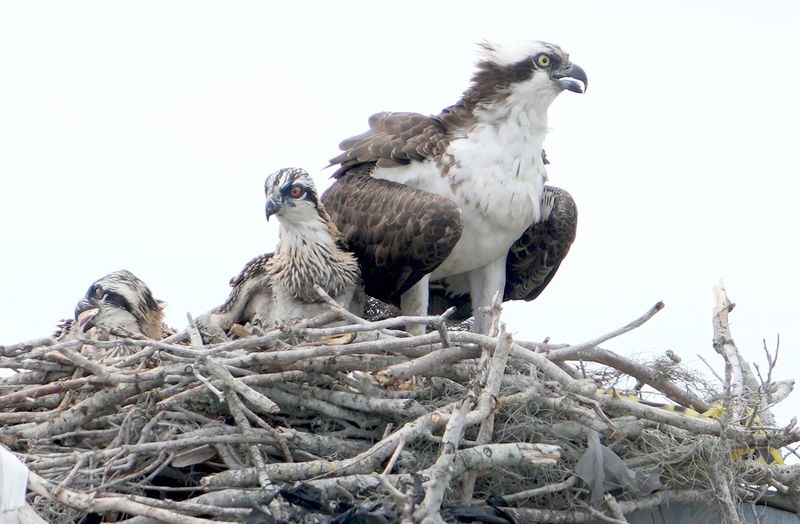
The osprey’s wily ways have outfoxed our wiry ways: One happy osprey couple still found this concrete-pole palace the perfect place to raise a family.
Motorists gaze above as they pass through one of Viera’s busiest intersections to ogle the two chicks atop the traffic signal. These raptors, also known as “fish hawks,” reach near-adult weight in 30 days. So these chicks may fly off soon.
But it’s not exactly a fly-by-night scenario here.
Osprey countermeasures can prove elusive.
After wind blew an osprey nest off a traffic signal arm and onto Stadium Parkway at the same intersection in 2013, county workers perched a fake owl atop the arm to spook other ospreys from ever thinking to nest there again.
It didn’t work. The very next spring, a still-happy osprey couple — maybe the same one — opted simply to nest again atop the other traffic light right across the road, at the same intersection. So the county retired the fake owl and replaced it with a wiry apparatus that was supposed to make it a hassle for ospreys or other raptors to land and build a nest there.
The birds were complicating the job of county maintenance workers.
The weight of the nests can stress the traffic pole or arm. What’s worse: the bird droppings are very corrosive and can damage metal hardware, lenses or electronics over time. Falling twigs and other debris pose hazards to vehicles or pedestrians below.
County officials assure their aware of what’s up there and will deal with the nest when they can.
“The County previously installed deterrent devices on the mast arm upright at this location to discourage nesting due to the associated safety concerns,” Rachel Horst, a county spokeswoman said Thursday via email. “While these measures are generally effective, wildlife can occasionally adapt or find alternative ways to nest.
“The County is unable to take any action while the nest is active, since they are protected under state and federal regulations,” Horst added. “Once the birds have left the nest, staff will evaluate and determine steps to remove the nest and replace the deterrent measures to reduce the likelihood of future nesting.”
Why do ospreys nest where they do?
Usually, ospreys opt for dead trees. But like owls and other raptor nesters they also grace traffic signals, power poles and sports field lights countywide. As development keeps encroaching on their habitat, or more eagles and other tougher raptors bully them out, displaced ospreys grab whatever high-up urban surface seems available and safe.
But those man-made structures often prove perilous: Ospreys carrying heavy fish from the Indian River Lagoon fail to clear cars on U.S. 1 and get hit on their way to nesting platforms installed to keep them off power lines. Or the birds burn and people lose power when osprey nests short out those lines.
But the ways for keeping nests away from lights and electric wires are often as touch-and-go as an osprey’s landings.
Osprey are not on the federal endangered species list. Like most birds that migrate, however, the species is federally protected under the Migratory Bird Treaty Act. Although impacted by DDT, like many similar raptors, osprey numbers have been increasing and they are of ‘least concern’ to conservation biologists.
Why not just remove the nest?
With a state permit, osprey nests can be removed from power poles and other man-made structures, as long as the nest doesn’t have any eggs or young in it. Permits typically require building a replacement nesting platform, though, or structure of comparable or better quality than what’s there.
Florida Power & Light Co. typically builds nesting platforms next to osprey nests to lure the birds away from the power lines and installs special devices on the cross arm to keep the birds from nesting there again. The nests can sometimes trigger outages, and the birds die in electrical fires atop the power poles.
Years ago, ospreys nested in the lights at Space Coast Stadium. They dropped twigs — and sometimes worse — as they build nests in the stadium lights.
The county put up nesting platforms to keep the osprey and owls from getting too close to the lights.
Sometimes, they flew too close for comfort to the players. In February of 2013, Washington Nationals lead-off hitter Denard Span made national news when an osprey dropped its freshly caught fish, which plopped down right beside him and interrupted a spring training practice. The star centerfielder squealed.
“I tell you what, that bird, he definitely didn’t have good hands. He dropped his dinner. He had butter fingers,” Span told the Washington Post at the time.
Contact Waymer at 321-242-3663 or jwaymer@floridatoday.com.
This article originally appeared on Florida Today: Brevard ospreys defy efforts to keep them off Viera traffic lights
Reporting by Jim Waymer and Tim Shortt, Florida Today / Florida Today
USA TODAY Network via Reuters Connect