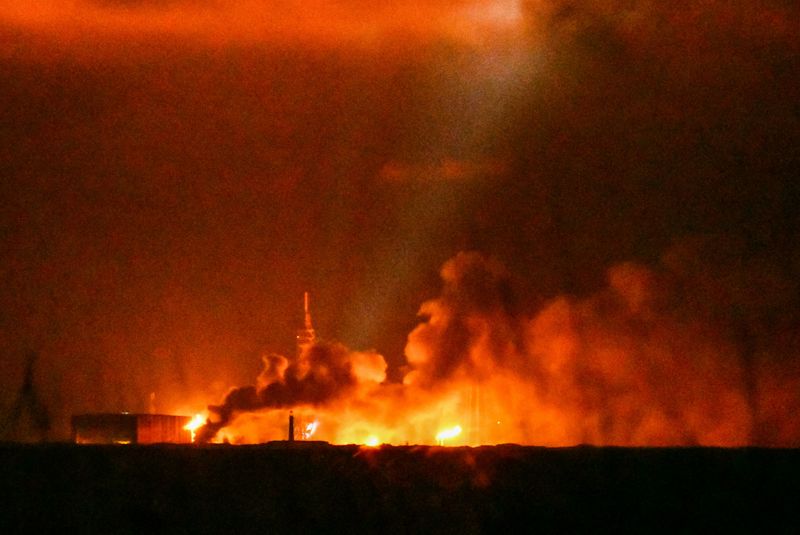
Blue Origin’s New Glenn rocket stood tall on its Cape Canaveral launch pad for a prelaunch static fire test May 29 when plans for a future liftoff came to fiery end as the rocket exploded, briefly turning the Space Coast sky an apocalyptic orange.
The explosion looks sure to be a major setback for Jeff Bezos’ Blue Origin, coming the same week it was announced the company’s uncrewed lunar lander would fly later this year in support of NASA’s ambitious moon base plans. Blue Origin was poised to be a key contributor to the Artemis missions, along with SpaceX, and now that timeline is likely in question.

“This is going to be hugely significant,” said Greg Autry, who is associate provost for space commercialization and strategy at the University of Central Florida, in an interview with FLORIDA TODAY. “It will be determined by the damage to the pad infrastructure.”
Shortly after 9 p.m. Thursday, a thunderous boom shook the Space Coast and the sky over Launch Complex 36 at Cape Canaveral Space Force Station lit up orange. The site burned for hours as seen from Brevard beaches. By morning light, the damage to the launchpad looked extensive.
There were no injuries and officials said no danger to the nearby communities. However, the Space Force warned residents to not handle any debris that might wash up on area beaches.
“It’s too early to know the root cause but we’re already working to find it,” Bezos wrote on X. “Very rough day, but we’ll rebuild whatever needs rebuilding and get back to flying. It’s worth it.”
Blue Origin’s orbital New Glenn rocket was being prepared for the fourth flight of a New Glenn from the Cape Canaveral pad, carrying a batch of Amazon Leo internet satellites to orbit.
The May 28 static fire was a power up of the rocket’s engines to test systems before an actual launch date. Blue Origin originally invested $1 billion to rebuild the launch complex, which has been present since the early days of spaceflight. The pad was completed in 2021, and New Glenn first launched in January 2025.
What is Blue Origin’s New Glenn rocket?
The company’s orbital rocket was named for John Glenn, the first American to orbit the Earth. New Glenn is Blue Origin’s entry into the orbital marketplace and was poised to be a competitor to the much more dominant SpaceX.
New Glenn launches satellites to orbit and spacecrafts off to other planets. In the future it is set to launch the company’s uncrewed and crewed lunar landers for NASA. It was also expected to launch national security missions to orbit.
New Glenn is not to be confused with the company’s New Shepard rocket, which carried tourists on suborbital hops from Texas. Blue Origin had recently paused its New Shepard flights as it shifted major focus to its lunar ambitions in support of Artemis.
Blue Origin’s New Glenn to serve NASA’s Artemis moon missions
NASA is in a race against China to return astronauts to the moon. The space agency has contracted both Blue Origin and SpaceX to design and launch lunar landers in support of the upcoming moon base and Artemis human landings.
NASA Administrator Jared Isaacman has called for NASA’s SLS (Space Launch System) rocket to fly more frequently, planning the upcoming Artemis III mission for 2027. The first step before getting astronauts back on the moon, Artemis III plans to see the Orion spacecraft carry four astronauts to Earth orbit on a test mission to dock with either or both the Blue Origin Mark 2 or SpaceX Starship HLS lander. Blue Origin’s Mark 2 lander will be launched atop the company’s New Glenn rocket.
Autry notes that while Blue Origin has multiple New Glenn rockets waiting in its Merritt Island facility, much will depend on how bad the damage to the launch pad was. With the rocket having shown previous good performance of the first stage boosters and BE-4 engines − the same engines also used on United Launch Alliance’s Vulcan rocket − he suspects this was not a design flaw.
“If the transporter strongback is not repairable, or if the water tower was destroyed, then you got a real problem,” said Autry. “If you can’t launch New Glenn rockets, than yes, it’s going to be very hard to deliver on the lander and other infrastructure that Blue is a critical part of for Artemis.”
Blue Origin was also awarded $188 million by NASA to launch rovers built by Astrolab and Lunar Outpost to the moon’s south pole region as part of moon base ambitions.
“Spaceflight is unforgiving, and developing new heavy-lift launch capability is extraordinarily difficult,” Isaacman wrote on X shortly after the May 28 incident. “We will work with our partners to support a thorough investigation of this anomaly, assess near-term mission impacts, and get back to launching rockets. We will provide information on any impacts to the Artemis and Moon Base programs as it becomes available.”
Autry said that while SpaceX is working hard to meet Artemis goals with its Starship, many experts have noted that Blue Origin was the stronger candidate for earlier Artemis uncrewed and crewed landings, as Blue Origin’s design is simpler.
Autry said he will not be surprised to see the Artemis III timeline slip.
“To be fair, SpaceX had a huge pad explosion in September of 2016 and they were back up and running in months,” said Autry. “So we’re not looking at shuttle sort of time frames.”
Blue Origin is also currently working on an adjacent launch pad, Launch Complex 36B, yet it is unknown when that infrastructure will be complete.
Officials react to New Glenn explosion
Notable names were quick to comment on the incident Thursday night on X (formerly Twitter).
“New Glenn is a critical launch vehicle for future commercial, national security, and NASA missions, including key components of the Artemis program,” wrote U.S. Rep. Mike Haridopolos, a Republican who represents the Space Coast. “I have spoken with Jared Isaacman, and we are closely monitoring the situation and working to better understand any potential impacts on upcoming lunar missions and other planned launches.”
Even SpaceX’s founder and CEO Elon Musk, Blue Origin’s biggest competitor, offered sympathy.
“Most unfortunate. Rockets are hard,” stated SpaceX CEO Elon Musk in a reply on X.
Cape Canaveral locals react to New Glenn mishap
Phil Stasik and his wife, Linda, live about 11 miles from Launch Complex 36 on northern Merritt Island, and many of their neighbors are Blue Origin employees. A longtime space fan, he had heard crews were planning to conduct an evening New Glenn static-fire test.
“We heard a loud bang. Our house shook. Our windows rattled,” Phil Stasik recalled of the explosion.
“We ran out into the driveway and saw the mushroom cloud rising off on the eastern horizon. We knew from its location that that would have been Slick 36,” he said.
The couple jumped in their car and drove a few miles to KARS Park overlooking the Banana River, where they watched “the incredible glow and fires on Slick 36.”
“This is part of life on the Space Coast. We’ve lived here for 32 years, and we’ve watched numerous other rockets have anomalies of various types. We’ve seen other explosions. It’s going to happen, much the way we know that there are accidents on the road and in the air — I’m a retired airline captain,” Stasik said.
He labeled the rocket explosion “a night that we all kind of dreaded,” but he expressed hope that Blue Origin remains “one of the world’s great hopes” that will land astronauts on the moon en route to Mars.
Meanwhile Ann Maloney, who lives just south of Minutemen Causeway in Cocoa Beach, heard the May 28 Blue Origin explosion as she was getting ready for bed. She didn’t think much of it at first, as it didn’t shake her house. She instead chalked it up to thunder or a large truck. That is until she realized something had actually gone horribly wrong.
“We just ran outside with our phone — and we could see the fire,” said Maloney.
While she lives in Cocoa Beach, Maloney noted that launches are starting to feel routine.
“But it’s not routine,” said Maloney. “These are big powerful rockets.”
Brooke Edwards is a Space Reporter for Florida Today. Contact her at bedwards@floridatoday.com or on X: @brookeofstars.
This article originally appeared on Florida Today: Blue Origin rocket explodes during Cape Canaveral test, Artemis setback likely
Reporting by Brooke Edwards and Rick Neale, Florida Today / Florida Today
USA TODAY Network via Reuters Connect