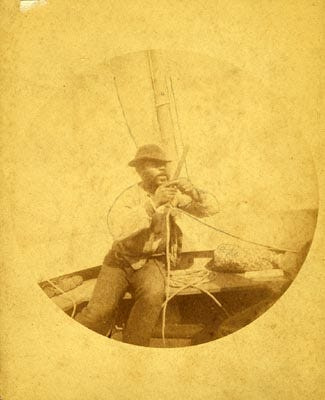
PANAMA CITY — Local history aficionados likely already know the story of Narcisco “Hawk” Massalina. The free Black man’s skills as a carpenter, fisherman, hunting guide and more during the budding years of the area’s development gave him a legendary status in the history of Bay County.
What some history buffs might be unaware of is the now-vacant town and community he started with his father.

Redfish Point is a ghost town on the Tyndall reservation that many free Black and formerly enslaved families called home.
The specific history of the community is caught somewhere between family folklore and shoddy gaps in historical documentation. Jose Massalina, the father of Hawk, founded the town. Despite his son’s fame, we don’t have many concrete details about the visionary himself. The only fact that goes uncontested is that he was a free Black man.
Mystery of Jose Massalina
Census data is all over the place in terms of when Jose Massalina was born. Records would have you believe he was 88 years old at the 1880 census but 60 at the 1860 census. Local historian Nancy Hudson believes he was born sometime between 1800 and 1812.
His last name is also spelled differently in different government records. His great-great-granddaughter Renee Marshall-McKinley says the correct spelling is actually “Masslieno.”
How Massalina got to St Andrews Bay is also up for debate. The popular local and family lore is that he was a Spanish merchant marine who jumped ship at Port St Joe, then walked all the way to what is now Bay County.
George West founded Panama City and prolifically documented everything from the weather to daily conversations. Notes from his diary were transcribed and compiled into a book called “George Mortimer West, His Path in History” by Hudson. In 1920, West met with Hawk Massalina, and Hawk shared some details about his father.
The notes make it appear that Jose arrived in the area from St Augustine, although his exact path is unclear. Jose’s motivations also aren’t certain, although he was fairly industrious. He started working as a carpenter, building ships and homes upon his arrival.
The late prolific local historian Marlene Womack noted in her book “Ghost Towns, Mysteries, & Tombstone Tales” that Jose Massalina first saw the area in the 1820s. Jose left for some time and was cutting timber for the government before arriving back at St Andrews Bay permanently in 1836, according to the notes from West’s diary.
A News Herald reporter chatted with Willie Spears Jr., great-great-grandson of Jose. Spears said he thinks what motivated Jose to come here was a combination of both economic opportunity and personal sovereignty. This gets complicated by the fact that Spain ceded the Florida territory to the U.S. in 1822, and this came with laws heavily policing Black people.
Jose had to have a guardian when he permanently returned to the area. A guardian is essentially an assigned White person who would have to approve contracts, property sales and travel of free Black people. One of his guardians was Capt. David Blood, an eccentric and worldly Irishman who settled near Beach Drive.
Unlike other parts of the South, the area didn’t have an established plantation economy or social order at the time, and was more of a frontier. Spears said this and other factors might have made St Andrews Bay more of a progressive place in the region, not limiting Jose’s ability to rub elbows or become a successful businessman.
And it apparently didn’t: Jose and his son Hawk became famed boat builders, fishermen, carpenters and hunting guides who were able to befriend many across what is now Bay County. The skills they possessed were in the same industries that were at the heart of an emerging economy at the time.
They also founded a town.
Redfish Point
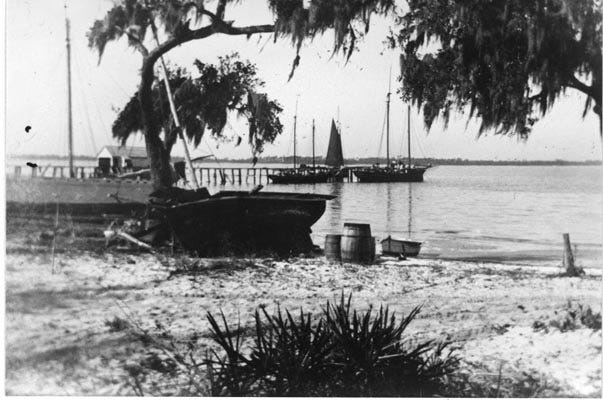
The town was named simply for the amount of redfish, red snapper and grouper that could be caught around the point. A feature in the News Herald on historic cemeteries says that Jose Massalina moved to the Redfish Point from his home on Massalina Bayou across the bay in 1866.
The Massalinas actually homesteaded around Davis Point, a bit further south of the tip of the peninsula we would call Redfish Point. Historic aerial imagery from 1941 shows more of what looks like the former town on the tip of the peninsula, with the homestead being separate.
Although blurry, a smattering of houses and roads can be seen along with a dock. South of what looks like the formal town along Smack Bayou is a larger structure in a clearing with another dock and some boats.
Some scattered homesteads can also be seen on what could colloquially be called Davis and Redfish Point.
Where’d they come from?
In the family lore, when Jose wanted to start this town, he went north to Georgia and came back with 40 enslaved families. Womack, the historian, notes that freed slaves from Econfina, another ghost town, and Jackson County joined the families at Redfish Point after the Emancipation Proclamation. Family names such as Gainer, Lee, Winslett and Baker were common.
During the Civil War, the U.S. Eastern Gulf Blockading Squadron built a prison camp and a large wooden dock at Redfish Point, according to library documents. This was used by the Union to watch for those trying to run their blockade into the bay. The camp became a holding place for many refugees who had gone there for the protection of the federal government.
Hawk Massalina fought for the Union at this time around the bay. He joined his father to live on the point in 1875.
The only documented population estimate for Redfish Point at its peak is in Womack’s book, where she says there were “seventy-five Negro families and several white individuals.” Government census data for the town was likely combined with the nearby Cromanton.
A look at the land
The Massalinas built the Judson Baptist Church at Redfish Point, which also served as a school and center of community life. Later reporting from the News Herald says the church was established in 1877.
The relocated New Judson Missionary Baptist Church in Panama City is still in operation today. Spears said he was unsure whether the church was originally Baptist upon its opening.
Jose would be buried in the church’s cemetery after he died in 1902. In 1911, Hawk deeded a half-acre lot to the “trustees of Judson Baptist Church.”
Other documents indexed at the library show that there was briefly an African Methodist Episcopal Church near the “old ferry landing” in the town between 1912 and 1924. It was housed in the home of the Rev. Emmanuel Cotton until a white rectangular frame building was constructed in 1913, but it was destroyed by a storm in 1926.
The ferry may have been run by T. Jex Gilbert, who ran an advertisement in the paper for his ferry services between Redfish Point and Panama City. The ferry ran between 8 a.m. and about 5 p.m., although it isn’t specified on what days.
Records show that the Massalinas acquired much of the town’s land through the Homestead Act of 1862. There’s an absence of plat maps in historical records of the community, which could mean the townspeople dwelled on land owned by the Massalinas.
Economy
Fishing was the main livelihood for the residents of Redfish Point.
“Catches of 18,000 pounds of mackerel off Hog Island were typical in March,” Womack wrote in the News Herald. “These fish sold for 3 cents a pound. From September through November, schools of mullet two or three miles long were frequently seen in the Gulf and bay.”
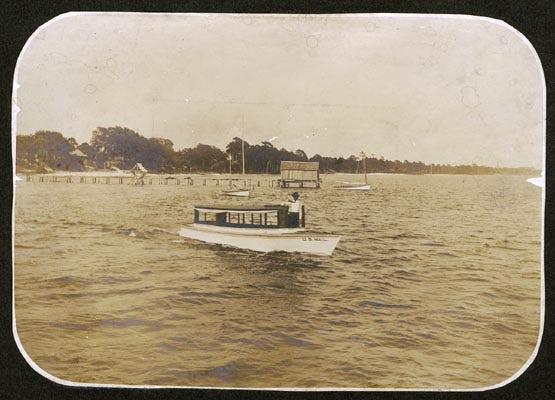
Some grew vegetables and other small crops, while many of the women ran an impressive same-day laundry service for residents at St Andrews. They would travel by boat across the bay to sell fruits and vegetables and pick up linens to wash. They would return the washed and ironed linens on their next trip into town.
Womack wrote that many of the Redfish Point residents were known as “the boat people” for their trips across the bay by boat every Saturday. The families would anchor along the coastline of East Beach Drive and set up their wares on the beach. The men would go house to house selling whatever fish was in season while the women retrieved the laundry. They would also get their shopping done downtown and meet in McKenzie Park.
The culture
Redfish point had some unique traditions, according to Womack.
Hawk’s home became a center of the community on Saturday nights when he would host large parties, which were referred to as “frolics.” In his later years, Hawk would host Emancipation Day celebrations.
“During weddings the marrying couple jumped over a broom, which sealed the marriage and brought good luck,” the historian wrote in a 2013 edition of the News Herald. “Brooms also kept the ‘haints’ away.”
What exactly a “haint” is varies between cultures in the South, but they are essentially evil spirits.
“When deaths occurred mirrors were covered with sheets and clocks stopped at the hour of death,” Womack wrote. “Bodies were kept at home on ‘cooling boards’ until burial.”
Most people would be buried in a pine box with a wooden cross to mark the grave, as tombstones were expensive, Womack said.
There are several anecdotes scattered across library materials of the community’s residents fearing Florida panthers, as well as other stories of bears breaking into outdoor smokers.
The fall
Residents of the East Peninsula were to be evacuated by July 7, 1941, for the construction of Tyndall Air Force Base. While the displaced residents were supposed to be compensated, other reporting by the News Herald on ghost towns located on the base showed that land owners often struggled to get paid.
A 1963 edition of the Panama City News Herald says that 35 to 40 Black families and 25 White families lived at Redfish Point at the time it was evacuated. Local historian Kenny Redd wrote in a 2020 edition of the News Herald that more than 300 African Americans were displaced.
The 1963 article says the government announced it had paid the sum of $185,766.70 for 25,734 acres, which came out to about $7.23 per acre. That’s the 2025 equivalent of about $160 an acre.
Many people refused these payments.
Hawk was reportedly one of the last people to leave his home and died in February 1948 at 107 while living with his two sons in Panama City. Spears, Hawk’s great-grandson, says that he died from a broken heart after losing his land and his community.
He never received a pension from his time serving the Union in the Civil War, and Spears says he was never compensated for his land. He was one of many Redfish Point residents who were relocated to the Eastern side of Panama City, around what we now call Glenwood, according to Spears.
Hawk wasn’t allowed to be buried with his family at Redfish Point, and was laid to rest in the Redwood Cemetery.
A 1951 city meeting was covered by the News Herald. At the meeting, Tulita Miller O’Reilly, representing the East Peninsula Property Owners’ Association, told Mayor Carl Grey that 63% of property owners never received compensation for their land.
Hope squandered
The Surplus Property Act of 1944 was a way for the government to begin liquidating its holdings to prepare for a transition into a peacetime economy. It would make the land taken by the government available to former owners.
Former residents of the peninsula and Redfish Point created the East Peninsula Property Owners’ Association to try and reclaim their land. The act was repealed in 1945, when local governments were made the recipients of surplus land.
Local business owners formed the Panama City Improvement Commission in 1953 and wanted to secure 4,000 acres for development on Redfish Point. They also wanted to build a $9 million toll bridge from Harrison Avenue to the peninsula to boost access to the military base and potential real estate sales.
This became controversial in the local political scene, and in the heat of the conflict, former Redfish Point property owners went to Washington to make their cases heard. They won the favor of then-congressman Bob Sikes, who introduced legislation that would give them priority if the land were declared surplus.
A vote by the county on Aug. 2, 1955, appeared to have put the situation in favor of the former landowners when commissioners voted against the creation of a new improvement authority. Two days later, the federal government ended the conflict by reincorporating Redfish Point back into Tyndall Air Force Base.
What’s left?
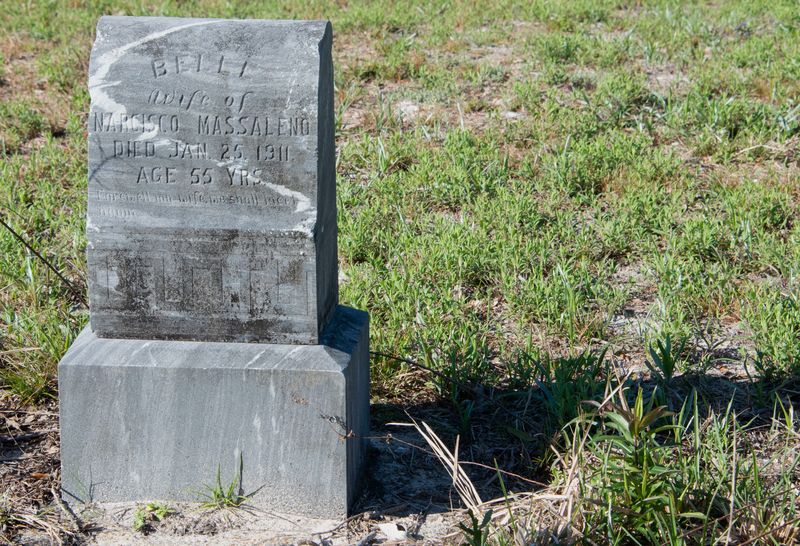
Like with most local ghost towns, all that remains are cemeteries.
Massalina Cemetery only contains one tombstone, belonging to Mary “Belle” Smith Massalina. She was the wife of Hawk and died at 55 in 1911. At one point there was a wooden grave marker for Jose, but it’s unclear if it’s still present.
A News Herald report from 2020 says officials located dozens of unmarked graves at the Massalina Cemetery. It’s the oldest on the Tyndall reservation and one of four cemeteries started by Black families.
Although many were lost to storms and time, some of the former buildings on the Tyndall peninsula were eventually moved, with some now in Panama City.
An early version of this article with most of what is currently published was reviewed by local history authorities as well as descendants of Jose Massalina.
This article originally appeared on The News Herald: Bay County’s Redfish Point was built on freedom, but lost to wartime
Reporting by Dylan Gentile, Panama City News Herald / The News Herald
USA TODAY Network via Reuters Connect