Freedom was born in Pensacola and hopefully still flies today.
The American bald eagle was born at the Wildlife Sanctuary of Northwest Florida to disabled eagle parents Athena and Apollo on March 3,1999, and released into the wild in a forest near Pigeon Forge, Tennessee, in June of that same year.

That would make Freedom, a fitting name for America’s national bird and national symbol, about 27 years old now. The average lifespan of a bald eagle in the wild is about 20 years or so, a little longer for eagles in captivity. But Freedom could be out there, soaring still. His father, Apollo, who has been at the Wildlife Sanctuary of Northwest Florida for more than 40 years, is 43 years old.
“With Apollo’s genes, I’d say he’s got a good shot (at still being alive),” said Emily Holden, Wildlife Sanctuary director.
Athena died in the early 2000s, but together with Apollo, she birthed 10 eagles that were eventually released into the wild, some whom have no doubt given birth to or fathered the next line of eagles, and those eagles became parents and on and on, so the line of Apollo and Athena, their legacy, continues.
Not bad for two parents who few observers thought would produce offspring since there was a physical limit to the normal mating courtship rituals that many birds—including bald eagles—indulge in, a sort of aerial tango that is meant to impress. Apollo came to the sanctuary in 1985 with a severe wing and foot injury, never again experiencing the freedom to soar above us all.
Cliff Owen, then a veterinarian at Warrington Animal Hospital who helped keep vigil with other sanctuary personnel in the days and weeks after Freedom’s birth, described it like this in 1999:
“It’s all (Athena) can do to get on the middle perch,” he said, referring to a perch just three feet off the ground. “(Apollo) can get up 10 to 12 feet, but he can’t soar. He can’t do normal eagle things.”
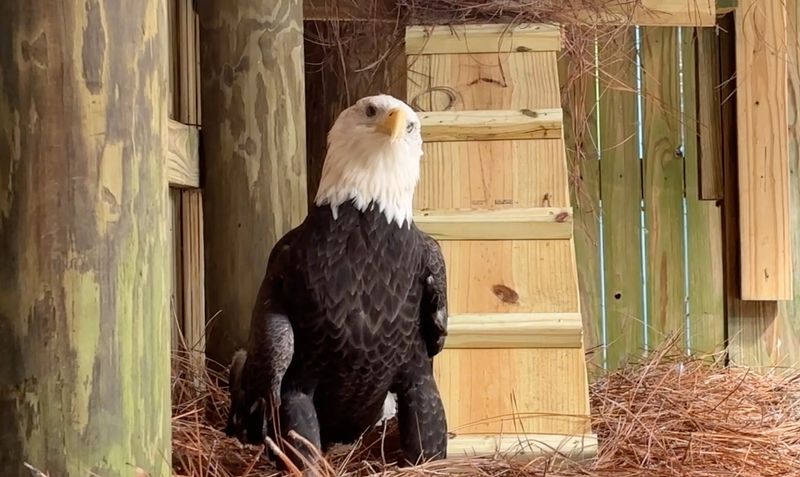
Today, Apollo is one of three permanent bald eagles who will never be released into the wild because of their physical conditions. The others are Winnie, Apollo’s mate after Athena passed, and Amelia, a gunshot victim and the largest of the three, who lost her mate Junior about three years ago.
Amelia and Junior produced 10 eagles that were released into the wild, and though Winnie and Apollo had no babies of their own, they did foster other baby eagles.
All those eagles, those majestic birds of prey, are flying now because people in Pensacola never gave up on birds that would have likely perished without them. But the care costs money, and the Wildlife Sanctuary of Northwest Florida, which began in 1982 to care for injured and orphaned wildlife, holds numerous fundraisers annually. In 2025, the Wildlife Sanctuary received 4,100 animals to care for, ranging from squirrels to vultures to turtles and more. This year, the sanctuary is on pace to eclipse that number.
On July 5, 2026, the Wildlife Sanctuary will host the “Let Freedom Wing” market on the sanctuary grounds from 2 to 6 p.m. The event will feature art and farmers market vendors, food trucks and animal encounters, including gloved birds, but not the eagles. They’re all getting old now.
Visitors can also visit the new shorebird habitat, which is designed to closely mimic the birds’ natural environment, including beach sand and native beach plants. The habitat was funded through a grant from the Pensacola and Perdido Bays Estuary Program.
When PNJ photographer John Blackie and myself went out on Saturday to watch Holden and other staff give a tour to guests from the PPBEP, we were invited inside the two separate enclosures that Winnie and Amelia reside in. We didn’t stay long and kept our distance, not wanting to scare off the beautiful birds who were giving us, well, the eagle eye.
We couldn’t see old Apollo at all though.
He’s old, really old for a bald eagle. He’s been living inside in recent months, occupying an entire room inside the Wildlife Sanctuary building, which holds the administrative wing, the hospital and indoor shelters and nurseries.
“He has arthritis, his visibility isn’t good and his mobility isn’t as good as it used to be,” Holden said. “He’s getting laser therapy treatments and joint supplements for geriatric issues. And he’s in the AC.”
It’s tough for Apollo these days and the day will eventually come, sooner than later most likely, when, well….
“I have that conversation with myself every day,” Holden said. “But he is 43 years old, and the goal is to keep him as comfortable and happy for as long as possible. We try to make sure he has a good day every day.”
For more information on the Wildlife Sanctuary of Northwest Florida and how to help, go to pensacolawildlife.com.
This article originally appeared on Pensacola News Journal: Apollo the bald eagle is 43. ailing, yet loved at Wildlife Sanctuary
Reporting by Troy Moon, Pensacola News Journal / Pensacola News Journal
USA TODAY Network via Reuters Connect
By Troy Moon, Pensacola News Journal | USA TODAY Network