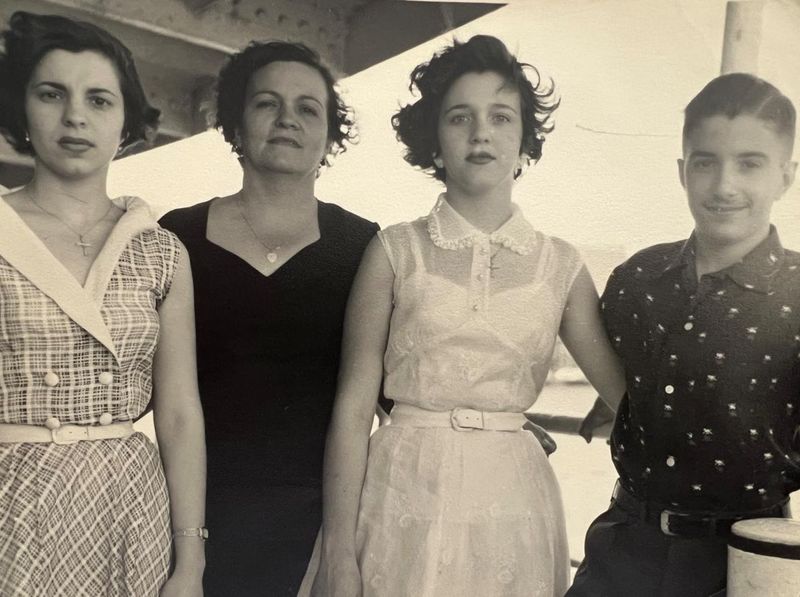
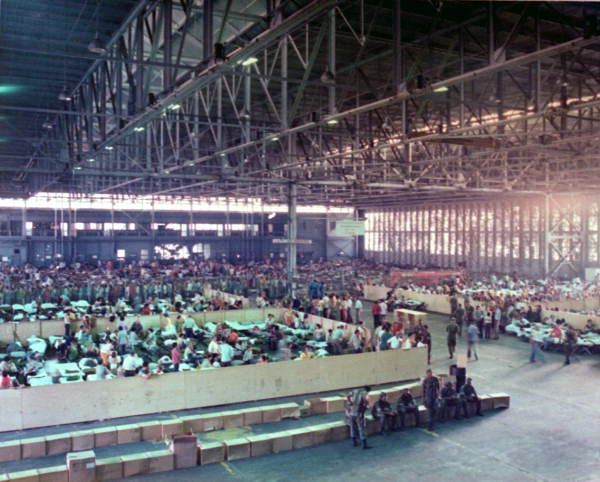
At the age my friends’ grandparents were retiring, my grandmother stepped off an airliner at Miami International Airport, picked up her green card at the Freedom Tower and took her place on a sweltering Hialeah shoe factory production line.
The wages she earned as a sneaker seamstress, a decade later, would help cover my university tuition. She eventually retired not long after my college graduation, when she was nearing 80.

It was just one of the many lives my grandmother, Elvira Otegui, lived over her four scores and seven years — daughter, mother, business partner, caregiver, immigrant factory worker and, yes, Abuela Cuca. I obviously owe her a debt I could never repay, other than the satisfaction I pray she derived from a photo of her, my grandfather and me in cap-and-gown commencement regalia.
But I am far from the only one indebted to immigrant parents or grandparents that over the past 150 years, and more, sacrificed the life they lived to come to America to provide a better life for their children and grandchildren.
Some were prompted by fear of political retribution, others wanted a prosperous life. Many desired to be an American. A common denominator for many of them is that they fulfilled their dream on industrial assembly lines from New York to the Midwest to the Southeast, building lives, sustaining families and providing futures.
My grandmother’s chapter in the United States speaks to a quintessential reality: American manufacturing, dating back to the Industrial Revolution, has always been dependent on bountiful, low-cost labor. But it is a piece of U.S. economic history that is conveniently overlooked in today’s debate over tariffs and bring-back-the-factories vows.
Tariffs, yes, but immigrant labor powered U.S. industrial machine, too
When championing his call for raising tariffs on U.S. trading partners, President Donald Trump often talks nostalgically about America’s industrial rise during the late 19th and early 20th centuries. The hero in his retelling of U.S. economic history is exclusively the imposition of import duties and barriers to establish a protective wall for manufacturing expansion.
“You know, years ago, 1870 to 1913, we didn’t have an income tax. What we had is tariffs,” Trump explained in one speech. “And the tariff system made so much money. It was when we were the richest — from 1870 to 1913 … It was when we were the richest.”
The almost singular focus on tariffs, others say, simplistically overlooks other factors. One of those was the role of workers — better said, the accessibility to millions of hands — that made the riches possible for industrialists and the epoch’s captains of industry.
“Two of the things that drove American growth in that period were people moving off the farms into factories,” said Edward Alden, senior fellow at the Council on Foreign Relations. “And the other is immigration.”
Many, many immigrants, almost 12 million people, migrated to the United States between 1870 and 1900, according to the Library of Congress. A 2020 report by researchers at Indiana University noted that another 14 million people arrived on U.S. shores from 1900 to 1914. In all, an estimated 25 million people came to the United States from other countries in the half-century timespan, from 1870 to 1920, that Trump so often lauds.
“You had the people available,” said Alden of the demands from labor-intensive factories making everything from garments to automobiles. “You had people showing up in what were then record numbers.”
Made flan in a Havana bakery, sewed sneakers in Hialeah factory
My grandmother arrived in the United States in 1971 as part of a much later wave of refugees from abroad.
She was one of the close to a million Cubans that came to America just in the two decades that followed Fidel Castro’s communist revolution. She was the next to last member of our extended family to make her way to safe haven, all legally, in the “Freedom Flights” after having stayed behind in the hamlet of San Pedro in central Cuba to care for my aged great-grandmother.
Nothing in her childhood or adulthood prepared her for a factory floor in a foreign country, other than the steeled determination forged by life in Cuba’s teetering democracy and volatile economy. In Havana, she raised my mother, my aunt and uncle in a second floor flat situated above the bakery owned by my grandfather, himself an immigrant from Spain.
My grandfather’s oven produced delicacies feted by his shopkeeper peers and entrepreneurs, also mostly sons and grandsons of Iberia, in the local chamber of commerce and centros, social clubs that were gathering spots for expatriates from the former colony’s governing empire.
But there was a secret the men of business were unaware of as they feasted on mariscos, shellfish, on a bed of saffron valenciano rice. My grandfather had a silent partner in this delicacies venture.
My grandmother made the fillings for empanadas as well as the prized flan dessert, creamy and topped with a thick caramel glaze. A good bit of that dinner they enjoyed before they capped off the evening by lighting their puros, Cuban hand-rolled cigars, was actually her labor.
Her life in Miami was a new chapter. She toiled sewing sneaker cloth at the International Footwear Company factory — we knew it as IFCO — in Hialeah.
I was still in elementary school at the time and was fairly unaware of what she did — she was my Abuela Cuca. All I knew is we attended the IFCO holiday festival at Hialeah Race Track each December and I periodically got a new pair of IFCOs, sometimes for Christmas, sometimes for my birthday and sometimes for back to school.
Once in college, I did know it was my grandmother’s factory wages that partially covered my tuition, my semester abroad in England and living expenses, including the $20 bill she would slip into a Bible in my room before she departed from visits.
But even then I had not pieced together the whole story.
Factory jobs like my grandmother’s a fulcrum of Cuban-American ‘enclave’
The Hialeah my grandmother knew was regarded as the largest industrial city in Florida and was home to manufacturers like Coulter Electronics Corp., Tower Paint Manufacturing Co., Gator Industries and PiBa Industries — plus IFCO and a number of other cohorts that formed a clothing cluster.
“South Florida used to be one of the top three/four garment manufacturing areas in the country,” said Guillermo Grenier, a sociology professor in the Department of Global and Sociocultural Studies at Florida International University. “When immigrant labor came in, that’s when Miami shot up into the big four of the garment industry.”
The driver of the growth, from the early 1960s through the 1990s, were transplants from across the Americas, initially Cubans.
Castro’s discards tended to congregate in multi-generational households “where everyone worked,” said Grenier. Men generally took up jobs in construction, women worked in the garment industry and age-eligible children took jobs in fast-food restaurants after school, he said.
“That was a big, big deal in Miami because it allowed the rise of what’s called the Cuban enclave where you actually had higher incomes among Cuban immigrants than other Latino immigrants,” said Grenier, who co-wrote “A History of Little Havana.”
“But it’s basically because they had these extended households and everyone was working.”
In a matter of 25 years — a generation — that enclave produced bankers, lawyers, accountants, doctors and at least one journalist, me.
“So when you talk about what does immigration do, well, yeah, you have your labor but then you also have a process of incorporation into the society,” Grenier said. “That’s how immigrants end up getting political power and all this stuff. But it starts with, basically, immigration.”
Social archaeology: Political power and globalization pioneer
As I entered adolescence, it was impressed upon me that I was to attend college, get a degree and become part of the professional establishment.
My trajectory into the post-immigrant “civil society,” I was made to understand, was because I was neither too good for a factory job nor entitled to one. Rather, the factory job was needed by the next arrival in search of a foothold in the American Dream — whether another Cuban family, or Nicaraguan, or Haitian or Brazilian.
“Every time there was an immigration wave into Miami you went into the garment industry, from the 60s through the 90s, and you saw it there,” Grenier said.
In fact, Castro’s disparagement of those he exiled helped fuel a politically powerful class. By the early 1980s, many Cubans in Florida, and across the United States, obtained U.S. citizenship. They soon flexed their political muscle by helping tilt state and federal elections, and electing state and federal lawmakers from within the enclave.
“It’s like an archeological site,” Grenier said. “Down, at the bottom, there are a bunch of immigrants that came in and started working their ass off. And then that helped build different layers of civil society.”
One of those layers was a diversified professional class. International banks sprouted, health-care clinics proliferated and ports boomed with commerce from the Americas.
“South Florida in the ’60s and ’70s was kind of a harbinger of what was to come in the United States,” Grenier said. “It was the cutting edge of what we now call globalization, but it was the cutting edge of globalization facing south to Latin America.”
Today, globalization is viewed as a profanity within the ranks of the America First political movement.
“Our country and its taxpayers have been ripped off for more than 50 years, but it is not going to happen anymore,” Trump vowed in his April 2 “Liberation Day” speech from the Rose Garden. “For years, hardworking American citizens were forced to sit on the sidelines as other nations got rich and powerful, much of it at our expense, but now it’s our turn to prosper.”
His rhetoric toward immigrants who crossed the border has been even harsher. He has said they come from mental institutions, prisons and insane asylums and likened them to the serial killer Hannibal Lecter from “The Silence of the Lambs” book and movie.
The president, during his decade in political life, has changed American conventional wisdom by convincing close to 80 million voters that the combination of globalization and mass immigration has been toxic to the country’s economic health. Traveling through much of rural and some parts of urban America, home to one hollowed out community after another, it’s hard to argue against the point.
Except for one counter to that narrative: Hialeah.
How did Hialeah defy fate that befell Rust Belt?
Beginning with the Caribbean Basin Initiative, and later the North American Free Trade Agreement, Hialeah suffered “a slow bleeding of the industry jobs,” Grenier said, just like any town in Ohio, Pennsylvania, Michigan or North Carolina. Once employing a workforce in the six figures, Hialeah’s manufacturing workforce ended last year with fewer than 10,000 jobs.
While broad swaths of America’s powerful industrial base never recovered from the gut punch, Hialeah has. Though just one-third of its residents have more than a high school education, the unemployment rate to close out 2024 stood at just 2.7%.
Today, half of the workforce in the immigrant-dominant city where 75% of residents are foreign-born is in sales, transportation, health care, finance, white-collar executive and administration positions. The number of enterprises in the city grew by almost 10% from the end of the pandemic through 2024.
“Hialeah is kind of booming,” Grenier said. “It’s because of immigration.”
Specifically, the enterprising, risk-taking, innovating, take-any-job-that-pays spirit that newcomers to America exhibit with boundless supply.
“An immigrant is part of a system and somebody in that system wants them to work,” Grenier said. “Somebody needs them to do what needs to be done in their business. They’re not just immigrants. They are also part of the economic machine of our society.”
There is also an aspirational, entrepreneurial drive. An Indiana University study noted a sharp increase in the number of patents issued in the United States in the first decades of the 1900s, a rise it attributed to immigrant innovation.
“The pattern is striking: assimilated immigrants are by far the most prolific group of innovators,” stated the European Immigrants and the United States Rise to the Technological Frontier report.
In today’s Hialeah, three-quarters of its businesses have four or fewer employees — “Shark Tank”-like ventures profiting from a niche or an idea sparked by some observation. Ironically, one area of innovation is counter-intuitively opportunistic.
Grenier said one growth area is doing business with non-government, start-up ventures in Cuba known by the acronym “pymes,” which stands for small and medium-sized businesses. An intriguing twist when considering the city renamed one of its major roadways Donald J. Trump Avenue.
You can also tell the story of South Florida immigration, Grenier noted, by simply looking at the tall office peaks dotting downtowns.
“If you look at the skyline, that’s the result of immigration in South Florida,” Grenier said.
My grandmother never expected to be a foundation of that landscape. But she most certainly was.
Antonio Fins is a politics and business editor at The Palm Beach Post, part of the USA TODAY Florida Network. You can reach him at afins@pbpost.com. Help support our journalism. Subscribe today.
This article originally appeared on Palm Beach Post: A Mother’s Day thank you to my factory worker abuela at a time of tariffs, deportations
Reporting by Antonio Fins, Palm Beach Post / Palm Beach Post
USA TODAY Network via Reuters Connect