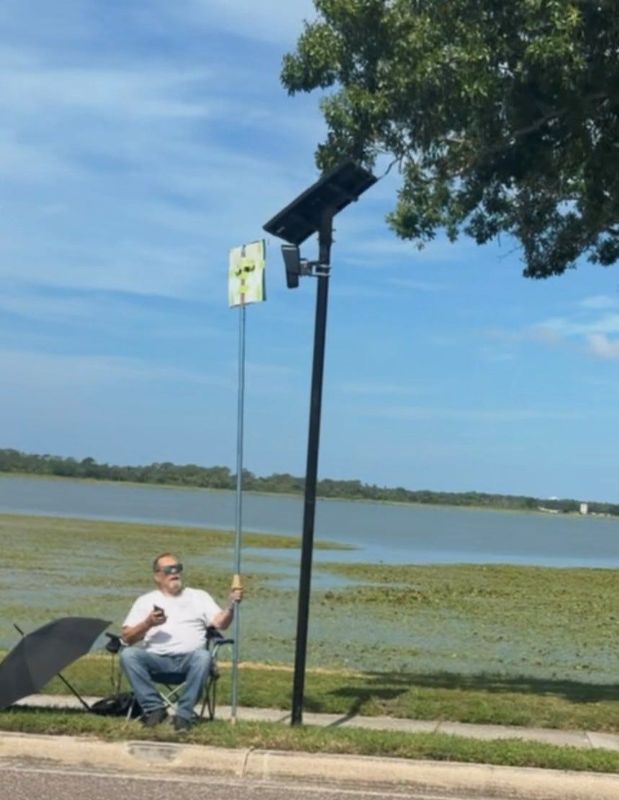
Automated solar-powered cameras, often referred to as Flock cameras after one of the best-known vendors, are showing up along Florida roads, at neighborhood entrances and near businesses.
Police say the cameras that record and analyze everything they see help find stolen cars, locate missing people and generate leads in serious cases.

They’re also triggering widespread bipartisan protests and even enthusiastic vandalism over fears that the cameras create a searchable record of ordinary drivers’ movements with too little oversight and too much opportunity for abuse.
In August, a Port Orange man destroyed three Flock cameras by cutting down the poles they were on.
Flock Safety announced on Aug. 13, following repeated reports of law enforcement officers using the system to stalk or harass people, that a new update will crack down on police officers who misuse the data.
Here’s what to know.
Shop Amazon for surveillence cameras
1. ‘Flock’ is a brand
Just to be clear, “Flock” has become a common term for automated license plate readers, or ALPRs, but Atlanta-based Flock Safety is not the only company out there selling them. The complaints are not specifically against Flock Safety but against the proliferation of automated surveillance tools.
2. Flock cameras record everything, not just traffic violations
ALPR cameras are not new. Florida cities have used red-light and speeding cameras for years, although they’ve also seen significant pushback from residents.
But while those cameras are activated by certain actions, Flock cameras are always recording. The software collects information such as:
Flock’s software can trigger real-time alerts when a description matches a wanted vehicle. It also uses artificial intelligence to add a description of each vehicle to a database that can be searched with natural language and incomplete descriptions, such as “man in blue shirt and cowboy hat” or “dark SUV with rear bumper damage,” according to the company website.
Flock Safety says the camera does not capture personal information, facial recognition, or anything tied to individuals. Local jurisdictions may choose to share the data with the national database.
3. Flock cameras are showing up in more places
Flock Safety says there are more than 120,000 cameras installed across 49 states.
The company does not provide a map of its camera placements, but volunteer-powered maps such as DeFlock and Eyes on Flock track sightings of Flock cameras, as well as ALPR systems from Motorola Solutions, Axis Communications, and others.
DeFlock shows around 10,000 ALPRs in Florida, mostly around large metro areas such as Orlando, Jacksonville, Tampa, and along both coasts. However, rural areas are not immune. The Hernando County sheriff installed more than 40 Flock cameras around country roads and along remote corridors near wildlife management lands, according to the Hernando Sun.
Another site, Have I Been Flocked, lets users check if their license plate is among those searched by law enforcement using audit logs obtained through public record requests.
4. Law enforcement officers say the cameras help solve cases faster
Many police departments and sheriff’s offices have reported great success using the new technology in solving crimes and finding missing people when speed is a priority. Flock Safety claims that in 2025, an estimated 20% of solved cases in areas where its cameras were deployed were assisted with Flock’s technology. “More than 10,000 missing persons were located last year with Flock’s help, totaling more than 27 per day,” the company website says.
In Florida:
There is also the chance for false positives. Misreads of license plates have led to innocent people being held at gunpoint and, in one case, attacked by a K-9, according to Max Isaacs, director of law and policy at the New York University Policing Project. The ACLU says that the cameras misread 1 in 10 license plates.
4. Critics call the system a warrantless surveillance state
Groups such as the ACLU and the Center for Democracy & Technology warn that networked license plate readers such as these can become warrantless mass-surveillance tools without retention, access, and data-sharing rules.
The ACLU warns it could chill First-Amendment-protected activities such as attending protests, visiting abortion clinics or religious centers, and other legal activities and provide governments with insight into a person’s beliefs and politics.
In 2025, a Texas law enforcement officer conducted a nationwide search of more than 83,000 Flock cameras for a woman who’d had an abortion. The Electronic Frontier Foundation found in a public records search that ALPR data was used to verify student residency requirements, investigate noise complaints, do background checks, and surveil protesters, immigrants, and more.
5. Some law enforcement accused of misuse of Flock cameras
Dozens of law enforcement officers have been arrested or resigned under accusations of reportedly misusing the Flock system to surveil romantic interests, partners, exes, or even just attractive women who caught their eye, according to nonprofit public interest law firm Institute for Justice (IJ).
Just in Florida:
Flock has said it has added features that flag impermissible searches and help agencies identify unusual usage patterns, but IJ reported that most of the cases of misuse were only discovered after the victims reported the officers’ stalking behavior. On Aug. 13, Flock Safety announced changes to its system to require reasons for searches, auditing assistance to flag abnormal behavior, and stricter controls over who may access information.
6. Flock says data is controlled and time-limited
Previously, Flock Safety deleted images and footage after 30 days, unless local law says otherwise. In its Aug. 13 announcement, the company said it was reducing that to seven days, except in cases that need more time under “evidence mode,” when a search is tied to an ongoing case number.
The statewide retention default is 30 days, but a Florida statute on records retention allows agencies to keep data designated as evidence in a criminal investigation. User queries may be kept longer or indefinitely for compliance audits.
7. Flock cameras have been used for immigration enforcement
While Flock Safety said it has no contract with Immigration and Customs Enforcement (ICE), some local law enforcement agencies with Flock contracts have agreements with ICE and assist with immigration arrests.
USA TODAY site Treasure Coast News discovered five agencies from Martin, St. Lucie and Indian River counties conducted 216 immigration-related searches using Flock Safety cameras from January through March. A public records search by 404Media.com found thousands of local police searches across the country were done on behalf of the federal government, often with immigration or ICE explicitly listed as the reason.
8. People are blocking or vandalizing Flock cameras in protest
License plate readers have been shot at in Tennessee, hit with a truck in California, beaten with a baseball bat in Virginia, cut down with a saw in Texas, and splattered with paint in New York. Viral social media posts “jokingly” demonstrate how to disable them. In Florida:
9. The Flock backlash is having an effect
More than 82 Flock Safety contracts have been terminated across 28 states since 2021 — nearly half of those in the first six months of this year. In Tallahassee and Pensacola, local officials are withholding earmarked funds for the cameras.
Even Florida gubernatorial candidates have been forced to take a stand. GOP frontrunner U.S. Rep. Byron Donalds has called for a “full and immediate pause” on the cameras in Florida, while one of his opponents, James Fishback, has made stopping them a central part of his campaign. Democratic frontrunner David Jolly isn’t going that far, but said in a WLRN interview that he thinks warrants should be required and wants an end to its use in immigration enforcement.
10. A national, weeklong anti-Flock protest is coming
DeFlock and other anti-Flock activists are planning a National Week of Action Against ALPTs for Aug. 15 to 22.
Ed Vogel, a member of DeFlock, said more than 20,000 people have registered and over 300 events have been planned, including presentations on surveillance technology, seminars on how to fight the spread, and guided tours of the cameras’ locations (called “Flock Walks”).
There are 25 events scheduled in Florida so far.
C. A. Bridges is a journalist for the USA TODAY Network-Florida’s service journalism Connect team. You can get all of Florida’s best content directly in your inbox each weekday by signing up for the free newsletter, Florida TODAY.
(This story was updated to add new information.)
This article originally appeared on Tallahassee Democrat: 10 facts about Flock cameras in Florida and why they’re controversial
Reporting by C. A. Bridges, N’dea Yancey-Bragg and John Pacenti, USA TODAY NETWORK – Florida / Tallahassee Democrat
USA TODAY Network via Reuters Connect
By C. A. Bridges, N'dea Yancey-Bragg and John Pacenti, USA TODAY NETWORK – Florida | USA TODAY Network