One of the most famous meteor showers of the year is about to be at its best.
The Perseid meteor shower first kicked off in the middle of July and has since been active for a few weeks as Earth passes through the dusty debris trail left behind by the comet Swift-Tuttle. Now, the cosmic show is about to hit its peak activity as our planet makes its way through the densest part of those tiny bits of comet dust.

With its abundance of whizzing bright meteors that leave long wakes of light and color behind, the Perseids is considered one of the best meteor showers of the year. And in 2026, clear skies and an invisible new moon will ensure that Californians have some stellar views.
Here’s everything to know right now in California about the Perseid meteor show ahead of its August peak.
When is the Perseid meteor shower active in 2026?
The Perseid meteor shower is due to be active in 2026 between July 17 and Aug. 24, according to the American Meteor Society.
When is the Perseids’ peak activity?
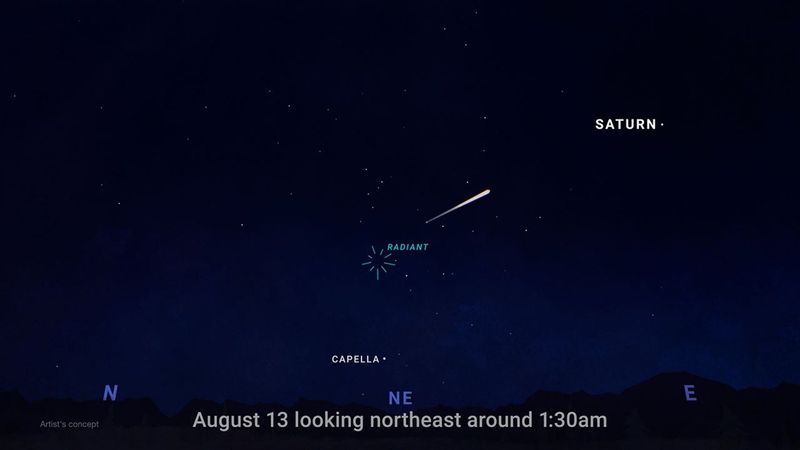
The Perseids meteors will hit their peak activity between Aug. 12-13 as Earth passes through the densest part of the associated comet’s cosmic debris.
Photos of the Perseid meteor shower
How many meteors will be visible? What to know about fireballs
Observed under dark skies, the Perseids can produce anywhere from 25 to 100 meteors in an hour that whiz at up to 37 miles per second, according to NASA.
Because the meteor shower originated from larger comet material, the Perseids are also known for producing bright explosions of light known as fireballs that persist longer than a typical meteor streak.
How full will the moon be? What to know about lunar phase
The bigger and brighter the moon, the more its light can interfere with your view of streaking meteors.
Fortunately, a waning crescent moon with just a thin curve visible will give way to a new moon by Aug. 12, during which our celestial neighbor won’t be visible to Earth at all, according to the Old Farmer’s Almanac.
Weather, cloud forecast for California during peak activity
Of course, clouds in the sky could also hamper the views.
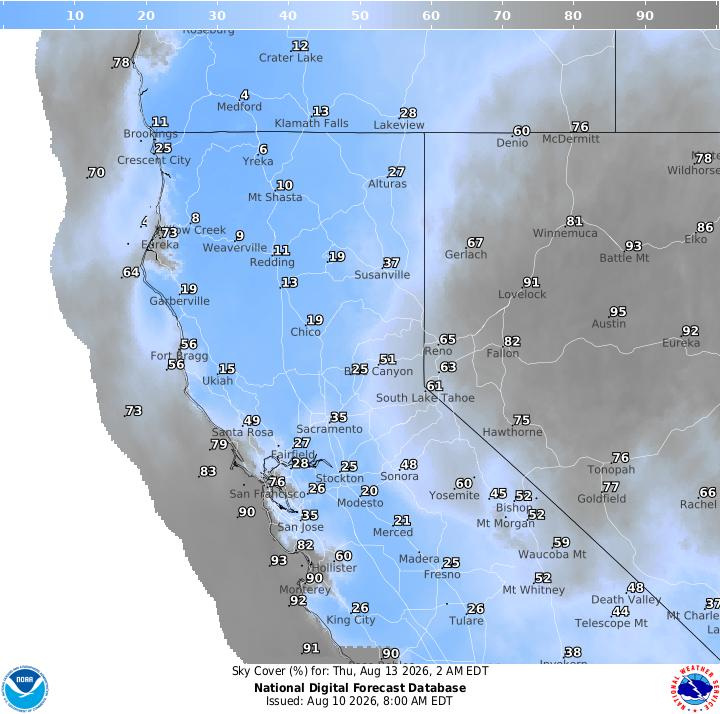
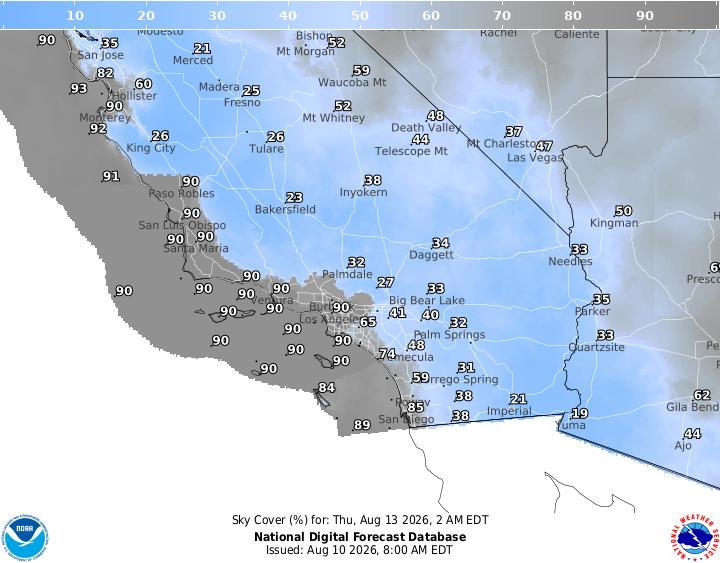
The National Weather Service shared a graphic showing relatively cloud-free skies forecasted during the meteor shower’s peak in California. Blue shading indicates clear skies, while areas with gray shading and higher percentage numbers have a higher chance for clouds.
Where are the best places to see meteor showers in California? Dark sky locations
The Perseid meteor shower is best seen in the Northern Hemisphere, which includes California and the rest of the United States.
Want to try to catch the meteor shower before it peaks? Spectators will have the best luck at dark sky locations on cloud-free nights and away from city light pollution.
To find a dark area near you, turn to DarkSky International. The U.S. nonprofit maintains a list of designated dark sky communities around the world, including 176 in the United States.
That includes these locations in California:
What time are the meteor showers visible in California?
In general, the best time to see meteors is between midnight and dawn. The Perseids, though, have also been known to appear as early as 10 p.m. local time, according to NASA.
Visit the website Time and Date to find the best times and viewing directions for your location.
What causes the Perseids meteor shower?
Originating from the constellation Perseus, the Perseids are made up of leftover particles from comet 109P/Swift-Tuttle that interact with Earth’s atmosphere.
Every year, Earth passes through the comet’s debris trail, resulting in the Perseid meteor shower when the broken bits of Swift-Tuttle disintegrates in our atmosphere at high speed, according to NASA.
Swift-Tuttle, which takes 133 Earth years just to orbit the sun a single time, was discovered to be the source of the Perseids in 1865 by Italian astronomer Giovanni Schiaparelli. Discovered in 1862, Swift-Tuttle is absolutely gargantuan – twice the size of the asteroid theorized to have wiped out the dinosaurs 66 million years ago.
Swift-Tuttle has not visited our inner solar system since 1992 and won’t be back again until 2125, according to the nonprofit Planetary Society.
Eric Lagatta is the Space Connect reporter for the USA TODAY Network. Reach him at elagatta@usatodayco.com
This article originally appeared on Palm Springs Desert Sun: The Perseids are peaking. How to see dozens of meteors in California
Reporting by Eric Lagatta, USA TODAY NETWORK / Palm Springs Desert Sun
USA TODAY Network via Reuters Connect
By Eric Lagatta, USA TODAY NETWORK | USA TODAY Network