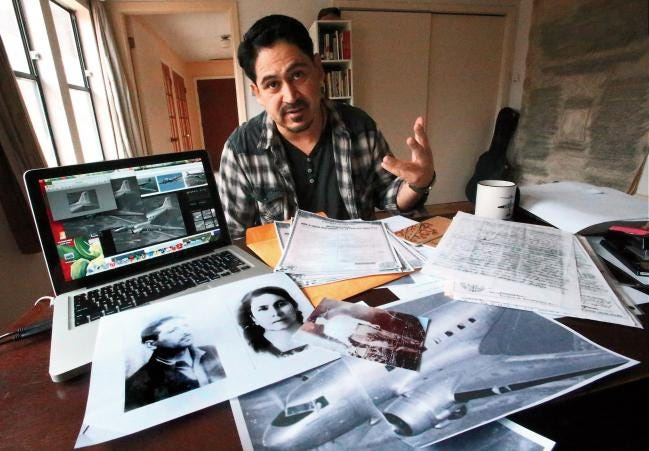
A California‑raised writer who has spent years documenting the 1948 Los Gatos plane crash is criticizing U.S. Immigration and Customs Enforcement for its language in a Jan. 28 Facebook post marking the tragedy’s 78th anniversary.
ICE’s post honored Deportation Officer Frank E. Chaffin, who died along with 31 others when a government‑chartered Douglas plane crashed in Los Gatos Canyon. But it also described the 28 Mexican passengers as “illegal Mexican aliens.”

Tim Z. Hernandez — author of “All They Will Call You” and a central figure in identifying the long‑nameless victims — said the wording “erases people and distorts the public record.”
“ICE publicly referred to the 28 Mexican farmworkers… as ‘illegal… aliens,’” Hernandez wrote in his own post. “Language like that erases people. Thirty-two lives were lost that day — crew, a federal officer, and people with names, families, and futures.”
Chaffin, an immigration security officer, worked for the Immigration and Naturalization Service under the Department of Justice. ICE did not exist until 2003.
Here’s what to know about the controversy and Hernandez.
What happened in the 1948 Los Gatos Plane Crash
The crash — long memorialized in folk singer Woody Guthrie’s protest anthem “Deportee (Plane Wreck at Los Gatos)” — occurred on Jan. 28, 1948, when Douglas N‑36480 left Oakland for San Diego.
On board:
About an hour into the flight, an engine failed. The plane fell into Los Gatos Canyon near Coalinga, killing everyone aboard.
News coverage at the time listed the American crew by name but referred to the Mexican passengers only as “deportees.” Guthrie’s anger at that omission produced one of the most famous protest songs in American folk music.
What the Bracero Program was — and its impact
The bracero program, launched in 1942, was a bilateral agreement that brought millions of Mexican laborers to the United States for temporary agricultural work. In California, it reshaped the state’s economy, supplying a massive workforce to Central Valley growers who depended on low‑wage, high‑output labor during wartime shortages.
Though the program promised fair wages and humane housing, bracero workers often faced exploitative conditions — from substandard living quarters to DDT “delousing” sprays at processing centers. Still, the program became the backbone of large‑scale farm production and permanently altered labor patterns in the West.
Nationally, the program accelerated the growth of industrial agriculture, cemented seasonal migration routes, and set precedents for employer‑controlled visa systems. Its legacy continues to influence immigration debates today, including the language used to describe workers like those who died in Los Gatos Canyon.
The program ended in 1964, after growing criticism from labor unions, civil‑rights groups, and federal investigations documenting persistent abuses.
Who Tim Z. Hernandez Is — and why his response matters
Hernandez, raised in Visalia and Dinuba in California’s San Joaquin Valley, has spent more than a decade reconstructing the identities and life stories of the crash victims. His research culminated in the 2017 documentary novel “All They Will Call You,” which blends investigative reporting, oral history, memoir, and poetry.
His work led to:
Hernandez argues that the ICE post repeats the same dehumanizing framing Guthrie fought against.
“Words like ‘alien’ and ‘illegal’ are meant to strip humanity,” Hernandez said. “Even if we disagree about immigration policy, what we should agree on is dignity. When language erases people, it becomes easier to justify treating them as something less than human.”
Hernandez notes that he also included the stories of Chaffin and the American crew in his work, believing none of the 32 lives should be overshadowed.
A song that keeps echoing from Guthrie to Springsteen
Guthrie’s song — later covered by Pete Seeger, Joan Baez, Bruce Springsteen, Dolly Parton, and others — imagines the passengers’ lives because newspapers would not print their names. Hernandez ultimately unearthed many of those names across cemeteries, archives, and villages in Mexico.
Descendants now gather at the crash site every year. Many learned only recently through Hernandez’s research that their relatives died in California at all.
Ernesto Centeno Araujo covers breaking news for the Ventura County Star. He can be reached at ecentenoaraujo@vcstar.com, 805-437-0224 or @ecentenoaraujo on Instagram and X.
This article originally appeared on Palm Springs Desert Sun: ICE draws backlash for ‘dehumanizing’ post on Los Gatos plane crash
Reporting by Ernesto Centeno Araujo, USA TODAY NETWORK / Palm Springs Desert Sun
USA TODAY Network via Reuters Connect