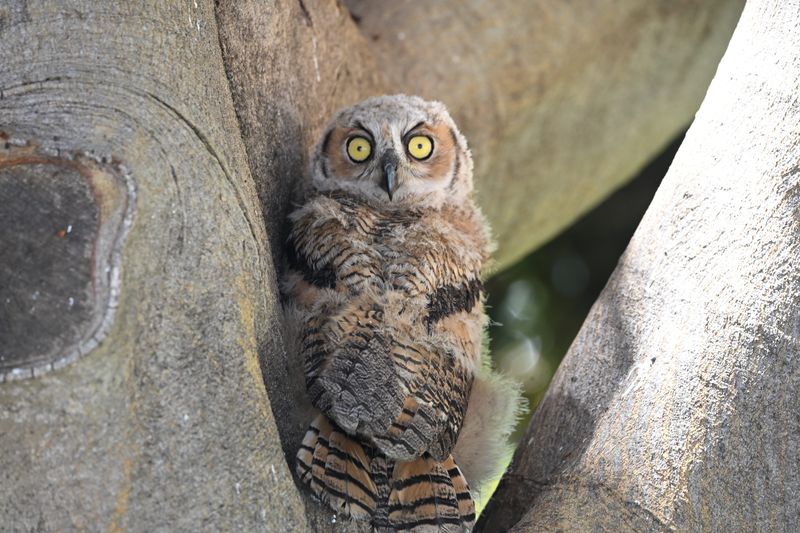
Like many dramas, the one that drew a stream of people carrying binoculars, cameras and sometimes toddlers to Ventura’s Cemetery Memorial Park started with intrigue.
For more than two years, a pair of great horned owls roosted in an avocado tree near Rhiannon “Ray” Norman’s home outside of downtown Ventura. Norman knew them so well, she named the female Sassy because of her impertinence. The male was Fred.

And then Sassy suddenly left. Fred departed later. Norman, a registered veterinary technician, went searching. She found the owls in a large tree at the top of Ventura’s Cemetery Park, just a few strides from Poli Street. Mama was in a nest.
The tree was a good place for viewing but a terrible place for owls to nest and raise a family. People take their dogs to the park, often not using leashes. The tree was just steps from the traffic on Poli Street.
At first, Norman kept news of the nest to herself. When she realized Sassy and Fred were parents to two newly hatched owlets, she went to Ventura city officials the second week of May and asked them to fence off the tree. Signs were posted that told people great horned owls are a protected species.
The city posted news of the owls on its Facebook page, asking people to respect the boundaries. Photographers standing outside the fence used long lenses to take photos of owlets stretching their wings or posing with mama, huge eyes glowing. The images filled social media.
The site became Owl Square. Parents with young children stood outside the fence, pointing at the fuzz-covered owlets peering over the edge of the nest. Neighbors checked on the owls too after or before work.
“I love birds,” said Anne McMahon, a pilates instructor who lives nearby. She came regularly “to see them grow and to make sure they were safe and thriving.”
They were at first. Sassy spent much of her time in the nest or on a branch just below it. Fred tucked himself into a corner of the tree mostly hidden by branches. The adults hunted at night, feeding the hungry babies meals of crow and squirrel.
The other constant presence was Norman.
“If it was not for Ray, this wouldn’t be here,” said her friend Patty Overley, pointing at the barrier on a Monday morning. “She’s been here some days for 10 hours.”
Norman, who runs a business called Animal HealingWorks, told people the owlets were 5 to 6 weeks old and would soon start to branch, venturing away from the nest. The next step would be learning to fly. The owlets would likely stay at or near the tree for months as they learned to hunt and survive on their own.
“It’s a good time to teach children about connecting with nature,” she said one morning, a few feet from the tree. “Animals teach us so much when we pause to listen.”
Nature took its course. Both owlets ventured from the nest on May 24. The firstborn settled on a branch just below the nest. The younger sibling fell from the tree to the grass below in the kind of tumble that happens often and is part of learning to fly.
Norman worried dogs could threaten the young raptor. Trained in handling animals, she rescued the owlet and, after a sleepless night, took it to the Ojai Raptor Center. It was uninjured. She said she was told the best course was to return the fledgling to the tree and let it climb back close to mom and dad.
The owlet had other ideas. It fled the tree, eventually gliding over the barrier to scamper, sail and flap across Cemetery Park. After several attempts to return the fledgling to the nest tree, the bird went AWOL sometime during the night. Three days later, the bird still hadn’t been found.
“The hope is he’s doing OK, and mom and dad are feeding him,” Norman said.
The firstborn owlet moved more in the tree, settling on a branch near the adults. It peered down at human visitors as if they were the show.
On May 27, three days after its sibling left the tree, the older chick followed suit, landing just outside of the fenced-in refuge. The owlet, still unable to fully fly, glided into Poli Street and was nearly struck by a car. Bystanders including a California Fish and Wildlife officer watched the scene unfold, then moved to keep the bird safe and control traffic.
Norman, summoned to the scene, rescued the owl from Poli. She took it in her vehicle to the raptor center.
It’s expected to stay there for now. The bird will likely be released somewhere near its Ventura home after it develops more flight skills and is able to fend for itself.
Owl Square feels different now. The owlets, as of May 28, were gone, though the adults remained. City officials said the barrier is expected to stay in place for about two more weeks.
Norman said she planned to visit the tree often to check on the adults, see if the AWOL owlet has emerged and tell the story of the infants. She talked too about the people who came to learn about owls, as well as the neighbors, photographers and others who teamed up to take turns checking on the raptor family.
“Everyone rallied behind these little owls,” she said.
Tom Kisken covers health care and other news for the Ventura County Star. Reach him at tom.kisken@vcstar.com.
SUPPORT LOCAL JOURNALISM: To see more stories like this, subscribe.
This article originally appeared on Ventura County Star: Community rallies behind little owls in Ventura’s Cemetery Park
Reporting by Tom Kisken, Ventura County Star / Ventura County Star
USA TODAY Network via Reuters Connect