Julienne Dallara woke up in her Woodland Hills home on Nov. 6, 1996, and couldn’t move her legs.
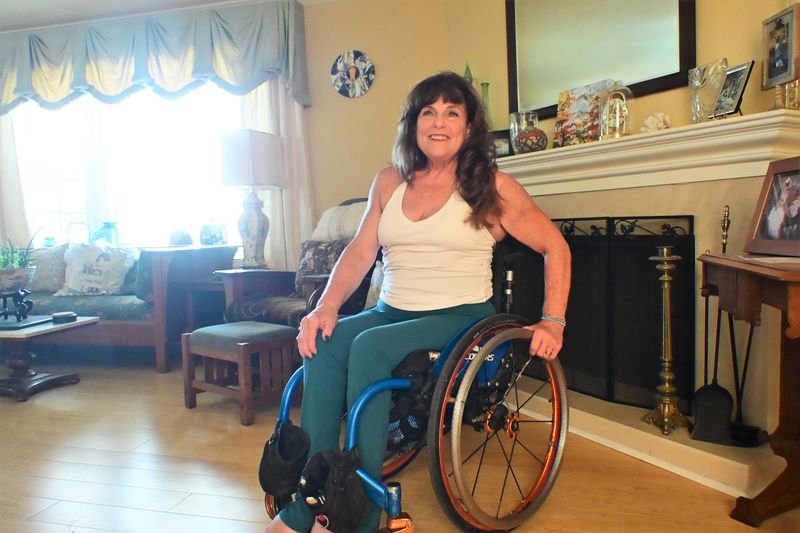
“Couldn’t walk. Couldn’t feel anything. Couldn’t pee,” she said, sitting in her wheelchair in her ranch-style home, now in the hills of Camarillo.

The then 36-year-old woman was diagnosed with transverse myelitis, a rare condition that caused her body’s immunities to attack her spinal cord. It meant she was suddenly paralyzed from the waist down.
In that moment, as she lay in her bed, nearly everything in her life changed. She had been a dancer, singer and actress who performed regularly at an comedy and improv club in Los Angeles. She had a 3-year-old daughter and a 7-month old son. And she couldn’t move her legs.
She did the only thing she could other than give up. She adapted and eventually embraced a life as an advocate for the disabled, serving as Ms. Wheelchair California in 2024. She was recently named an ambassador for a state government program for people with disabilities.
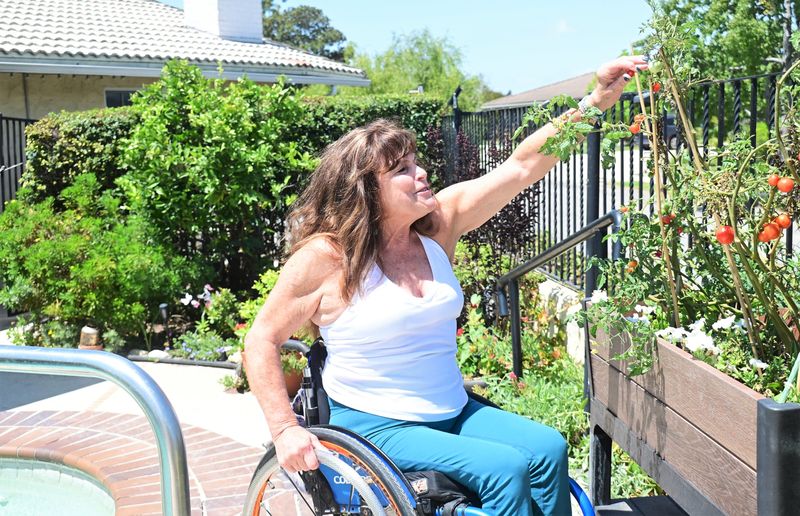
She’s a podcaster, a gardener, a widow and a brand new grandmother. She’s gone through joy and heartbreak.
She’s still paralyzed. But she’s also fiercely independent and has built a life around helping others gain that power.
“Life is not over because you’re in a wheelchair,” she said.
‘I do it myself’
Dallara told her story in her Camarillo home surrounded by a garden she filled with milkweed in a successful enticement to the monarch butterflies she loves. At 66, her upper arms are muscled from decades of propelling herself in her wheelchair.
Before paralysis, she did many things: performed an off-Broadway musical, farmed cannabis in Hawaii and worked for the Bureau of Indian Affairs in Alaska.
“My mom said my first full sentence was ‘I do it myself.’ Which explains a lot,” she said in a disability advocacy video on YouTube.
The moment she woke up that morning in Woodland Halls 30 years ago was so traumatic her brain has blocked the memories. But what sticks in Dallara’s mind is the denial. She was convinced the condition would disappear as quickly as it emerged.
“I thought I would wake up, and it would be all over,” she said, remembering the question she asked during one of the many medical tests and exams. “How long will this MRI take? I have a chicken defrosting on the counter.”
Doctors thought it was multiple sclerosis. A neurologist at Los Robles Regional Medical Center in Thousand Oaks finally put his finger on transverse myelitis.
It’s a rare neurological disorder that can be caused by infection, other disease or problems in the body’s defense mechanism. Dallara said her immune system had been attacking the lining of her spinal cord.
She said the damage happened in her lower back. If it had occurred higher, she could have been paralyzed from the neck down.
“Everybody is lucky,” she said. “I think I”m lucky because I can still use my hands and I can breathe on my own”
Opening a door
Rehabilitation therapy helped, giving her enough mobility to move with a walker. A relapse in 1997 put her back in the chair.
She discovered she could still take care of her kids in her wheelchair. When obstacles emerged like no ramps at a school and insurance coverage denials, she, her family and others advocated for change and usually won.
She worked selling vans with ramps and other equipment for the disabled. She connected through a support group with Janette Knudson, who had been paralyzed in a car accident a few years earlier.
Knudson was raising a young daughter and needed transportation other than public buses. She and Dallara helped piece together money from nonprofits and from a church fundraiser to find an accessible van she could drive.
For Knudson, it meant freedom. For Dallara, it opened the door to the world of advocacy.
“Amazing,” she said of how it made her feel. “It’s seeing a problem that seems insurmountable and then finding a way to chip away at it.”
Disability ambassador
Dallara landed a job with the Abilities Expo, an organization that puts on events across the nation featuring technology, services and equipment for disabled people.
Dallara sold booths at the expos to exhibitors including CalABLE, a plan run by the California State Treasurer’s Office and created by federal law 12 years ago. The plan allows people to invest money in a CalABLE account that is tax-free and carries protections to keep participants from losing Medi-Cal or disability benefits.
Dallara has been named an ambassador for the program, meaning she helps people understand how it works. Her focus is change in the program that means people are now covered if they were paralyzed before age 46 instead of 26.
It means she’s covered by the program, too.
Becoming Ms. Wheelchair
Now retired from the Abilities Expo, her advocacy roles include a Triumph Foundation organization that provides services, including adaptive equipment for bicycling, target shooting and other sports.
She does podcasts for a Live to Roll organization, interviewing people with disabilities. She’s part of a tight-knit community of advocates whose members include Knudson, the woman who needed a van.
The advocacy is needed because barriers are growing and time allotted for rehabilitation is nowhere near what it was 30 years ago. The efforts also help those who provide it, Knudson said.
“When we have a disability, finding purpose in life is really important,” she said.
A couple of years ago, Dallara was trying to find people interested in competing to become Ms. Wheelchair California. Friends asked her why she didn’t apply. She couldn’t think of an answer so she did. She won.
Her one-year tenure was built around trying to find ways to encourage nonprofits to collaborate more even though they are often competing for funding. The Ms. Wheelchair role is also designed to bring attention to the barriers facing disabled and ways of hurdling them.
“It’s educating people that we can still do things despite the barriers we face,” said Angela Piazza, the program’s coordinator, a former Ms. Wheelchair and Dallara’s friend. “She’s a great advocate, and she loves to help people.”
Dallara sees all of her advocacy work as helping people finding ways to adapt.
“There’s always a way,” she said, noting that finding the path brings a sense of control to people who often feel as if they’ve lost freedom.
“You’re actually whittling away at anything that keeps us from our power,” she said.
Tom Kisken covers health care and other news for the Ventura County Star. Reach him at tom.kisken@vcstar.com.
SUPPORT LOCAL JOURNALISM: To see more stories like this, subscribe.
This article originally appeared on Ventura County Star: ‘Always a way’: Camarillo woman who woke up paralyzed advocates for others
Reporting by Tom Kisken, Ventura County Star / Ventura County Star
USA TODAY Network via Reuters Connect
By Tom Kisken, Ventura County Star | USA TODAY Network