

By Jim Bloch

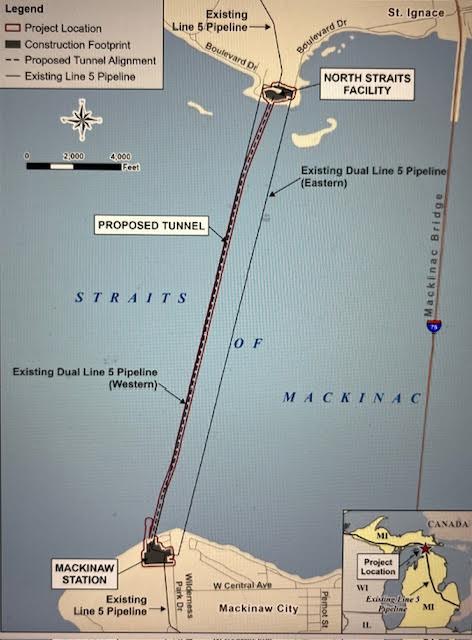
The United States Army Corps of Engineers, Detroit District, released its draft environmental impact statement on Enbridge Energy’s proposed tunnel under the riverbed of the Straits of Mackinac to encase a pipeline that will deliver 540,000 barrels of “light crude oil, light synthetic crude oil, light sweet crude oil, and NGLs between the Applicant’s existing North Straits Facility and Mackinaw Station.”
The new pipeline in the tunnel would “approximately maintain the existing capacity of the Line 5 pipeline while minimizing environmental risks,” the report said.

USACE released the draft statement May 30. The tunnel project is expected to cost a billion dollars.
For 72 years, Enbridge has relied on two 20-inch pipelines that run along the bottom of Straits to transport its petroleum products from the Upper Peninsula to the Lower. The pipelines have experienced several problems, including a strike with a 12,000-pound anchor from a tug and barge in 2018.
The Corps concluded that – beyond some damage to vegetation and cultural practices – the tunnel project would protect the environment significantly better than the two alternatives that were considered – either covering the existing twin lines with gravel or doing nothing.
The 645-mile Line 5 runs across Wisconsin into the Upper Peninsula in a 30-inch pipe that picks up again in the Lower Peninsula all the way to Marysville and under the St. Clair River to Sarnia’s Chemical Valley.
Opponents of the line fear a spill in the straits. The currents in the Straits frequently switch directions, which would magnify the consequences of a spill. In 2016, David Schwab, a hydrologist at the University of Michigan, estimated that a leak in the Straits could pollute more than 600 miles of coastline in Lake Michigan and Lake Huron and affect several islands, including Beaver, Bois Blanc and Mackinac.
While there has not been a spill into the Straits, Line 5 has experienced more than 30 spills, dumping more than a million gallons of oil into the environment.
Critics contend that shutting down the line would be the safest alternative for the lakes.
USACE, however, contends that Line 5 will remain a necessity for the next 25 years.
“The pipeline delivers petroleum products to refineries in Michigan, Ohio, Pennsylvania, Ontario, and Quebec,” the report said. “Market demand for these products in the Eastern North Central region of the U.S., which consumes much of the commodities transported by Line 5, remains steady or slightly increases through 2050, according to the U.S. Energy Information Administration (EIA 2025). Furthermore, these projections were calculated prior to the Executive Office of the President revoking and replacing previously established energy policies as part of its directive to encourage domestic energy exploration and production (DOE 2025). The USACE determined the current needs for transport of the pipeline products are supported by their existing use, and the need for the pipeline products in the foreseeable future is supported.”
At the end of March, the Trump administration said that Line 5 was subject to “special emergency processing procedures” in line with the president’s declaration of a “national energy emergency.”
As a result, USACE said it will expedite the permitting process for the tunnel.
The head of the Michigan Public Service Commission has said that Michigan does not have an energy emergency. The state produces more energy than it uses.
Environmental activists said that if a real energy emergency existed, Trump wouldn’t be canceling wind and other renewable energy efforts. In any case, the tunnel would lock in the climate changing impacts of burning fossil fuels, critics say.
One of the fears of opponents of Line 5 is a methane explosion in the tunnel, and the absence of secondary containment.
USACE appeared to take the word of Enbridge that such an explosion was unlikely. “The Applicant has asserted that methane is not present in the Straits at a concentration to present an explosion risk and that there is virtually no risk of explosion in the Tunnel from operations of the Line 5 Replacement Segment,” the report said.
But such an explosion is not unheard of. A tunnel explosion occurred offshore of what now is St. Clair County’s Fort Gratiot Park in1970, killing 22 workers. The Detroit Metropolitan Water Department was nearing the end of a project to build a 5.5-mile tunnel under Lake Huron to create a new source of water for much of Southeastern Michigan. In 1968, it started work on the 16-foot-wide tunnel, bored 230 feet under the lakebed and lined with concrete.
The project is eerily like Enbridge’s proposed concrete-lined tunnel with an inside diameter of 21 feet, routed through bedrock 60-370 feet beneath the lakebed in the Straits.
The USACE report is not final, but it suggests that the Corps will approve the tunnel project when it makes a decision next fall. Members of the public may comment on the report through June 30 at https://www.line5tunneleis.com/comment-here-new/.
Jim Bloch is a freelance writer based in St. Clair, Michigan. Contact him at bloch.jim@gmail.com.
