

By Jim Bloch

The Michigan Public Service Commission voted 2-0, with one abstention, to approve the proposal by Enbridge, the giant Canada-based petroleum transportation company, to build a tunnel under the Straits of Mackinac to house a roughly four-mile section of the pipeline known as Line 5.
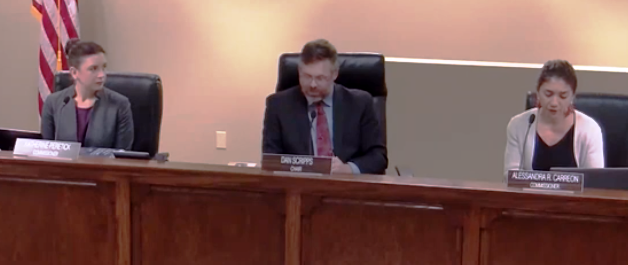
Daniel C. Scripps, chair, and commissioner Katherine L. Peretick voted to approve the siting permit; Alessandra R Carreon abstained, claiming her four months on the commission were too few to master a case that the MPSC had been working on for more than three years, which had more than 1,500 filings and 23,000 public comments.

The approval for the siting of the tunnel came Dec. 1. Enbridge filed for the permit in 2020.
Line 5 carries an average of 542,000 barrels of light crude and natural gas liquids per day on its 645 mile route from Superior, Wisconsin to Marysville, Michigan; a 30 inch pipeline runs through the Upper Peninsula to St. Ignace, where it divides into two 20-inch pipes that snake along the lakebed of the Straits, before combining back into one pipe for its run through the Lower Peninsula to Marysville, where it crosses under the St. Clair River in a pipeline directionally drilled below the riverbed in 2020.
The pipeline is 70 years old, about two decades older than its original estimated lifespan.
The commission made its decision despite Governor Gretchen Whitmer’s order in 2020 revoking and terminating Enbridge’s 1953 easement, arguing it violated the public trust doctrine under which the state must protect the integrity of the Great Lakes. Whitmer said Enbridge violated the conditions of the easement by allowing fewer supports of the pipeline than every 75 feet; allowing the coatings of the pipe to deteriorate; and allowing too much curvature in the pipe.
Enbridge ignored the Governor’s order.
Is it common for a state commission to ignore a governor’s direct order?
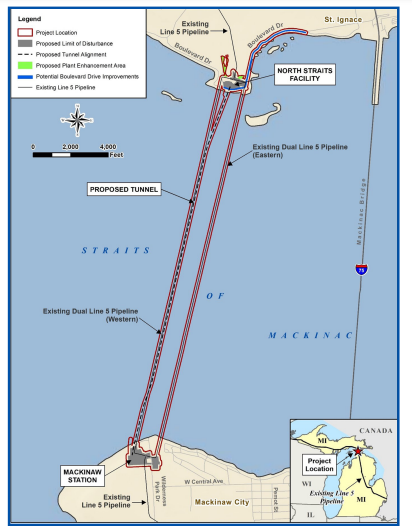
The tunnel would run just west of the existing twin pipes on the bottom of the Straits.
“We will decline comment on (that) question,” said Matt Helm, the public information officer for the commission, via email.
The project and rationale
“Enbridge would replace the dual pipelines with a single, 30-inch pipeline in the concrete-lined tunnel with an inside diameter of 21 feet, routed through bedrock 60-370 feet beneath the lakebed,” the MPSC said in its decision. “The tunnel will have space for the Line 5 replacement segment in addition to ventilation systems, leak detectors, dewatering equipment, and equipment needed for inspections and maintenance, among other things.”
The commission found that the tunnel was the best way to protect “the ecological, natural, and cultural resources of the Great Lakes.” It said that other methods of moving the petroleum, such as truck, train, barge and oil tanker, would increase the risks of spills. The tunnel will be “built using state-of-the-art materials and practices that will meet or exceed industry standards,” the commission said, and the pipe-within-a-tunnel will be a big improvement over the twin pipes that now stretch along the bottom of the Straits, which have been subject to anchor strikes and other problems. The tunnel itself will act as a backup containment vessel if the new pipeline leaks.
The MPSC determined “that the route, location, and design of the project is reasonable and should be approved.”
Enbridge is elated
“The decision by the MPSC is a major step forward in making the Great Lakes Tunnel Project a reality, securing the vital energy people in Michigan and surrounding region rely on every day,” said Mike Fernandez, Enbridge’s senior vice president of public affairs, communications and sustainability, in a statement. “The permit from the MPSC is key to building this engineering marvel and continuing to deliver to Michiganders the energy on which they have come to depend on from Line 5.”
The company said that :more than 50 percent of northern Michigan relies on propane that comes from the natural gas liquids transported by Line 5.”
Tribes, opponents are dismayed
A number of opponents of Line 5 intervened in the case, including Bay Mills Indian Community; the Environmental Law and Policy Center and Michigan Climate Action Network; For Love of Water; Grand Traverse Band of Ottawa and Chippewa Indians; Little Traverse Bad Bands of Odawa Indians; Michigan Attorney General Dana Nessel; Michigan Environmental Council; Michigan Climate Action Network; National Wildlife Federation; Nottawaseppi Huron Band of Potawatomi Indians, and Tip of the Mitt Watershed Council.
One of the biggest fears of the Bay Mills Indian Community is that a methane leak into the tunnel could result in a explosion and a massive oil leak into the Great Lakes, which contain 84 percent of the surface freshwater in the U.S.
Because the current often changes direction in the turbulent Straits, a sizeable spill could jeopardize the waters, coastlines and islands on both sides of the Mackinac Bridge.
“Instead of complying with a Governor’s public safety order to decommission Line 5 in Michigan, individuals working at a state agency granted Enbridge a permit for a project for which they hold no property rights and no safety track record in good standing,” said Bay Mills President Whitney Gravelle in a statement.
According to Earthjustice, Line 5 has spilled 1.1 million gallons of oil over the course of its operation in 33 incidents. Enbridge’s Line 6 saw the largest and most expensive inland oil spill in U.S. history in 2010 near Kalamazoo.
“Today’s decision is another notch in a long history of ignoring the rights of Tribal Nations,” said Gravelle.
“The proposed project still needs other permits to move forward,” said David Glover, in a statement. Glover is the lead attorney for Native American Rights Fund, which represented Bay Mills — along with Earthjustice — before the commission. “We cannot allow one corporation to imperil the ecosystems and lives of all those that live nearby or depend on the Straits for their well-being.”
What’s next
“With today’s Commission order, Enbridge will be able to proceed with the construction of the replacement pipeline so long as the project receives approval by regulatory agencies including the Mackinac Straits Corridor Authority and United States Army Corps of Engineers,” the MPSC said.
Michigan Attorney General Nessel filed a suit against Enbridge in 2019 to take down the entire pipeline. In 2022, the judge moved the case to a federal court. In September, Nessel asked the U.S. Court of Appeals for the Sixth Circuit to send the case back to state court.
In a statement after the MPSC’ decision, Nessel called “Line 5 a ticking time bomb in the heart of the Great Lakes.”
Jim Bloch is a freelance writer based in St. Clair, Michigan. Contact him at bloch.jim@gmail.com.
