

By Jim Bloch

Ever get the urge to wander through the primeval forests of Michigan before the arrival of Europeans, when perhaps 15,000 Indians lived among 500 year old white pines and forests of dominated by towering oak and hickory trees — with none of the hum and howl of freeways, fairways, freighters or factories?
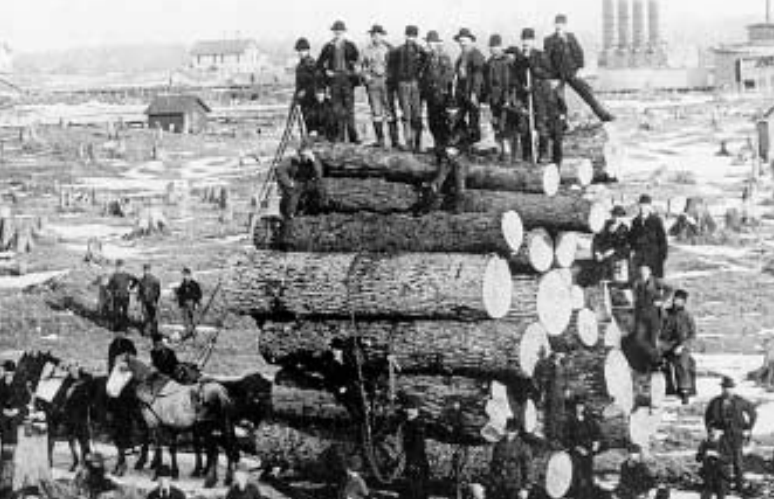
Between 1865 and 1900, timber barons and their largely immigrant crews clearcut Michigan, making the state the largest producer of lumber in the country, accounting for 25 percent of the board feet produced annually.

As a result, stands of old growth trees are rare anywhere in the state.
Until recently, there were 11 official locations in Michigan that had been recognized by the Old Growth Forest Network.
Now there are 12.
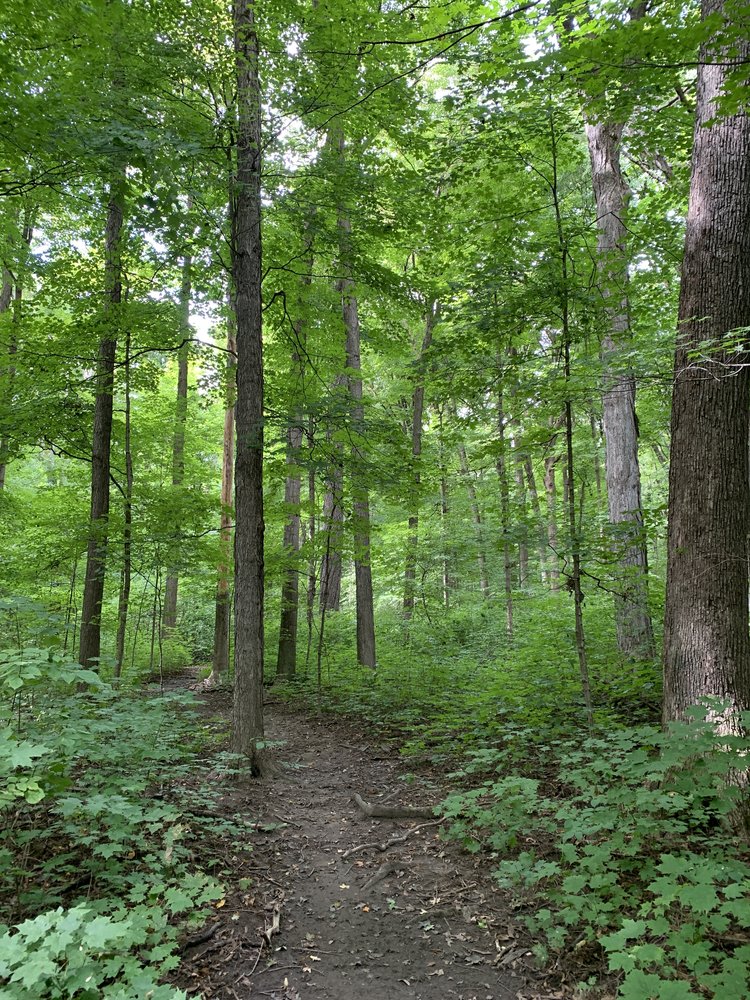
The Baker Woodlot at MSU.
On Oct. 7, the 78-acre Baker Woodlot on the campus of Michigan State University in East Lansing was inducted into the network.
“Our goal is to locate and designate at least one protected forest in every county in the U.S. that can sustain a native forest,” according to the network’s website. “We estimate that to be approximately 2,370 out of 3,140 counties.” There are network forests in 34 states.
The overstory of the Baker Woodlot is dominated by maple and beech, according to the woodlot’s website, with an abundance of other woody and herbaceous species throughout. The largest trees in the forest are northern red oak, tulip poplar and eastern cottonwood. The understory is marked by elderberry and spicebush. Wildflowers dot the scene in spring.
A couple of miles of trails wend through the property, which has been intact and minimally used for 160 years; the university is 168 years old.
“Originally called South Woodlot, then Farm Lane Woodlot, it was eventually named Baker Woodlot in 1941 in honor of two early foresters at Michigan State, James Fred Baker and Harry Lee Baker,” according to the university. “J. F. Baker was appointed Professor of Forestry and Chairman of the Forestry Department on 1 October 1907. Mr. H. L. Baker eventually became the first State Forester of Florida.”
Part of the woods serves as the Rachana Rajendra Neotropical Migrant Bird Sanctuary.
“On 5 June 1999, a portion of the Baker Woodlot was designated as the Rachana Rajendra Neotropical Migrant Bird Sanctuary,” said the university. “Ms. Rajendra, a lover of birds and nature, was an MSU student. When a tragic automobile accident took her life in 1997, her family and friends established an endowment in her memory.”
The property is fenced, accessible by four entrances. It’s open all year from dawn until dusk. There is no hunting.
There are no network forests in St. Clair County. The two nearest old growth forests are the 70-acre Witherell Woods in the Palmer Park section of Detroit in Wayne County and the 220-acre Sand Point Nature Preserve in Huron County.
Jim Bloch is a freelance writer based in St. Clair, Michigan. Contact him at bloch.jim@gmail.com.
