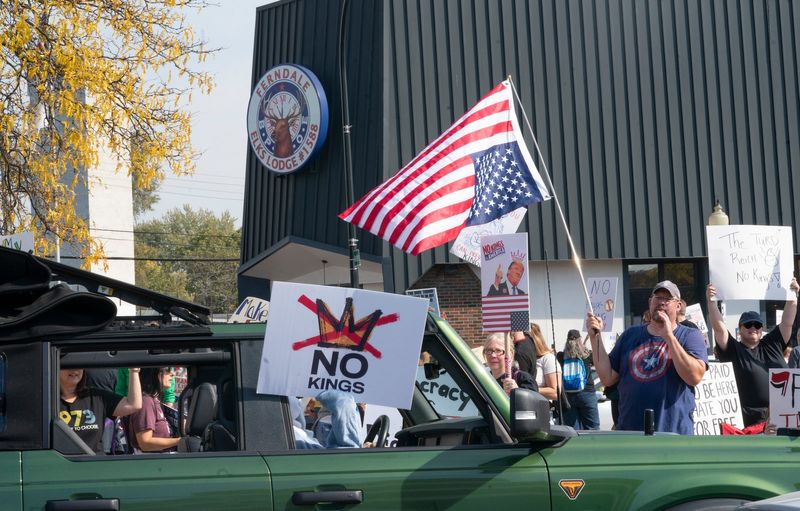
Since 2020, I’ve kept a notecard fastened to my refrigerator with a magnet. The card has a quote from Roger Baldwin, a co-founder of the ACLU, and it reads, “So long as we have enough people in this country willing to fight for their rights, we’ll be called a democracy.” With another nationwide No Kings protest approaching on March 28, I’ve been thinking a lot about the importance of showing up, raising our voices in support of every person’s right to live in this country with the expectation of freedom, justice and democracy.
In June and October 2025, millions of people peacefully took to the streets in thousands of events across the United States to speak out against the unprecedented assault on democratic principles and values by this federal administration. Continuing to exercise our right to demonstrate our disagreement with policies and actions that harm our communities and our country is particularly important, because free speech itself is one of the Trump administration’s primary targets.

We are all seeing the brazen attacks on the free speech rights enshrined in the First Amendment and foundational to a thriving democracy. These have ranged from weaponizing the Federal Communications Commission in an attempt to intimidate critics into submission, revocation of press access for certain journalists and media outlets, threatening to revoke federal funding for universities, using federal agencies to target individuals and organizations holding views critical of the government and terrorizing protestors through federal law enforcement. This administration knows just how vital the role of constitutionally protected speech is in countering the kind of authoritarian tactics that we’re seeing unfold in the United States.
Last April, a survey of more than 500 U.S.-based political scientists found that the vast majority think that, with the Trump administration in command, this country is moving swiftly from being a liberal democracy toward some sort of authoritarianism. The situation has only become more clear over the past year.
What authoritarianism looks like in practice
What do I mean by the term “authoritarianism”? The answer can be found in a 2022 report titled the “The Authoritarian Playbook,” published by the nonpartisan organization Project Democracy. That document examines seven common tactics employed by would-be dictators. Trump, to one degree or another, has adopted them all: Politicizing independent institutions, spreading disinformation, aggrandizing executive power, quashing dissent, corrupting elections, stoking violence and scapegoating vulnerable communities.
Multiple executive orders targeting trans people, a group already marginalized and struggling against bigotry, is a prime example of that last item. It is also a reason why protecting LGBTQ+ rights must be a priority, alongside protecting the rights of immigrants routinely vilified by this administration. People who are our friends, neighbors and family members are being caught up a massive nationwide crackdown widely opposed by a significant majority of Americans.
Just last week, the ACLU was at the U.S. Court of Appeals for the Sixth Circuit to argue on behalf of immigrants in ICE detention unlawfully being denied their fundamental right to due process. A new Trump administration edict, issued last year, reversed 30 years of policy and practice that held steady through five previous administrations. As with our client’s case, hundreds of federal district court judges around the country have ruled against the government in thousands of cases where immigrants in ICE detention have been illegally denied the right to seek release on bond while their cases are sorted out.
The onslaught of attacks on such a wide variety of fronts serves the Trump administration’s plan to overwhelm and exhaust those who support and advocate for a free, just and democratic society.
An assault that includes the rule of law itself.
How the rule of law is being challenged
From tariffs the Supreme Court ruled were unconstitutional – draining at least $160 billion from American businesses and consumers – to a weaponized Justice Department targeting political enemies with prosecutions devoid of merit, the Trump administration has shown time and again its disregard for the law.
That disrespect extends to judges as well. The nonpartisan group Just Security, based at New York University School of Law, has identified 34 cases where courts have expressed concerns over noncompliance with judicial orders and 90 cases where judges didn’t trust information the government was providing.
Moreover, judges who issue decisions that don’t align with Trump administration positions are maligned with dangerous personal attacks. Last week, shortly after Trump described one federal judge as “wacky, nasty, crooked and totally out of control,” U.S. Supreme Court Chief Justice John Roberts, a nominee of President George W. Bush – without directly naming the president – said that what is happening is “dangerous and it’s got to stop.”
That notecard I mentioned lives on my fridge among photos of my kids, novelty magnets from places our family has traveled, an expired Ramadan calendar and multiple dry-erase calendars and to-do lists. And while I’ve looked at that notecard almost every day for six years, a quibble that I have with the quote has crystallized over this last year.
We cannot view our fight as for our rights alone. We have to be committed to fighting for each other’s rights – the rights of our neighbors, the rights of the people behind us at the supermarket, the rights of people who live across the country from us and whom we’ve never met, the people who are afraid to drop their kids off at school because of the threat of ICE, trans people who are fighting for their existence right now, Black and brown communities that have fought to survive and thrive despite systems designed to reinforce centuries of racism.
What protesters should know about their rights
This fight is for our collective rights. It is for our principles of democracy. It is for what we can build together when we see our existence and our rights as interconnected. No single rally will be enough, but it is an important moment to demonstrate mass solidarity in a show of unwavering resistance to authoritarianism.
Before you participate in any demonstrations, it is important that every protestor know their rights. You can find resources in multiple languages at aclumich.org. I know that a lot of people are questioning whether authorities will recognize the First Amendment right to protest and there is no guarantee. However, knowing your rights aids you in making the best decisions for yourself and helps ensure that lawyers and organizations can fight on your behalf to protect your rights. We cannot afford to concede our most fundamental right to speak out against government actions with which we disagree.
Sadly, as we’ve all seen, there is no guarantee that legal protests won’t be met with authorities unwilling to recognize our right to speak out. No one ever promised that protecting democracy would be easy. But protect it we must.
Loren Khogali is the executive director of the ACLU of Michigan. Submit a letter to the editor at freep.com/letters and we may publish it online or in print.
This article originally appeared on Detroit Free Press: Why showing up for ‘No Kings’ protests matters | Opinion
Reporting by Loren Khogali, Op-ed contributor / Detroit Free Press
USA TODAY Network via Reuters Connect