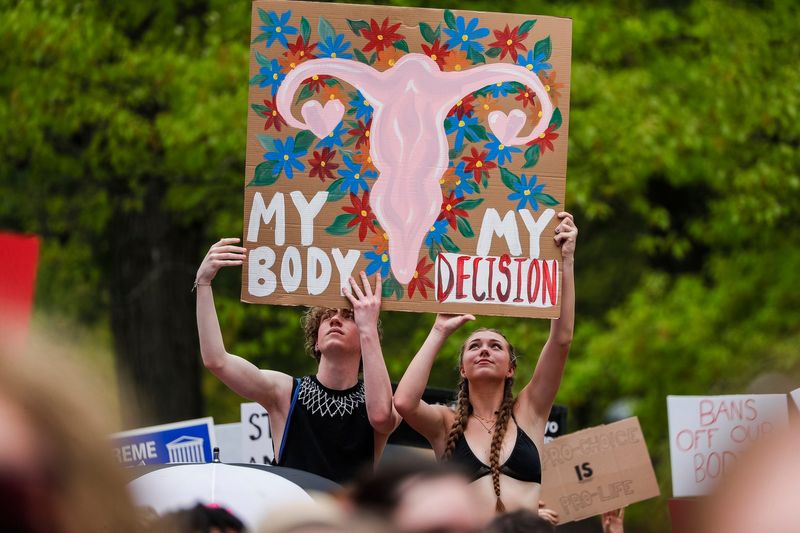
Last week, a Michigan court made something clear that should have never been up for debate: Pregnancy does not erase your right to make your own medical decisions.
Until now, Michigan had what’s known as a “pregnancy exclusion,” a law that meant if you were pregnant and became incapacitated, your medical decisions could be ignored, even at the end of life.

In a sweeping ruling, the Michigan Court of Claims struck down that law. The court found the pregnancy exclusion unconstitutional in all situations, concluding that it interfered with a person’s right to make their own medical decisions, failed to protect patient health and went against accepted medical standards.
At its core, the ruling affirms a simple but essential truth: Autonomy matters. Pregnancy does not erase that we are full human beings with the right to make decisions about our body and medical care. Our pregnancies should never make our medical decisions negotiable, reduce our voices, override our values or give the state permission to decide what happens to your body.
This ruling means that being pregnant does not make your medical decisions negotiable. Pregnancy does not reduce your voice, override your values, or give the state permission to step in and decide what happens to your body. The same rights that allow every person to accept or refuse medical care still apply, fully and without exception.
Because personhood is not conditional. It does not shrink, disappear, or become secondary during pregnancy. You are still the patient. You are still the decision-maker. And your right to say yes or no still holds.
Our bodily autonomy matters
I know this not just as a clinician, but as one of the plaintiffs in this case.
As an OB/GYN physician assistant, I help patients make deeply personal, informed decisions about their bodies and their care. Like many people, I created an advance directive so that if something ever happened to me, my loved ones would not have to guess what I would want.
What I came to understand is that under Michigan’s pregnancy exclusion, there was no guarantee those decisions would be honored.
If a person were pregnant and became incapacitated, Michigan’s pregnancy exclusion law meant their advance directive could be set aside. The person they chose to speak for them could be blocked from carrying out their wishes. Clinicians could be required to continue treatment that the patient had clearly declined.
Not based on individual medical judgment. Not based on the patient’s values or wishes. But based on pregnancy alone.
The pregnancy exclusion law created a separate standard of care, overriding informed consent, the foundation of ethical medicine, and replacing it with a blanket rule that allowed the state to step in at the most vulnerable moment of a person’s life.
The court rejected that.
In its decision, the court recognized that Michigan’s constitutional right to reproductive freedom protects the right to make and carry out medical decisions during pregnancy. That includes decisions about life-sustaining treatment and who gets to speak for you ― and the fundamental right to say no.
Affirming the voices of Michigan voters
That clarity matters, because this issue has never just been about one law.
It is about who dictates medical care: the state, or the individual.
Too often, conversations about reproductive rights are reduced to a single issue. But the underlying question is much broader: Are pregnant people treated as full decision-makers, or as exceptions to the rule?
This ruling answers that question here in Michigan.
It affirms that pregnant people are not vessels. They are patients. They are individuals. And their decisions do not become optional the moment they become pregnant.
This decision is a powerful affirmation of what Michigan voters already made clear in 2022: that decisions about pregnancy belong to the individual, not the government. But it is also a reminder of how easily that principle can be undermined when laws go unchallenged.
We should not have needed a lawsuit to establish that pregnant people deserve the same rights as everyone else. That they can make informed decisions. That their consent matters. That their dignity does not disappear the moment they become pregnant.
And yet, until this week, that was the reality.
This ruling changes that.Nikki Sapiro Vinckier, PA-C, is an OB/GYN Physician Assistant, author of the upcoming book We Deserve More, a reproductive health content creator, and a plaintiff in Koskenoja v. Whitmer. She is the founder of Take Back Trust, a digital platform helping people navigate reproductive healthcare in this changing landscape. You can find her on social media @nikkivinck. Write a letter to the editor at freep.com/letters and we may publish it in print or online.
This article originally appeared on Detroit Free Press: Why I sued Michigan over ‘pregnancy exclusion’ law ― and won | Opinion
Reporting by Nikki Sapiro Vinckier, Op-ed contributor / Detroit Free Press
USA TODAY Network via Reuters Connect