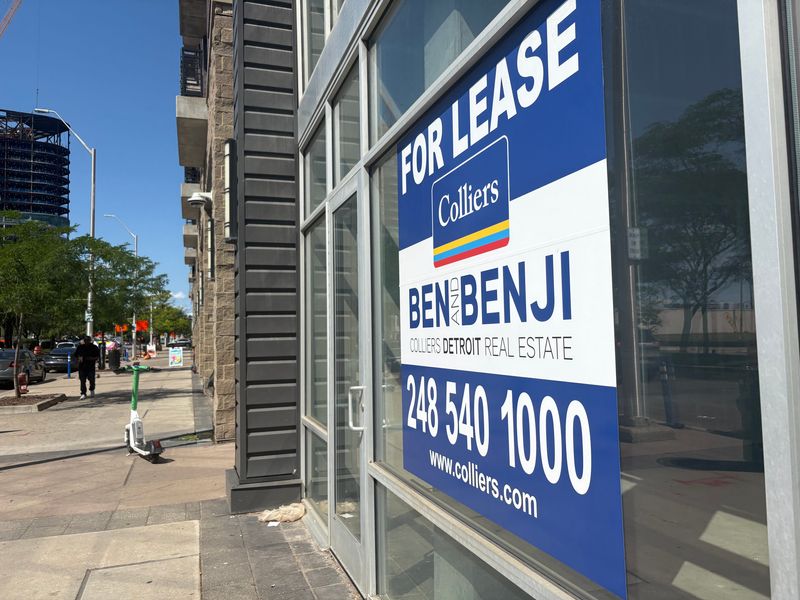
Despite the city’s comeback, downtown Detroit’s commercial property values tumbled in 2026 after rising almost every year for the last decade, hit by a collision of now-familiar circumstances turbocharged by the COVID-19 pandemic, including high interest rates and falling demand for downtown office space, experts said.
The state equalized commercial property values in Detroit’s “Central Core” area — the Financial and Central Business District, Midtown and New Center — decreased 10% in 2026, according to Wayne County’s annual property assessment report released at the end of April. Citywide, Detroit’s state equalized commercial values dropped from $6.6 billion in 2025 to $6.2 billion, according to Wayne County’s property value equalization reports.

Scott Vandemergel, the equalization and division director for the Wayne County Assessment & Equalization Division, attributed the decrease to post-COVID interest rate levels and debt capital costs, lower demand for office space and increasing supplies of new hotel rooms and apartment units.
“It all comes down to supply and demand…, and I think those stars have aligned in a way that is causing property values to go down,” said Alex Calderone, the president of Bloomfield Hills-based Calderone Advisory Group, a financial advisory and litigation support consulting firm.
Detroit’s yearslong challenges to grow its population and attract businesses back have made it difficult to reverse the city’s oversupply of property, he said, even though the city’s estimated population grew for a third straight year.
“Detroit’s an oversupplied city, and there has to be some catalyst for that dynamic to change,” Calderone said.
Contributing to the seemingly anemic demand for residents moving downtown is the reality that average Detroiters’ incomes aren’t high enough to afford high rents in the city center, said Jeff Horner, an urban studies and planning professor at Wayne State University.
“This makes building anything very difficult, even with a huge amount of subsidies,” Horner said. “And of course, if you can’t build housing to bring people into your city, that’s going to hurt your population.”
Detroit’s commercial property values have been on an upward trajectory for a decade, driven by new growth and development. Since 2015, the state equalized value of the city’s commercial property has increased more than 185%, from $2.3 billion to $6.6 billion in 2025.
But the decrease in values downtown contributed to a 6% decline in Detroit’s overall state equalized commercial property values this year. It follows about a decade of increases after 2014, when the values had almost six straight years of decline starting in 2009 amid Detroit’s dire financial straits.
Calderone said it makes sense that it’s taken a few years after interest rates and construction costs spiked in the early 2020s for those factors to trickle down to affect the demand for commercial property and decrease property values, offering a potential explanation for why Detroit’s downtown values are just now seeing a tumble.
There can still be demand for property early on in a cycle of high interest rates because buyers may still have hope about the possibility to refinance eventually, he said. But interest rates have proven sticky, and Calderone said the costs of owning commercial property, such as utilities, maintenance and renovations, have also risen.
“I think if you combine that with the demand destruction (falling demand for office space) coming out of COVID and stemming from the hybrid work environment that’s largely here to stay, you do have to some degree a perfect storm that can impact these values,” he said.
One business owner’s perspective
Andy Linn has seen the evolution of Detroit’s commercial sector firsthand.
Linn co-owns the home goods and gift stores Nest and City Bird next door to each other on Canfield Street in Detroit’s Midtown neighborhood. City Bird opened in 2009 and Nest opened in 2011.
The nature of the area’s foot traffic has changed noticeably, Linn said. The stores’ customers have shifted from downtown workers to a significant increase in tourists.
“What it all equals out to is that our sales are actually up, but I’m noticing that it is different traffic making up for a loss in the traditional urban traffic we would have seen before,” Linn said.
He said as he’s compared notes with other small business owners in the city, the experiences of restaurants and bars seem to mirror what retail stores have been seeing: Lunchtime traffic is much lower than it used to be, while the time around dinner has gotten more popular.
Lower demand for office space
Wayne State’s Horner added that in addition to high interest rates and lower demand for office space and moving downtown, the biggest financial benefits of tax incentives, which were approved to resuscitate downtown commercial development, such as transformational brownfields, have mostly been maxed out.
Transformational brownfield plans first took effect in 2017 and were intended for mixed-use projects expected to have a “transformational” benefit for local economic development and community revitalization. The plans allow the recipient businesses behind the sites to capture tax revenue generated for up to 30 years. Until Gov. Gretchen Whitmer signed legislation in July raising the ceiling on the tax revenue capture, previously awarded plans had drawn down the state’s fund to support major projects.
“I think that there’s been sort of this … maxed-out position of possible tax breaks that can help restore the growth in commercial development in downtown Detroit, and I think that’s been played out,” Horner said.
The legislation signed by Whitmer raised the ceiling on the tax revenue capture to $3.2 billion from $1.6 billion. The tax capture is expected to be used to support the redevelopment of Detroit’s Renaissance Center.
Does Detroit need more hotel rooms?
The drop in downtown values this year hasn’t muted an appetite for new hotel construction downtown, according to the leader of Detroit’s visitor and convention bureau.
On the contrary, Visit Detroit CEO Claude Molinari said the city’s core needs more hotel rooms to compete with other cities in attracting major events. He said a planned hotel project adjacent to Huntington Place where the streets known as Fort, Washington, Congress and Cass meet — which would mean demolishing the Fort Washington Plaza office building — solves two problems at once by adding more rooms and reducing unused office space downtown.
He said not having enough hotel rooms is an “Achilles heel” when trying to attract major events.
Still, “we’re seeing a huge increase in interest in building hotels in southeast Michigan, but Detroit in specific,” Molinari said.
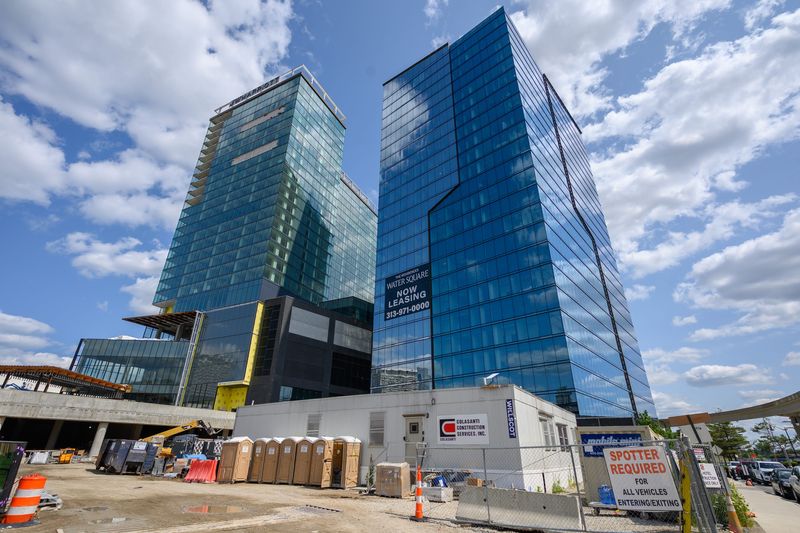
The hotel at Fort, Cass, Washington and Congress next to the Huntington Place is planned to have 600 rooms. The announcement of the project last spring follows another planned 600-room hotel that will connect to the convention center, the JW Marriott Detroit Water Square. It’s under construction at the former Joe Louis Arena site and is expected to open before Detroit hosts the NCAA Final Four men’s basketball tournament next April.
The Detroit EDITION hotel at the Hudson’s Detroit development, planned for 227 luxury rooms, and the 180-room NoMad Detroit planned in Michigan Central Station are other projects that will add more hotel rooms to the city’s core.
But the city will also lose several hundred hotel rooms when the Marriott at the Renaissance Center closes after the Final Four in 2027. The hotel has about 1,300 rooms now and is expected to have about 850 after the RenCen’s renovation.
Molinari said recent past events Detroit has hosted, such as the 2024 National Football League Draft and a major autonomous vehicles and drones show at the convention center, show there’s an appetite for holding major events in the city. But he said Detroit has lost out on hosting some events because it doesn’t meet the minimum requirement for available hotel rooms.
“Detroit is a real inflection point here, where things have the perception of the city is turning around,” Molinari said. “This is the best time, in my opinion, for developers to invest in the city, especially knowing that there’s a demand specifically for hotels. In general, there’s demand for everything but office space in this destination.”
jcardi@detroitnews.com
This article originally appeared on The Detroit News: Why are commercial values dropping in Detroit? Experts cite the reasons
Reporting by Julia Cardi, The Detroit News / The Detroit News
USA TODAY Network via Reuters Connect
By Julia Cardi, The Detroit News | USA TODAY Network