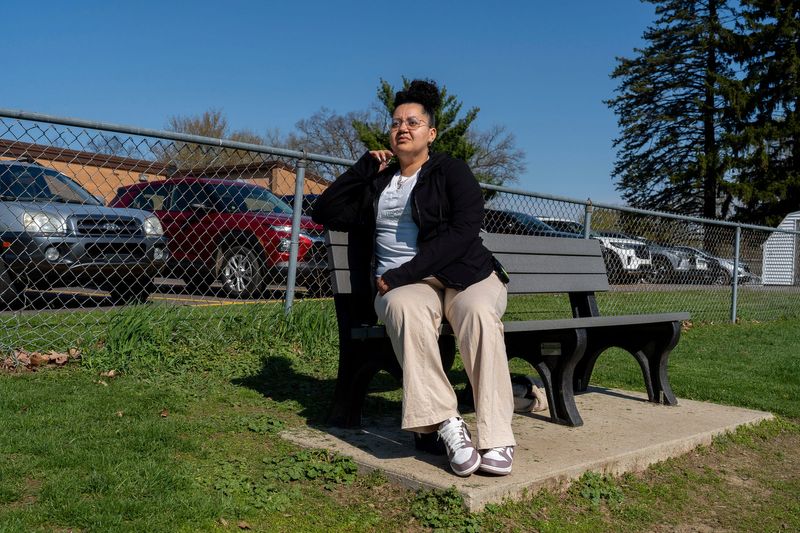
One early fall morning in 2024, Andreya Chapman was lying on the ground in excruciating pain.
She doesn’t really remember it — the pain was so bad, she says, she blacked out much of that day — but her co-worker Julissa Milukhin does.

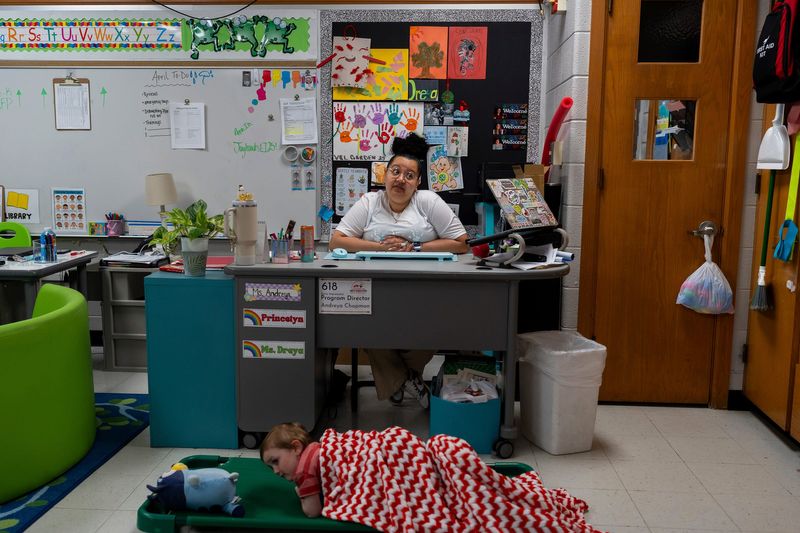
Milukhin says she found Chapman in the fetal position on a classroom carpet at Early Impressions Preschool and Childcare in Jackson, where they both work.
Chapman had muscled through that morning — she needed to open the center by 6 a.m.
But even as she made her way in, Chapman, 34, worried about making it through the rest of the day because of the sore, throbbing pressure she felt in her tailbone.
The problem had started years before, when Chapman noticed blood in her stool. But because she was uninsured, her doctor visits were spotty. She never really got an answer to what was causing her symptoms. It would eventually lead Chapman — with Milukhin’s convincing — to the emergency room that morning.
Chapman’s experience mirrors that of many who work in childcare. Inconsistent access to health care. Bouncing from Medicaid to getting kicked off after a small raise renders them ineligible. And unable to afford insurance elsewhere or get it through their employer.
“If you want good quality programs, you need good, quality people,” said Milukhin, who has worked in the industry for two decades and is currently uninsured because she can’t afford her employer’s plan. “Quality people need to be taken care of with basic necessities.
“We are the first line of defense for these little kids. But who is taking care of us?”
State officials say they have recognized the problem and that it contributes to pervasive staffing shortages in early education. They’ve tried solutions, including this year launching a lower-cost benefits marketplace for workers to buy into. But some providers say the attempted fix isn’t enough, with insurance benefits still far too expensive for most of their staff to afford.
Chapman’s health scare was severe. Her ER visit led to an emergency colonoscopy and a stage 3 colorectal cancer diagnosis.
Treatment was successful, but she’s now left with thousands of dollars in medical debt and has still gone off and on insurance as she transitioned back to work, leading her to skip follow-up doctor appointments.
Michigan childcare workers lack consistent access to health care
Chapman’s employer does offer health insurance for workers at Early Impressions. It’s just that Chapman said she never took advantage of it before she knew something was seriously wrong because it was too expensive.
After being kicked off of Medicaid when her hourly pay was bumped up from $15 to $19 an hour for a promotion to co-director, paying about $100 a month for her share of the coverage meant she’d effectively still be making $15 an hour. As a single mother of a young son, she needed that money for more urgent, daily expenses.
Nearly 40% of Michigan’s childcare workers make so little income that they are covered by Medicaid, according to a 2023 data analysis published by Georgetown University’s Center for Children and Families. The state median hourly wage for a childcare worker in Michigan is $13.88.
But sometimes, as both Chapman and Milukhin have experienced, as early educators progress through their career and get even a small pay bump or new income from a second or third job (Chapman works part-time at an axe-throwing bar), they no longer qualify.
Once off Medicaid, these workers can’t just buy into employer-sponsored health insurance. Unlike many other private industries, experts say most childcare businesses can’t afford to offer an employer-sponsored benefit.
In Michigan, only 35% of childcare workers receive health insurance through their employer – that’s compared with the over 70% of private-industry workers in the United States who receive benefits through their employers.
Without access to Medicaid, employer-sponsored health insurance, or enough income to afford paying monthly commercial health insurance – which can cost an average of around $580 for an individual to $1,700 for a family per month in Michigan – childcare workers like Chapman are left uninsured.
A recent Small Business Association of Michigan survey of around 5,000 childcare workers found around 40% to 50% of respondents were either on Medicaid or uninsured and only around 22% of respondents had health insurance through their employers, which gives a sense of how many are on their own if they don’t qualify for Medicaid.
‘A low-income business’ can’t afford to offer benefits
In Michigan as across the United States, the vast majority of childcares are small businesses, like ChaVonne MacGowan’s site, Seeds of Knowledge Creative Learning Center in Detroit.
MacGowan serves around 20 kids and has five employees. She’d like to offer her staff health insurance but says she can’t because, unlike most other businesses, she can’t raise prices to bring in more revenue to pay for employee benefits — her families can’t afford higher tuition.
“We’re a low-income business because we can’t raise tuition prices,” she said.
And the lack of good benefits pushes people away from the industry who might be experienced and qualified, especially mothers, who need coverage not just for themselves but for their families, said MacGowan. As a result, she says she often needs to find younger workers who might be under their parents’ health insurance.
Michigan has a shortage of roughly 9,000 early educators, according to the most recently available state data.
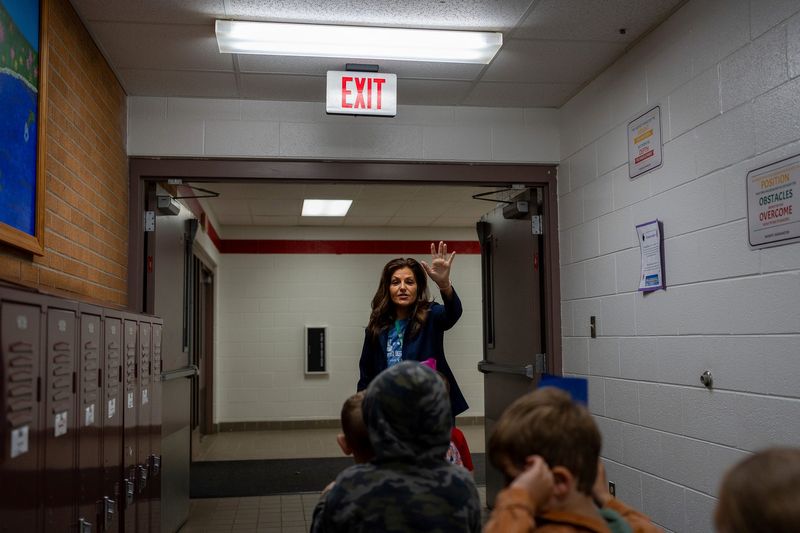
At Early Impressions, owner Angela Mentink was uninsured for a long stretch of her own career in early education. She worked part-time to make enough for expenses like out-of-pocket medical costs when small things, like strep throat or a needed prescription, came up.
Eventually, she expanded her childcare business to a size at which she’s required by the federal Affordable Care Act to offer employees health insurance, but only about 20 of her 125 employees opt in, Mentink says.
The majority of those who are able to opt in are the teachers in the state-funded pre-K classroom, where state funding allows for higher salaries.
“A lot still can’t afford to buy into the program and we can’t afford to pay any higher,” she said.
To afford offering health insurance, among other benefits, Mentink said they had to increase tuition rates but also got lucky because around that time they were receiving federal and state COVID-19 stabilization grants, which helped too. At this point, she said, the business needs to ensure tuition rates are high enough to offer employees health, dental, vision and 401(k).
State attempts to fix problem fall short
The state of Michigan launched a pilot program called Nurture Benefits earlier this year to address the issue of the lack of benefits, including health insurance, offered across the industry.
The state’s early education agency, MiLEAP, worked with the Small Business Association of Michigan to negotiate with insurance carriers and create a marketplace of benefits, including health insurance, dental, vision, 401(k), and life and disability, that childcare owners can offer their employees.
Insurance premiums are slashed in half by program funding, so that the base rate on a plan that would be around $580 monthly ends up running a childcare worker about $290. Unless employers choose to further subsidize insurance premiums for their staff, offering the benefit is free to the businesses aside from the paperwork to get employees set up.
But even with the reduced rates, results so far have been mixed, some providers say.
The program, launched in January, will have roughly 100 employers enrolled by the end of April. As a result, around 200 childcare workers are covered through the program, but only 130 of those have bought into health insurance benefits, said Michelle Beebe, chief revenue officer of SBAM.
Beebe said 177 opted for dental and 174 for vision. This was surprising to her given the high need for health coverage across the industry, but understandable given dental and vision are much cheaper benefits at under $200 monthly for both.
Beebe said SBAM gets hundreds of inquiries a month from those working in the industry. The goal is to have 500 childcare employees on health insurance by the three-year program’s end.
After learning about Nurture Benefits, Beebe said many childcare providers looking to offer affordable benefits for their staff bow out because they know staff aren’t going to pay.
Mentink and MacGowan both said they looked into Nurture Benefits, excited by the possibility of offering lower cost insurance to their employees. For Mentink, the prices weren’t any better than her current plan’s. For MacGowan, once she saw the cost breakdown, she knew her staff wouldn’t be able to afford it.
And like many early education initiatives in Michigan, Nurture Benefits is currently temporary, which makes some providers apprehensive to offer a benefit to employees that can be taken away.
The $4.4 million investment for Nurture Benefits came from a federal preschool development grant. Currently, the program is slated to end in September 2027 as MiLEAP awaits confirmation that the program’s third year of federal funding will come through, said Emily Laidlaw, deputy director for early education at MiLEAP.
MiLEAP has been clear about the funding source with providers and the time frame during which they can rely on benefits, she said.
The department is currently collecting feedback from ongoing program evaluations to communicate the program’s impact on the childcare industry to state policymakers potentially interested in making Nurture Benefits permanent beyond the pilot.
“We’re focused on bringing people into the pilot to stabilize turnover and staffing gaps we see in early education that results in fewer spots for kids to attend while families work and go to school,” said Laidlaw.
In childcare, passion comes with precarity
Chapman said she pities those who don’t get to work with little kids every day.
The job means the world to her. Chapman says it’s about being able to watch and impact a child’s growth at the most pivotal point in their developmental lives. She recalls a recent moment when a girl in one of her pre-K classrooms with a speech impediment said Chapman’s name correctly for the first time.
“ ‘Don’t cry in front of that girl.’ ” Chapman recalls thinking. “It’s watching them from where they start to where they go. They’re my babies.”
During her year of cancer treatment – which included multiple rounds of radiation, chemo pills and chemo infusions along with a surgery to remove her tumor that left her permanently reliant on an ostomy bag – Chapman was too weak to work. She says she got through the year off of work financially only with the support of her community, who sold T-shirts and organized other fundraisers on her behalf in addition to donating paid time off to her.
Eventually, after her doctors declared her cancer-free in July 2025 – the same month her mom’s death devastated her and her younger sister – Chapman had to go back to work. Not only for the solace her job offered, but because she could no longer afford not to.
Starting work part-time a few months back had gotten her kicked off Medicaid and she couldn’t get insurance with her employer until working full-time for three months.
For a few months after her cancer treatment ended, Chapman was uninsured again, skipping doctor appointments.
“At my first appointment back, my doctor was like, ‘where have you been?’ ” Chapman said.
‘Playing catch up’
Chapman recently had her first appointment with a primary care doctor in about nine years.
She’s excited about the prospect of a consistent doctor with whom she can tackle the different issues she has been waiting to address, like hot flashes. Chemotherapy put her into early menopause and she gets hot flashes 10 to 15 times a day, so they’re upping her meds.
She also still has regular appointments with her cancer doctors to run blood tests and clean the chemo port still implanted in the upper right part of her chest. All these appointments pile onto the thousands in medical debt she has to pay off but is currently trying her “hardest to ignore.”
“I’m playing catch-up. I’m still trying to figure it out,” Chapman says.
But she doesn’t entertain the idea of leaving the field for another with better pay or benefits – this job is where she’s able to forget about her troubles.
“Then I leave here and these things slap me in the face,” Chapman said.
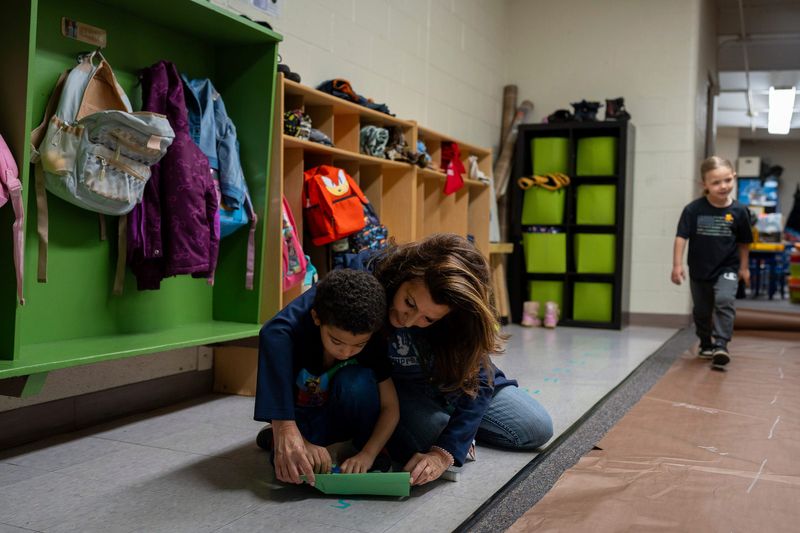
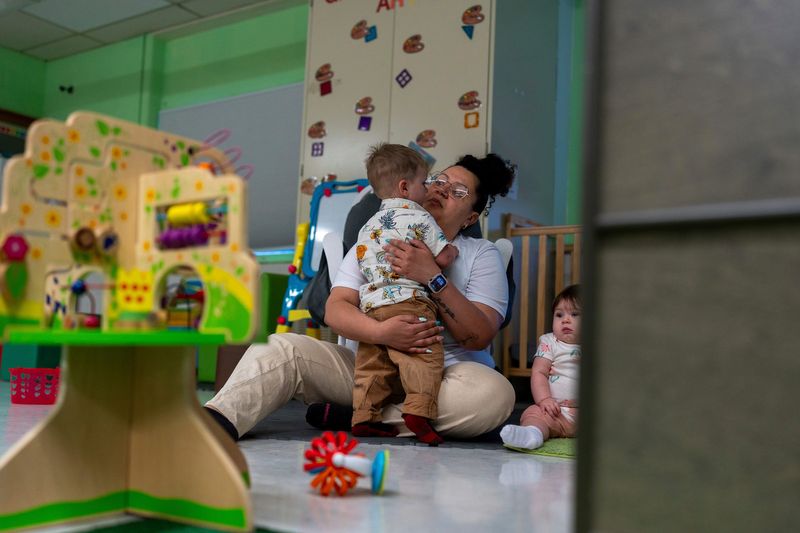
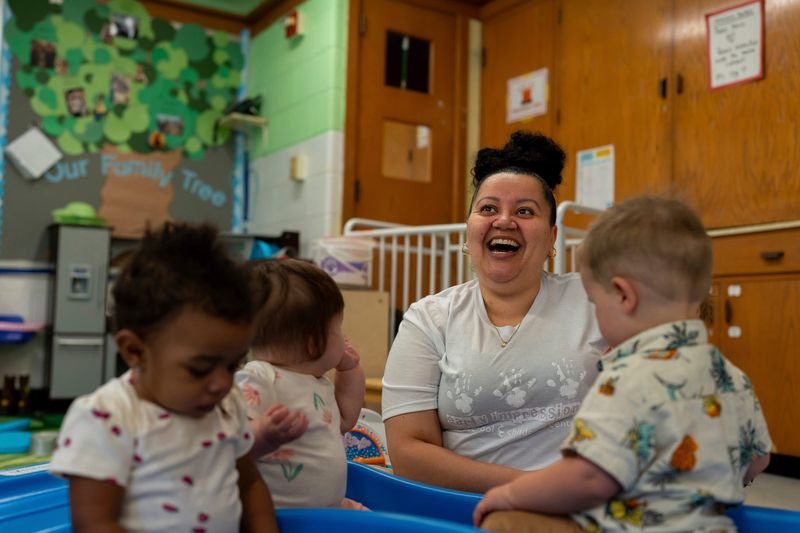
In the infant and toddler classroom, Chapman sits on the carpet with her mind in three places at once: teaching two toddlers how to share a rocking chair, while making sure another doesn’t get a finger pinched, while whipping her hand around to steady the fuzzy head of a baby who started to roll backward.
After what she has been through, a job where she gets to raise the future still feels like enough to Chapman.
Beki San Martin is a fellow at the Detroit Free Press who covers childcare, early childhood education and other issues that affect the lives of children ages 5 and under and their families in metro Detroit and across Michigan. Contact her at rsanmartin@freepress.com.
This fellowship is supported by the Bainum Family Foundation. The Free Press retains editorial control of this work.
This article originally appeared on Detroit Free Press: ‘Who is taking care of us?’: Childcare workers can’t afford insurance
Reporting by Beki San Martin, Detroit Free Press / Detroit Free Press
USA TODAY Network via Reuters Connect