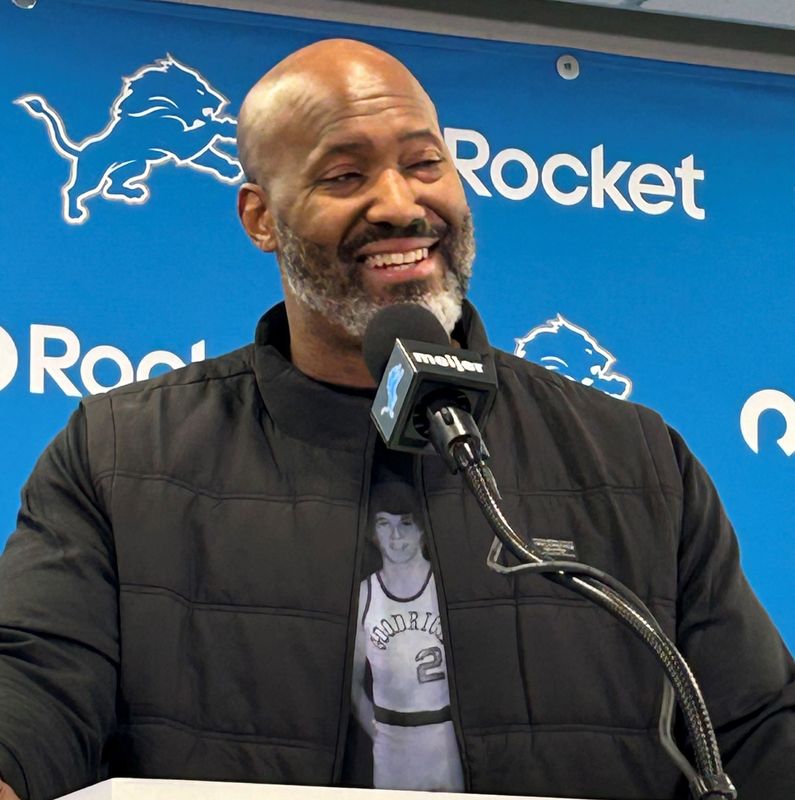
Nearly every day since the end of last season Brad Holmes has had to look at a reminder of what went wrong – a handwritten note on his office wall that the Detroit Lions missed the playoffs in 2025.
“When you miss the playoffs … that might be the kick in the rear that you need at times,” Holmes said. “So that right there, I had it written up on my office wall and all that kind of stuff. Yeah, it was just, not saying I don’t have fire in other drafts or I didn’t, but it was just a little bit more.”

Holmes worked his sixth draft as Lions general manager this week and, in many ways, it was reminiscent of his first.
He attacked the trenches, taking only linemen on the first two days of the draft. He prioritized “very gritty football players” who at a minimum should add competition to what’s still one of the NFL’s best rosters. He stuck to the same nuts-and-bolts blueprint he used to build the Lions from a laughingstock into one of the most dangerous teams in football.
“I’m not saying that we forgot about our identity, but just making sure that, that was at the top of mind,” Holmes said. “And so that’s why every single player that we took, there’s sometimes where we’re writing notes and I write down, ‘This guy’s a football player.’ I go back and I’m reading my notes through all the guys that we’ve picked and I’m just highlighting that I said that about every single one of these guys.”
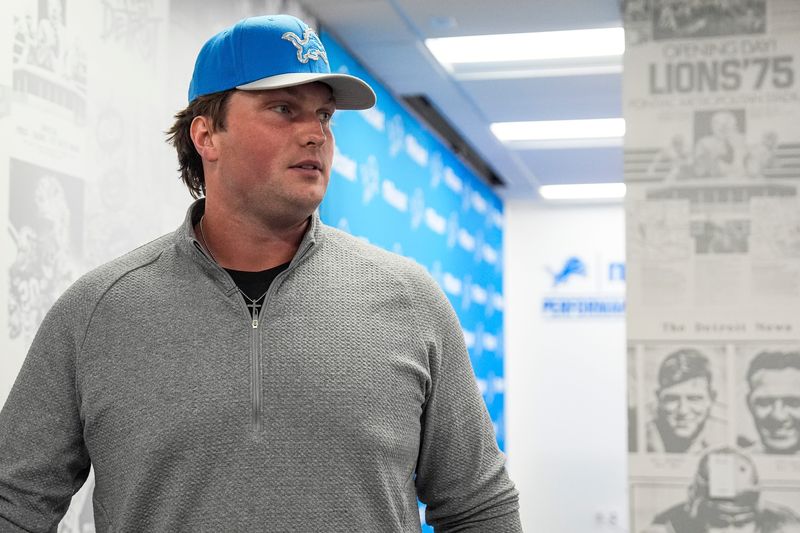
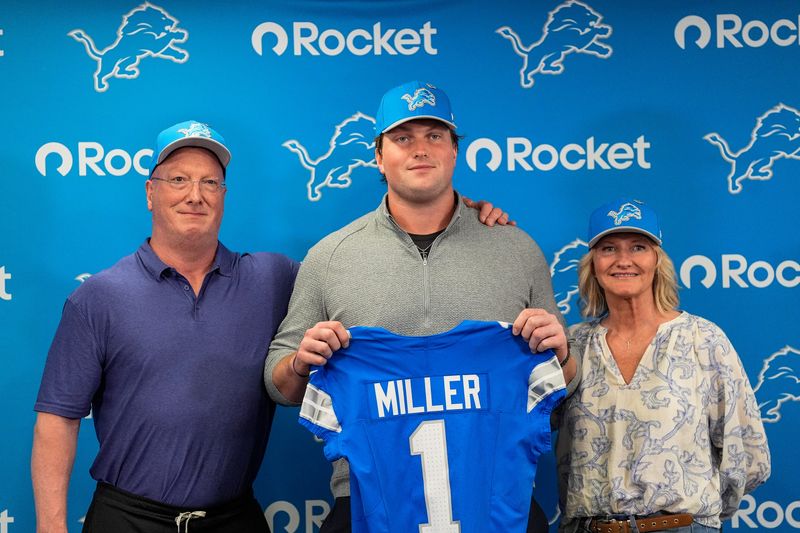
The Lions opened the draft by taking Clemson offensive lineman Blake Miller, their presumptive starting right tackle this fall, at No. 17 overall.
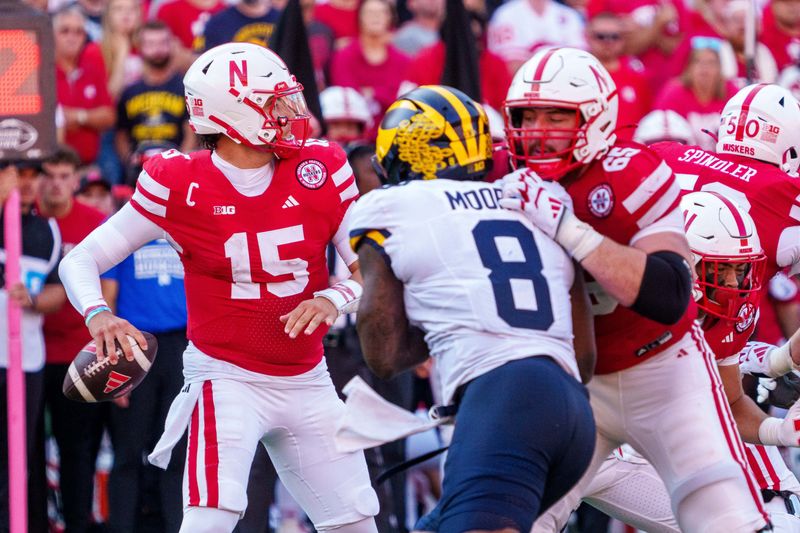
They followed by trading up in Round 2 for Michigan’s Derrick Moore, a physical pass rusher who should play at least a rotational role at defensive end.
And they closed the draft on Day 3 by addressing linebacker (Jimmy Rolder), cornerback (Keith Abney II), wide receiver (Kendrick Law) and the defensive line again (Skyler Gill-Howard and Tyre West), all positions that lacked depth.
It was boring and simple and risk-averse, and after a 9-8 season? It might be just what the Lions need to get back on track.
“It’s just taking that long, hard look in the mirror and just looking at everything from top to bottom and saying, ‘Look, what can we do to do things better?’” Holmes said. “What kind of tweaks and change and adjustments, and those are the kind of things that I was talking about at the end of the season when I said some of these adjustments might not come with a headline.”
The Lions didn’t make many headlines on the draft or free agency but that’s not what the offseason’s about.
They rebuilt their offensive line and got younger and, at least in Holmes’ case, got their fire back.
“It’s the further you go or the higher you go, it takes a little bit extra urgency and discipline to make sure that you’re keeping that instilled,” Holmes said. “I think everybody’s a human being and everybody can feel like, ‘OK, well what we’re doing is working so let’s keep doing that.’ And then you get hit in the face, it’s like, ‘Whoa, maybe it’s not good enough.’”
Maybe this draft won’t be enough to get the Lions back on track, either. But at least it’s a start.
Here are five more thoughts on the Lions draft:
Best of show
It’s probably a copout to call Miller my favorite Lions pick, but I pegged him as the best fit among the realistic offensive line prospects who could make it to 17 back in March, and nothing that happened this week changed my mind.
Miller is tough and experienced and more athletic than people realize. He’s a dominant run blocker who has the chance to be a two-contract starter in the NFL. And while I’m sure he’ll have some hiccups this fall as a rookie, there’s not much more you can ask of a first-round pick.
Holmes always tries to drive the fairway in the first round of the draft and the strategy has worked wonders so far.
Monroe Freeling might have more upside, and it’s possible the Lions viewed Kadyn Proctor as a future star. But Miller was the best, safest player in the draft.
As for the Lions’ best value pick, give me Abney, the fifth-round cornerback. The Arizona State star didn’t play much slot cornerback in his NFL career, so there’s some projection with how the Lions plan to use him on the field. But he was a productive college player who has a nose for the ball and isn’t afraid to get his hands dirty in the run game.
Three and out
With just two top-100 picks, the Lions’ biggest miss in this year’s draft wasn’t a player but rather the absence of having a third-round pick.
The Lions traded two third-rounders from this year’s pool to move up and take wide receiver Isaac TeSlaa in the third round last year. The Jacksonville Jaguars turned those picks into Texas A&M defensive tackle Albert Regis and Oregon guard Emmanuel Pregnon.
It’s too early to pass judgement on whether TeSlaa is worth Regis, Pregnon and wide receiver Tai Felton, the player the Minnesota Vikings took with the third-round selection the Lions included in the trade last year. But as promising as TeSlaa looked in the little playing time he got as a rookie, there’s no denying the opportunity cost the Lions missed out on by not having a third-round pick this week.
I like what the Lions did in the draft, but I still see holes at safety, tight end and on the defensive line they could have addressed.
Senior-itis
The Senior Bowl matters, at least to Holmes.
Last year, the Lions traded up to take TeSlaa in the third round after TeSlaa impressed Holmes by “just being a pest and he was just pissing off the DBs and the defenders” with his blocking at the Senior Bowl.
This year, Holmes said Moore won him over with strong performances in Senior Bowl practices, when he showed “he’s a real pass rusher” against “the top competition.”
“Derrick, I don’t think he played in the game, but his practices were really, really good,” Holmes said. “But I knew for him, what he showed was not only did he really show that he was an improved pass-rusher – not just outside on the edge, he can sub-rush, too, which is very intriguing about him as well. I think that was a very underrated component of his game.”
While many of the draft’s top players sit out the Senior Bowl – just four first-round picks (guard Keyland Rutledge, cornerback Chris Johnson, defensive tackle Caleb Banks and tackle Max Iheanachor) played in the game this year – the game has become a proving ground for many Day 2 and 3 picks.
“It’s a lot of stories that you can get from it,” Holmes said. “There’s some smaller-school, developmental guys that have rough days at the start of the week and they kind of get better and then have good games. Not everybody plays in the game. There’s some guys that – a lot of guys opt out and they play the whole game. I mean, I think that says a lot.”
Day 3 depth
Holmes was stoked about what he was able to accomplish on Day 3, saying “it actually even exceeded my expectations in terms of the players that we’re able to get and just maximizing the resources that we had.”
The Lions started the day with seven picks and ended with five players: Rolder, Abney, Law, Gill-Howard and West.
Most pundits considered this a down draft with little star power up top and a decline after the first 150 or so picks. Holmes didn’t see it that way.
“When you get to Day 3 you can throw a lot of the stuff out the window,” Holmes said. “‘What round did you have him in? What grade did you have on him?’ Man, just pick the player that you want. And so that’s kind of our mindset, so I just thought it was going to be a fun time. I don’t know if they’re going to be seventh-round guys, sixth-round guys, whatever, but we were able to get some guys that we had ranked way higher that fell for whatever reason. I’m not really worried about that, we’re not worried about that, we’re just thrilled that we have them.”
Playing coy?
I don’t know if Holmes was playing coy, but he said after the draft he didn’t know how strong or weak the draft would be in 2027.
Things change, and what seems like a strength now may turn into something completely different next April. But shouldn’t a GM have some sense of what future drafts look like to manage their capital in those years?
“Somebody told me that the quarterback class is supposed to be strong,” Holmes said. “I would be shocked if it’s not stronger than this past year’s. But that’s really the only thing that I know. I don’t really know how strong it is.”
For what it’s worth, next year’s draft could have a bumper quarterback crop with QBs such as Arch Manning, Dante Moore, C.J. Carr, Julian Sayin and Brendan Sorsby potentially available, in addition to blue-chip talent at receiver (Ohio State’s Jeremiah Smith) and defensive end (Colin Simmons).
Moore (Oregon/Detroit Cass Tech) and Carr (Notre Dame/Saline) have a chance to join Jake Long and Eric Fisher as the only Michigan natives to go No. 1 overall in modern draft history.
Dave Birkett covers the Lions for the Detroit Free Press. Contact him at dbirkett@freepress.com. Follow him on Bluesky, X and Instagram at @davebirkett.
This article originally appeared on Detroit Free Press: Lions’ 2026 draft approach was simple: ‘This guy’s a football player’
Reporting by Dave Birkett, Detroit Free Press / Detroit Free Press
USA TODAY Network via Reuters Connect