Lansing — Gov. Gretchen Whitmer’s $24.5 billion education spending plan, unveiled Wednesday, would shift roughly $1.7 billion traditionally used for K-12 schools to go instead toward universities and community colleges, marking the largest School Aid Fund diversion from public schools in Michigan history.
The largest School Aid Fund shift in history — a total of $1.3 billion — occurred in the current fiscal year budget.

The diversion of School Aid Fund money from K-12 schools to other education-related spending items has long been a concern for school groups seeking to ensure those tax dollars are used for K-12 schools only.
Whitmer, as the Michigan Senate minority leader in 2013, criticized Republican lawmakers for tapping the School Aid Fund when the total shift was about $400 million. But now the outgoing Democratic governor has proposed a higher education budget that spends four times as much School Aid funding on higher education as Republicans did in 2013.
The $1.7 billion total School Aid Fund shift comprises roughly $525 million for Michigan’s 28 community colleges and $1.2 billion for the state’s $2.6 billion public university budget.
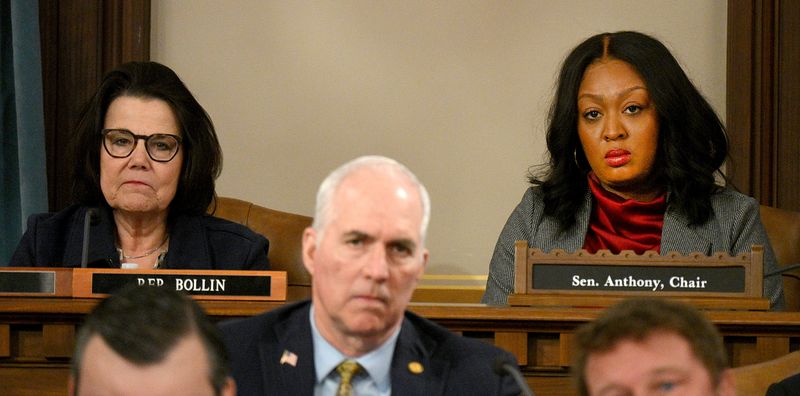
Senate Appropriations Chairwoman Sarah Anthony, D-Lansing, said shifting $1.7 billion in School Aid Fund money to higher education would be “extremely difficult” for the Democratic majority in the Senate.
But Anthony said the budget constraints are real.
“We may need to get creative this year, but we won’t take those types of decisions lightly,” Anthony said.
How it works
Money in the School Aid Fund primarily comes from the sales tax and income tax and, for nearly 50 years after the 1963 Constitution, traditionally went to K-12 schools.
However, over the last roughly 15 years, governors and lawmakers from both political parties have steadily moved more and more of the funding to other types of education, like university and community college programs that were previously supported by the General Fund.
Those shifts over the last 15 years, according to the Citizens Research Council of Michigan, “were born out of the fiscal pressures to address a long-standing structural imbalance in the general fund budget.”
The $1.7 billion shift proposed in Whitmer’s budget Wednesday would mark the largest to date.
While the state Constitution allows School Aid funds to be used for “higher education,” the issue has become a growing concern for K-12 school groups, who view it as a slow erosion of the revenue streams on which schools rely upon.
K-12 Alliance of Michigan President Alan Latosz applauded some of the goals Whitmer outlined in her proposal but also expressed some concerns about the continued funding shift.
“Once again, this budget shifts record amounts of funding out of the School Aid Fund, funding that taxpayers expect to be spent within their local schools, to be spent elsewhere, while providing a small increase in our per-pupil foundation funding that doesn’t even match the inflationary increases in costs our schools face,” Latosz said in a statement Wednesday.
The issue has even entered policy discussions in the 2026 gubernatorial campaign. Former Detroit Mayor Mike Duggan, an independent, is running for governor on a plan to dedicate all School Aid Fund funds exclusively to K-12 schools.
“The money should be in the hands of our schools,” Duggan said Friday at a Michigan Education Association forum in Detroit.
The Michigan Association of State Universities, on the other hand, released a statement praising the governor’s shift of School Aid Fund dollars to support scholarship opportunities and underscored the legality of that funding decision.
“We commend the governor’s proposal to shift additional School Aid Fund (SAF) dollars to support state financial aid programs that improve affordability and access to higher education for families across Michigan,” said Dan Hurley, chief executive officer for the Michigan Association of State Universities.
“We note again that the Michigan Constitution explicitly authorizes SAF funds to be spent on higher education,” Hurley said.
Student funding, literacy program boosted
In all, the total education budget would tally up to $24.5 billion, including $21.4 billion for K-12 schools, $2.6 billion for universities and financial aid and $525 million for community colleges.
The $21.4 billion K-12 budget would increase current per-pupil funding from $10,050 to $10,300. The 2.5% increase will cost the state an additional $325 million in the coming fiscal year, according to the State Budget Office.
Whitmer’s budget blueprint also would increase weighted foundation payments by about 6%, or $128 million, an increase that boosts funding for at-risk students, preschoolers, English language learners, students in rural districts and career and technical education programs.
But funding for online cyber schools in Whitmer’s budget would decrease to about $8,240 per pupil, on the premise that students in cyber schools cost less to educate than those in traditional brick-and-mortar schools. The funding imbalance has long been a sore spot for Republicans, who have argued the decision is more about ensuring the continuation of a traditional public school structure than honoring student options and choice.
State Rep. Tim Kelly, a Saginaw Township Republican who leads the House’s education budget, argued Wednesday that the governor’s budget proposal penalized students choosing a non-traditional route because there were few to no unionized teachers working in those cyber schools.
“That’s basically what it comes down to: If a student is non-union supported, you don’t care,” Kelly said.
State Budget Deputy Director Kyle Guerrant denied that was the case, noting non-union public charter schools receive state funding equal to traditional public schools.
Whitmer’s budget proposal also includes additional funding for early literacy interventions, including a $100 million tutoring program, $150 million in continuing funding for better literacy curricula and training and $10.5 million for more literacy coaches.
The increase comes as Michigan lawmakers have spent about $1 billion over the past decade to boost students’ reading scores, to no avail. Michigan’s average fourth-grade reading score on the National Assessment of Educational Progress has declined from 2015 to 2024, despite efforts to move the state to the top 10 by 2024.
In the 2015 NAEP results, Michigan was behind 42 other states in fourth-grade reading proficiency at 29%. In 2024, Michigan was behind 45 other states — far from the top 10 — at 25%.
Whitmer’s budget also continues funding for state-subsidized breakfast and lunch for all students and about $300 million in funding for mental health and student safety programs. The budget bill retains language requiring schools, in order to tap the school safety funding, to agree to waive privilege in a mass casualty event. Similar language in last year’s budget has so far withstood legal challenges.
The budget proposed Wednesday also includes ongoing funding to provide state-subsidized universal pre-K for four-year-old children.
Both the state-subsidized school breakfast and lunch and the universal pre-K programs have been highly publicized by Whitmer’s office throughout her time in office.
eleblanc@detroitnews.com
cmauger@detroitnews.com
This article originally appeared on The Detroit News: Whitmer’s education budget shifts record $1.7B from school aid fund
Reporting by Beth LeBlanc and Craig Mauger, The Detroit News / The Detroit News
USA TODAY Network via Reuters Connect