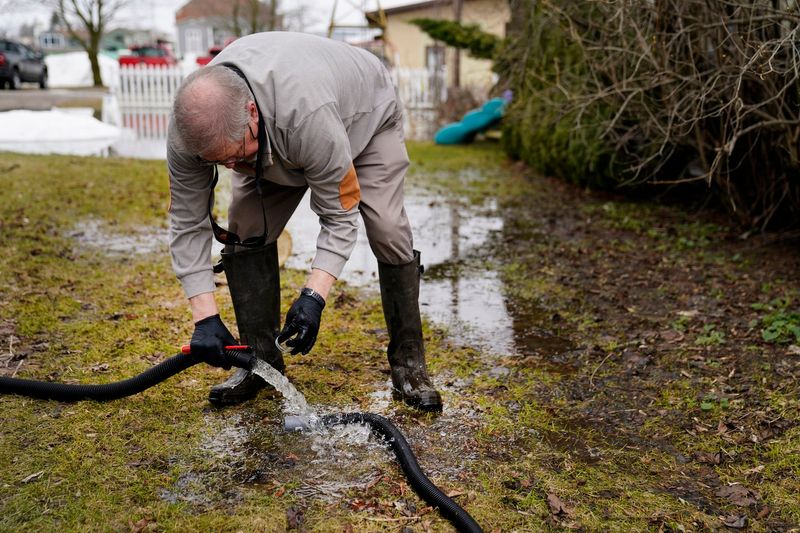
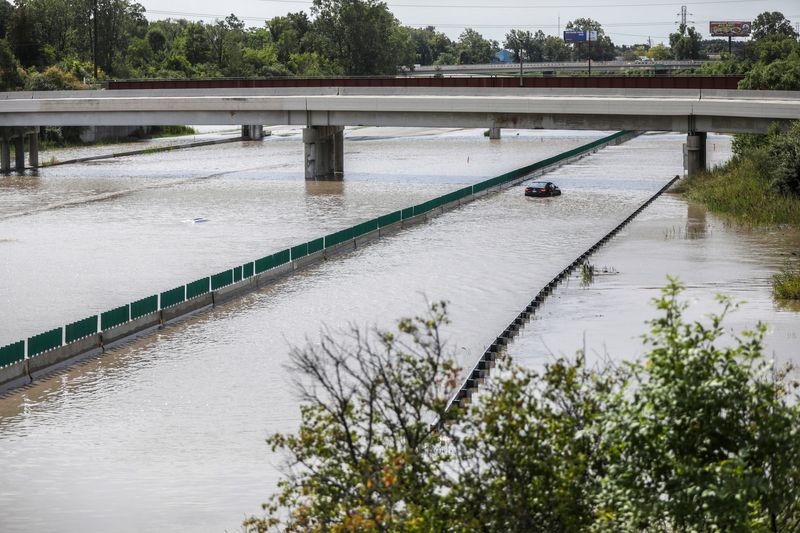
Last month’s nearly statewide flooding, fueled by record rainfall and snowmelt from unprecedented late-March blizzards, left whole northern Michigan neighborhoods inundated, destroyed roads and bridges and had multiple high-hazard dams at danger of potentially collapsing.
But it’s not correct anymore to say that was caused by an extreme weather event, Richard Rood contends.

Rood, a professor emeritus of climate, space sciences and engineering at the University of Michigan’s School of Environment and Sustainability, ticked off the major floods in Michigan triggered by increasingly extreme rainfall:
Scientific research shows conclusively that the Great Lakes region is getting more rainfall during more extreme weather events, and that an increasingly warming climate is driving it.
“People describe these events as historic, they describe them as extreme,” Rood said. “What becomes clear to me is that there are fingerprints or markings of warming all over these events. Some of them are definitive and clear, and those are the ones from the extreme precipitation.
“We should not be referring to these events as extreme. They are extreme by past measurement, but they are more than likely typical of a future measure … it’s better to assume that what you are experiencing now is more typical of what we will see in the next five to 30 years.”
Total precipitation, and amount that falls in intense storms, on the rise
Total annual precipitation in the Great Lakes region has increased by 14% since 1951, according to Great Lakes Integrated Sciences and Assessments (GLISA), a partnership between the University of Michigan and Michigan State University funded by the National Oceanic and Atmospheric Administration that helps Great Lakes communities build resilience against climate change. The frequency and intensity of severe storms has also increased, a trend that will likely continue as the effects of climate change become more pronounced. The amount of precipitation falling in the heaviest 1% of storms increased by 35% in the U.S. Great Lakes region from 1951 through 2017, according to GLISA.
Research published in 2022 out of the North Carolina Institute of Climate Studies, looking at extreme precipitation events in the Great Lakes Region, amplified and supported GLISA’s assessment. Researchers examined historical rain and snowfall data from the Great Lakes region over several periods: 1908–2020, 1949–2020, 1980–2019, and 1980–2020. Each time period showed an upward trend in the number of extreme precipitation events, how long they lasted and how much precipitation fell during them.
“One of the things I have been studying since the 1990s is whether extreme precipitation is changing, and indeed it is in many parts of the country − not everywhere, though, which is interesting,” said Kenneth Kunkel, a professor emeritus with North Carolina State University, principal research scholar with the North Carolina Institute of Climate Studies and lead author on the 2022 Great Lakes region research.
“The Midwest and Northeast have been a real focal area for this (extreme precipitation) increase. And the Great Lakes, kind of straddling the Northeast and Midwest, has really been experiencing that. You are getting storms that are more intense and longer lasting.”
Warmer oceans, thousands of miles away, changing Michigan’s weather
As the global climate warms, oceans are getting warmer, and that includes the western Atlantic Ocean and Gulf of Mexico, two regions that deliver atmospheric moisture to the Great Lakes region. More warming means more moisture in the air, which can turn into heavier storms when weather systems collide at the Great Lakes.
“The sea’s surface temperatures in the Gulf of Mexico are extraordinarily warm; record warm,” Rood said. “When the spring and fall comes to the Great Lakes region, the air is warmer that’s coming in from the south, and it’s coming in earlier and changing the seasonal cycle of the melt.”
Added Kunkel, “The globe is getting warmer and part of that warming is reflected in warmer oceans that feed heavy weather or weather systems that can cause heavy precipitation.”
Four tornadoes tore through four southwest Michigan counties March 6, killing four people and injuring nearly two dozen others, including an EF3 tornado on the 1-5 Enhanced Fujita scale, an international tornado strength measurement. The tornado’s wind speeds maxed at 160 mph, according to the National Weather Service.
It’s the earliest EF3 or stronger tornado in recorded Michigan weather history, and weather experts remarked on the stunning sight of a tornado breaking apart frozen lake ice as it passed through.
The relevant academic research involves the study of weather patterns over long time periods, but Kunkel said more extreme weather earlier in Great Lakes springs can be expected in the decades to come.
“The time period when you can get these very warm, moist air masses I expect to expand, coming in earlier in the spring on average and to stay around later in the fall,” he said.
Warmer winters could cause more freezing rain disasters
The area of the United States that stays generally frozen throughout winter is shifting northward, Rood said.
“Even if you look at Southeast Michigan from the 1950s or even 1980, you didn’t see January and February and much of March going above freezing that much,” he said. “Now you see it above it all the time.”
That becomes a problem when the weather bounces above and below the 32 degrees Fahrenheit freezing mark as significant precipitation is falling. For more than 60 hours from March 28-31, 2025, northern Michigan received continuous freezing rain. The accumulated ice left more than 200,000 people without power, some for two weeks or more, and caused massive destruction in forests as branches and whole trees snapped.
“Our forests aren’t ready for these kinds of changes,” Rood said.
Stormwater infrastructure built for an era that no longer exists
Southeast Michigan’s water, sewer and stormwater infrastructure was largely built after World War II, at a time when rainfall was much less intense, and Metro Detroit looked much different. Much of the farmland and open areas that once helped absorb, filter and slow stormwater are now developed, with pavement, roofs and other hard surfaces causing stormwater to rush more quickly into drains and tributaries − overwhelming them in major storms.
The Southeast Michigan Council of Governments’ work on flooding and resiliency was elevated in urgency after the 2014 floods, when the region was declared a federal disaster area.
“I think we’ve had four federal disaster declarations in flooding since that time,” said Kelli Karll, manager of the environment and infrastructure group for SEMCOG.
“We often talk in frequency of rain events. A 100-year rain event typically has about a 1% chance of occurring in any single year. We know we have seen that more than one time a year; we’ve seen it multiple times per year.
“A 10-year event, a 10% chance of occurring in any single year, that’s traditionally what our storm sewer pipes might be sized for. That’s roughly 2, 2.5 inches of rain over a 24-hour period.”
SEMCOG last September convened a flooding task force with more than 80 regional representatives to look at ways, collaboratively and as individual communities, to better prepare for changing flood dynamics and inadequate infrastructure.
“We are really working on a flooding and resiliency plan out to 2050,” Karll said. “What types of projects, policies and actions do we need to be implementing to start to tackle it? It’s not going to be corrected overnight; we can’t rebuild all of this infrastructure and upsize everything.”
SEMCOG officials estimate they need about $3.5 billion annually in maintenance and investment in water, sewer and stormwater infrastructure. “That does not include treatment plants, and it doesn’t even include upsizing to address flooding,” Karll said.
One area of focus is identifying nature-based solutions, areas in the region where wetlands and open natural areas can be expanded and enhanced to help mitigate flooding, she said.
“We are looking at really large-scale natural features, wetlands and open areas 5 acres, 10 acres, in size, where when we have these rain events, water can be redirected to these large-scale natural areas to hold the water and offset the flooding,” Karll said.
Lack of ongoing, dedicated funding for stormwater an issue
The biggest impediment to improving Michigan’s infrastructure to meet the challenges of increased extreme weather is simply a lack of the billions of dollars it would entail. But Michigan has another problem, at least in the eyes of those who think about stormwater infrastructure: the lack of a dedicated funding source to improve and maintain stormwater infrastructure.
“When people pay their water and sewer bills, that’s just drinking water and wastewater,” Karll said. “There isn’t any funding source for maintenance and improvements to stormwater infrastructure. The work that communities do often comes from their general fund, or it comes from grants and loans.
“That’s not sustainable into the future − especially with the flooding and the needs that we are facing now.”
Stacy Hissong is an attorney specializing in drain, water and municipal law, and is general counsel for the Michigan Association of County Drain Commissioners.
“People don’t think about storm water systems basically at all until their basement floods,” she said. “They don’t think of it as infrastructure they way they think of roads or sewers.”
Nearly a dozen Michigan communities have created dedicated stormwater utilities to fund infrastructure improvements. Specific, active projects and funding efforts for stormwater management are heavily concentrated in Southeast Michigan and the Huron River watershed, including cities like Ann Arbor, Pontiac, Royal Oak, St. Clair Shores, Dearborn Heights, Warren, and Flint. But lawsuits and legal threats have many communities reluctant to operate stormwater utilities, Karll said.
In October 2024, the Michigan Court of Appeals upheld the legality of Ann Arbor’s stormwater utility fees, ruling they are valid user fees, not unlawful taxes under the Headlee Amendment. That was a positive development, Karll said.
A bill pending in the Michigan Senate, sponsored by Democratic Senators Rosemary Bayer, Veronica Klinefelt and Stephanie Chang − Senate Bill 441, the “Stormwater Management Utility Act” − aims to enable local Michigan governments to establish dedicated stormwater utilities and fee systems. This legislation allows for the creation of stormwater management plans, utility fee ordinances, and enterprise funds to manage infrastructure.
That would be an improvement over the generally used current system of occasional stormwater special assessments on annual winter taxes, Hissong said.
“Let’s say I own a piece of property in Clinton County, and I have a drain on it,” she said. “If no work has been done on the drain for 10 years, I never got an assessment; it’s not on my tax bill. But then we might do a million-dollar project, and I have a $10,000 assessment that’s going to be paid over my next 20 years. I had no idea.
“I went from paying nothing to paying a significant amount because our current drain code structure doesn’t include the ability to have an annual payment as they do for water and sewer to build up a fund for improvements.”
A shift from looking at history to looking to the future
Infrastructure engineering has typically been designed to withstand rainfall events calculated based on what’s happened in the past. But that doesn’t work in a warming world with increasingly intense weather events, Kunkel said.
“You get the 100-year storms that are often used in design for building something,” he said. “But if something has a long lifetime, we should be considering that the value we have today, or historically, no longer holds in the middle of the century or end of the century.”
SEMCOG’s regional flood task force is taking that mindset, focusing on the needs as they are projected to exist in the future, Karll said.
“The reactive costs are much more,” she said. “It’s not just fixing infrastructure and repairing damage to roads; it’s the toll on people. It’s the insurance costs of fixing basements from backups. Being proactive is the key.”
The engineers “get it,” and elected officials increasingly do as well, Rood said.
“With each one of these vents, more and more people in government realize this is a problem they have to deal with,” he said. “They see the consequences in their community.”
Contact Keith Matheny: kmatheny@freepress.com.
This article originally appeared on Detroit Free Press: What used to be extreme weather is becoming normal in Michigan
Reporting by Keith Matheny, Detroit Free Press / Detroit Free Press
USA TODAY Network via Reuters Connect