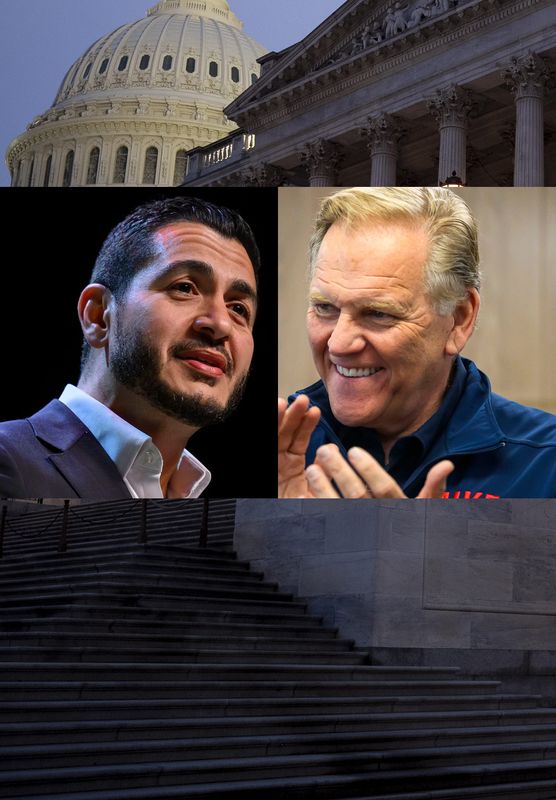
If the first 48 hours after Tuesday’s Michigan primary were any indication, Republicans plan to rely more on conjecture than confrontation in their campaign against Democratic U.S. Senate nominee Abdul El-Sayed.
Campaign materials have begun referring to El-Sayed by his full name, Abdulrahman Mohamed El-Sayed. Ads supporting Republican nominee Mike Rogers juxtapose El-Sayed with imagery from Sept. 11 and Osama bin Laden while highlighting Rogers’ role in the operation that killed the al-Qaida leader.

Texas Sen. Ted Cruz went on Fox News this week to argue there is a “green-red convergence” between “communists and the Islamists,” suggesting El-Sayed supports Sharia law and harbors anti-Christian and anti-American views. Cruz also pointed to El-Sayed’s acquaintance with progressive social media influencer Hasan Piker, who has made indefensible comments about the Sept. 11 terrorist attacks.
President Donald Trump, meanwhile, called El-Sayed “a man of hate,” claiming he hates Jewish people “with a passion that burns in his heart.” Vice President JD Vance elevated El-Sayed on Wednesday by warning of “a President El-Sayed” in 2028. Apparently, Republicans are betting there is such a thing as bad publicity.
Their involvement only emboldens the Democratic establishment to rally behind El-Sayed.
But the broader strategy is unmistakable: define El-Sayed by his religion, his associations and his identity before voters define him by his message.
His equivocation over the existence of a Jewish state is fairly concerning and out of the mainstream. At the same time, his opposition to unconditional military aid to Israel reflects views that have become increasingly common among many Democrats and younger Americans. And El-Sayed has repeatedly argued that, as a Muslim, he would defend religious liberty as one of America’s defining principles.
Republicans may succeed in energizing parts of their base and persuading some Jewish and independent voters.
But if this is the centerpiece of their campaign, they’re leaving El-Sayed’s actual argument largely unchallenged.
El-Sayed did not win Michigan because only Muslim voters in Dearborn turned out for him. He won because he built a coalition that extended well beyond Michigan’s Arab American communities. He won college-educated Democrats — from university towns like Ann Arbor and East Lansing to Kent County, a white-collar area, and pockets in suburban communities such as Rochester Hills, Canton Township, Sterling Heights and much of rural northern Michigan.
Those voters appear to be responding less to El-Sayed’s identity than to his promise that government can solve problems they believe have gone unaddressed.
If Republicans continue to rely on labels such as “communist” or “Islamist,” they risk talking past voters who are focused on more pressing concerns like the cost of living, healthcare, housing and whether their children will have greater opportunity than they did.
The better strategy is to challenge El-Sayed’s faith in government as the solution.
Take his call to reduce the influence of money in politics. Republicans should argue that shrinking government’s role in the economy through deregulation and reducing regulatory capture would remove many of the incentives that fuel special-interest influence in the first place.
Take affordability. Republicans should point to the tax cuts they enacted in 2017 and make the case that economic growth, lower taxes and regulatory reform — not larger government — are the surest path to putting more money in people’s pockets.
And then comes the central question Republicans should ask in every campaign.
How do you promise to leave families with more disposable income while also proposing a Medicare for All system that would require trillions of dollars in new federal spending? Support for Medicare for All has often declined when people are confronted with its cost or the fear of replacing private insurance. Republicans should force Democrats to explain how those numbers add up.
From his campaigning, it sounds like that means al least a payroll tax hike, a capital gains tax, a Death Tax hike and a second Death Tax on inheritance — policies that destroy wealth and jobs.
Republicans don’t need to convince the electorate that Abdul El-Sayed is different. Voters already know that.
They need to confront the ideas he’s offering and convince voters that his solutions will not deliver what he promises.
kbuss@detroitnews.com
This article originally appeared on The Detroit News: Vilifying Abdul El-Sayed may motivate Republicans. But it won’t defeat his ideas | Buss
Reporting by Kaitlyn Buss, The Detroit News / The Detroit News
USA TODAY Network via Reuters Connect
By Kaitlyn Buss, The Detroit News | USA TODAY Network