(Editor’s note: This is the fifth installment of UAW Candidate Q&A, a six-part series asking questions directly to candidates running to be president of the United Auto Workers union. The Detroit Free Press will publish responses from all candidates.)
Come late August, hundreds of thousands of members of the United Auto Workers union will have a choice: Reelect sitting president Shawn Fain, or opt for a new face to lead one of the nation’s most historic labor unions.

Five members are challenging Fain, a popular president and political figure. Fain was at the helm of the union in 2023 when it secured handsome raises after a simultaneous strike of all three Detroit automakers (Ford Motor Co., General Motors and Stellantis). The upcoming election was complicated by news that Fain is facing a grand jury investigation directed by the U.S. Department of Justice over allegations that he improperly used his post to seek benefits for his family members. Fain has denied the allegations.
According to the UAW’s court-appointed monitor, who oversees the union’s elections, ballots will be delivered to members “on or about” Aug. 21. Ballots must be returned by Oct. 5, and tabulation will commence on Oct. 6.
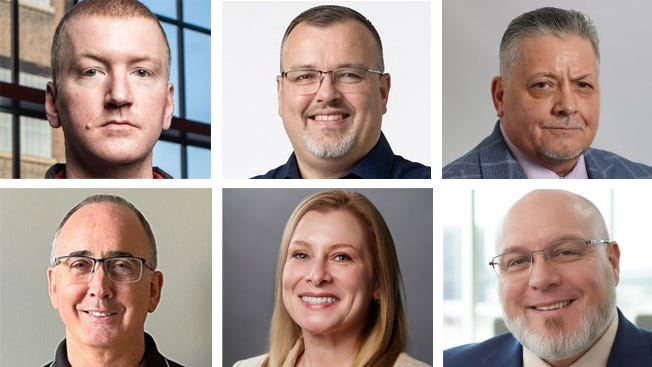
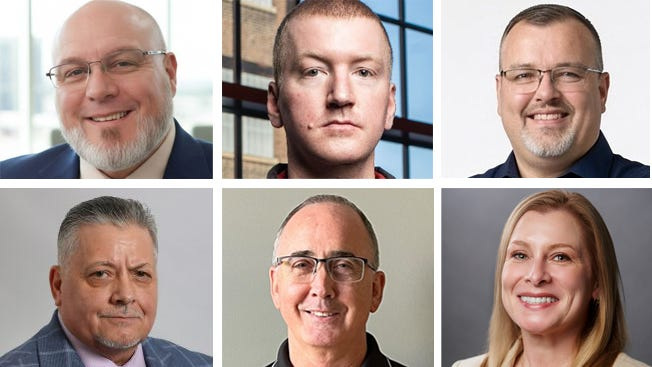
The candidates are:
Will Lehman, a 38-year-old Mack Trucks employee from Local 677 in Macungie, Pennsylvania.
Greg Mooney, a 46-year-old recording secretary from Local 2147 in Lima, Ohio, where he has worked in the aerospace and defense sector of the union for four years.
Rich Boyer, the 63-year-old vice president of the UAW who rose out of Local 140 in Warren.
Shawn Fain, the 57-year-old incumbent president of the UAW, hailing from Local 1166 in Kokomo, Indiana.
Tricia Geiger, 43, a 20-year UAW member who is currently an international servicing representative at UAW Local 977, a GM union hall in Indiana. Geiger got her start in the union at UAW Local 651 in Flint.
Brian Keller, 57, a 27-year automotive worker and member of the union represented by Local 1248 in Warren.
The Free Press offered each candidate the opportunity to answer six detailed questions, in their own words, for publication. Candidate responses were limited to 1,000 characters for the sake of brevity.
In the first installment, candidates explained what they see as the key issue facing the union. In the second, candidates explained why they are running for the office. On Tuesday, candidates outlined their plans for the 2028 contract negotiations with the Detroit Three automakers. On Wednesday, the hopefuls explained how they would help the union grow. Today, the Free Press asks:
The UAW has long carried considerable political influence. How would you use this position to advocate for labor on a national political scale? With what political party do you most closely align?
Lehman: I align with neither the Democrats or Republicans. I am a socialist. Both capitalist parties are parties of the corporations and banks. They agree on making the working class pay for the crisis of American capitalism.
The UAW’s “political influence” has meant delivering members’ dues and votes to the Democrats and getting nothing in return. Under both parties, plants closed, tiers were imposed, pensions gutted. Trump — frontman for the financial oligarchy — is assaulting democratic rights, with ICE terrorizing communities and workers like Renée Good, Lorenzo Salgado Araujo and union brother Alex Pretti killed. The Democrats have capitulated.
I would use the presidency to mobilize the membership’s industrial power: to defend immigrant workers, against dictatorship and war, in support of every workers’ struggle. Workers need our own political movement, independent of both big-business parties, to take power in our own hands.
Mooney: I would move our politics toward the center and use the UAW’s political influence to fight for policies that protect American jobs and workers, regardless of party. This means pushing for stronger trade policies, real protections against AI and automation, and ending the practice of sending union money almost exclusively to one political party. It is time we stop being taken for granted and make those who represent us earn our support.
I am a true independent who believes in America First principles. My political ideology aligns closely with that of a JFK-era Democrat. I believe in putting American workers and all UAW members first, securing our borders, supporting domestic manufacturing, and reducing the one-sided flow of union money into politics. However, I am not blindly loyal to any party. I will work with anyone who genuinely fights for working families and hold accountable those who do not. It is my belief that one should vote based on the issues, merit, and character.
Boyer: UAW President Stephen P. Yokich used to say, “I’m not a Democrat. I’m not a Republican – I’m a trade unionist.” Personally, I align with the political party that openly affiliates with union workers and supports our rights to bargain collectively. I would advocate that organized labor fields more members as candidates across the political landscape that are exclusively tailored to win their specific race.
Fain: As my friend Chuck Browning always says, I’m not a Democrat, I’m not a Republican, I’m a trade unionist. Our job is not to get our members to vote for one party. Our job is to get our members to fight hard for their issues in the political arena.
But whatever we do, it has to be driven by the membership. We’ve made great strides in putting our endorsement process into the hands of the membership, getting candidates to show up for our members on the picket line or our first-ever UAW Michigan Senate forum. But we need to go further.
We need to elect working-class people that understand the realities of what working class people are going through. Our members are all over the political spectrum and we’re approaching our politics and who we support as a “pick a side” moment. When politicians or candidates show their support by standing with the UAW and the working class over corporate greed and billionaires, they’ll get our support – it’s that simple.
Geiger: I am not a Democrat or a Republican. I am a Unionist. If elected, I intend to refocus our national CAP resources away from divisive candidate-focused campaigns and towards member unifying issue campaigns that provide opportunities for broader coalition development in the labor movement, across the political spectrum, and in our communities. The Teamsters recently had success with the bipartisan passage of the “Faster Labor Contracts Act”. This doesn’t mean we will never endorse candidates and the local/regional CAP councils will retain their autonomy, but the current structure isn’t working. It is not driving meaningful wins for working people. So, it is time we try something new. We must make politicians work for working people and hold those we support accountable – not remain conveniently silent while politicians our members got elected court AI in our own backyard.
Keller: The UAW’s political influence should always serve working people — not political parties. I will support candidates, regardless of party, who fight for collective bargaining, good-paying American jobs, retirement security, fair trade, and workers’ rights. My loyalty is to UAW members, not to any political party.
Liam Rappleye covers Stellantis and the UAW for the Detroit Free Press. Contact him: LRappleye@freepress.com.
This article originally appeared on Detroit Free Press: UAW Q&A: President hopefuls on how to wield union’s political power
Reporting by Liam Rappleye, Detroit Free Press / Detroit Free Press
USA TODAY Network via Reuters Connect
By Liam Rappleye, Detroit Free Press | USA TODAY Network