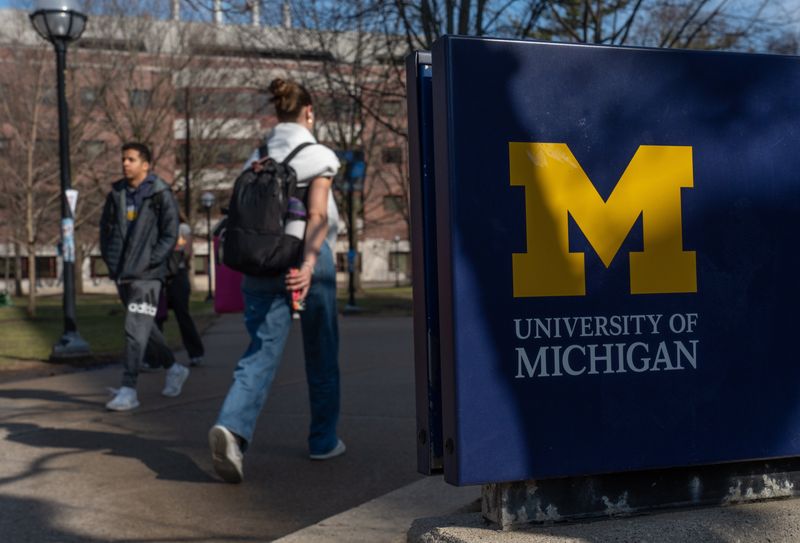
One year ago, the University of Michigan dismantled its diversity, equity, and inclusion programming after the Trump administration distributed a letter threatening to withhold federal support.
The letter was not legally binding, but U-M scrambled to comply, ending most DEI programming across the campus.

Months later, a federal judge permanently struck down efforts to restrict DEI in schools, ruling that President Donald Trump’s anti-DEI campaign violated the First Amendment and federal procedural rules. Frankly, it was embarrassing that U-M, with its vast resources, capitulated to a threat based on the thinnest pretext, one that many legal experts believed was unconstitutional.
As we’ve reached the one-year mark since the dismantling of diversity, equity, and inclusion at U-M, we should critically reflect on the circumstances that led to its demise. For many people, the dismantling of DEI at U-M was a betrayal of the core institutional values that U-M purports to hold. Was the University of Michigan’s response the right course action and in the best interests of our community?
I believe the answer is no, and that it is time to reinstate legal DEI on U-M campuses. I am appealing to U-M leaders to act “with all deliberate speed.”
U-M’s pretext for ending DEI has been knocked down by a federal court, and there is no legal impediment to bring back DEI programming, so the university should do this as soon as possible.
At the recent U-M Board of Regents meeting, the chair of the Senate Advisory Committee on University Affairs, Derek Peterson, stated that the closure of the Office of Diversity, Equity and Inclusion made it harder for U-M to “advance equity work” and “to widen access to higher education for excluded groups.”
In practice, what this means is that important sources of support for underrepresented students have been removed, which ultimately threatens campus inclusivity and retention efforts.
An unnecessary retreat
The dismantling of DEI was based, in large part, on the “Dear Colleague” letter sent by the U.S. Department of Education’s Office for Civil Rights, directing all federally funded institutions to eliminate race-conscious policies or risk losing federal support.
This letter was a political pressure tactic rather than a legal mandate, and explicitly stated it had no force of law. Many of us urged U-M to resist this government overreach, but instead the university, like many institutions, engaged in anticipatory obedience, preemptively complying before any legal enforcement occurred.
Several responses to the “Dear Colleague” letter underscored its problematic nature. A group of distinguished law professors who teach antidiscrimination law, constitutional law and civil rights wrote a memo in which they argued that DEI programs were lawful under federal civil rights laws and Supreme Court precedent. The lawyers made the following conclusions:
Under prevailing federal civil rights laws and Supreme Court precedent, DEI initiatives that do not employ racial classifications or otherwise limit opportunity to individuals from certain racial groups remain legally secure … even if the policy is designed to promote overtly racial goals like diversity, equity or inclusion.
Nevertheless, U-M leaders announced the closing of the Office of Diversity, Equity and Inclusion, the Office for Health Equity and Inclusion, and the discontinuation of the DEI 2.2 Strategic Plan.
However, making such far-reaching decisions based on the problematic “Dear Colleague” letter and the threat of losing federal funds was ill-fated.
U.S. District Court Judge Stephanie Gallagher overturned the Trump administration’s anti-DEI campaign in August of 2025. The Trump administration initially appealed this ruling but recently abandoned the court ruling, which confirms that DEI programs not based on identity exclusions were never illegal.
Trump is still determined to dismantle DEI activities, but even the wording of his most recent executive order legitimizes DEI, stating that “DEI activities are …. often illegal….” This wording indicates that there are DEI activities that are not illegal. I would argue that with few exceptions, most U-M DEI activities were not racially discriminatory.
DEI was working
Why should U-M reinstate DEI practices? Because the university’s own data show they worked. U-M’s DEI progress reports ― now removed from the website ― documented significant enrollment gains among Asian American, Hispanic/Latinx, Native American, Black and multiracial students across undergraduate, graduate and professional programs.
Former Vice Provost for Equity & Inclusion and Chief Diversity Officer Tabbye Chavous also noted major improvements in affordability and access for low-income and first-generation students. DEI strategic planning also strengthened awareness and accountability in hiring, promotion and workplace culture.
Second, there continues to be strong support on campus to bring back DEI. Last month, SACUA passed a formal resolution affirming its support for DEI as a core academic and institutional value. This followed a prior resolution that passed with almost 70% support to continue legally compliant DEI initiatives.
Third, the negative misconception that DEI was about lowering standards and elevating unqualified people was a gross caricature of what DEI was actually intended to do. DEI focused on fairness, access and reducing structural barriers.
Leadership lessons from MSU
Finally, restoring DEI will help U-M to re-establish itself as a national leader in expanding access and opportunity for underrepresented groups.
There is no shame in acknowledging that U-M’s dismantling of DEI was, in retrospect, a mistake. It is notable that the Michigan State University Trustee Rema Vassar recently stated in unequivocal terms that the decision to dismantle DEI was “a choice, not a legal requirement,” and that MSU needs to apologize to students who faced hostility during this time, and restore the position of vice president for diversity, equity and inclusion with the appropriate budget and authority among other actions.
It is refreshing to have a trustee speak with such moral clarity.
Dismantling was the Wrong Solution
I am not naïve about the difficult political climate that has made DEI tantamount to a slur. There is a sad reality that the acronym DEI and the words diversity, equity and inclusion have been so unfairly maligned that they might be beyond rehabilitation. I hope that is not the case. Regardless, I agree with Vassar that U-M must also return legal DEI.
I am also not naïve about the fact that DEI was not perfect. If there were students who felt excluded from DEI programming, that is a problem. However, the solution was not to dismantle the entire DEI infrastructure. Like any imperfect initiative, U-M leadership should have given DEI leaders sufficient opportunity to address the concerns and improve the programming.
Contrary to Executive Order 14173, we should also be clear that the Trump administration’s attacks against DEI were never truly about restoring merit-based opportunity. It is hard to ignore the hypocrisy of an administration that disparages Black and other minoritized individuals as “DEI hires” while routinely elevating loyalists who in many cases are underqualified.
It is time for U-M leaders and the U-M Regents to reinstate legal DEI on U-M campuses. Doing so will be a step in the right direction toward restoring confidence in our leadership and being a true embodiment of U-M’s slogan, “Leaders and the best.”
Kevin Cokley is the University Diversity and Social Transformation Professor and Associate Chair for Diversity Initiatives at the University of Michigan-Ann Arbor. Submit a letter to the editor at freep.com/letters, and we may publish it in print or online.
This article originally appeared on Detroit Free Press: U-M gutted DEI after a weak Trump threat. Now, the law is clear. | Opinion
Reporting by Kevin Cokley, Op-ed contributor / Detroit Free Press
USA TODAY Network via Reuters Connect