Nearly 40 years after Marty McFly first hit 88 miles per hour, “Back to the Future” continues to find new ways to travel through time.

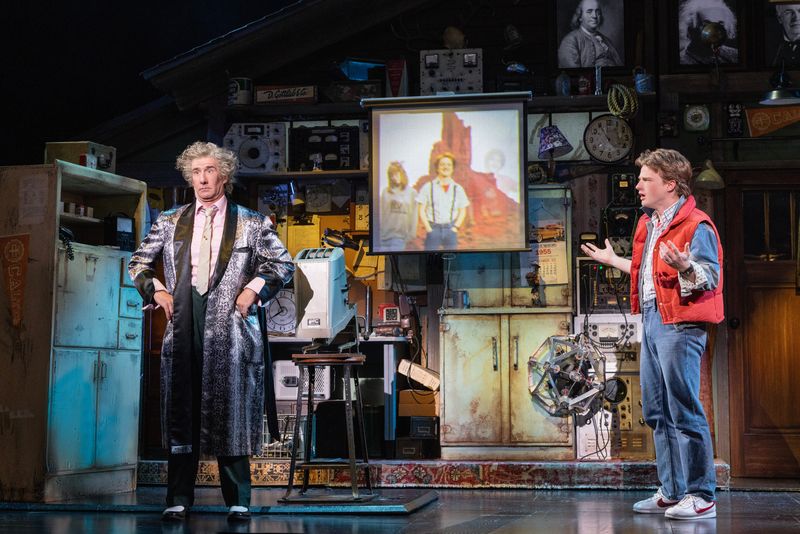
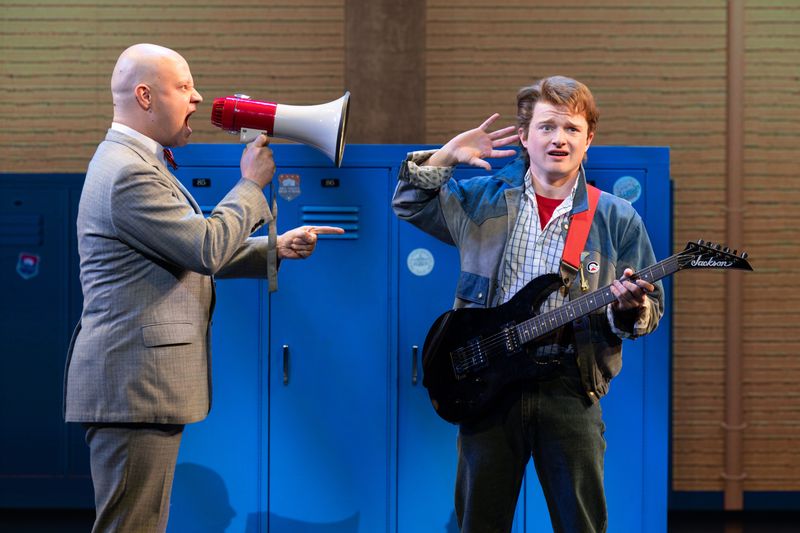
The beloved time-travel tale rolls into East Lansing in musical form, bringing DeLoreans, nostalgia and theatrical sleight of hand to Michigan State’s Wharton Center for a one-week engagement from Jan. 13-18.
Not that it is an exact replica.
Bob Gale, who co-wrote the films with Robert Zemeckis and wrote the book for the musical, said they had to make it viable for the stage.
“Back to the Future: The Musical” is Gale’s first foray into musical theater after a lengthy film career. He found himself delighted with the process for rebuilding the production so it could travel.
“We couldn’t do some of the pyro effects because the fire laws are different in every locale,” Gale said.
The touring production has a slightly smaller ensemble and orchestra, incorporating technology to create the sound of a string section. They modified the major special effect with the DeLorean at the end because it couldn’t be made compatible with 50 different theaters.
“We build our own stage on top of the existing stage,” Gale said. “One of the major requirements of our show is making the DeLorean move around. It sits on a turntable, and there’s a unit that grabs the bottom of the DeLorean and moves it forwards and backwards, and turns. With all that and the video backgrounds and the foreground stuff, we’re able to create the illusion of it going 88 miles per hour.”
Gale said they turned to a former university engineering department head to design a traveling turntable. Gale said they figured out how to fold it into a design they call The Taco.
“It’s really quite an amazing sight to see how they assemble this, because it’s like a gigantic jigsaw puzzle,” Gale said.
The musical was nearly two decades in the making, Gale said, in part because they wanted to make sure they got it right. After the success of the movie trilogy (1985-1990) many people had asked for more sequels. However, its star, Michael J. Fox, developed Parkinson’s disease.
“For years, people have been saying, why don’t you guys do ‘Back to the Future Part Four’ and we would just say, no, we’re not doing that for no other reason than Michael J. Fox is not in any condition to do it,” Gale said. “And who wants to see a ‘Back to the Future’ movie without Michael J. Fox?”
Then Zemeckis and his wife, Leslie, saw “The Producers” on Broadway in 2005. As they were walking out of the theater, Leslie observed that “Back to the Future” would make a good musical. He agreed with her and gave Gale a call.
“This would be a way to give the public more ‘Back to the Future,’ ” Gale said. “No one would confuse it with the movies. Nobody would think we’re continuing the story of the movies, because obviously we’re not. We’ve simply retold the first movie on stage in a completely different medium.”
Unlike a film sequel, there was no ticking clock. Gale said the absence of public demand for a “Back to the Future” stage musical gave the team the freedom to develop it slowly and commit only when they were confident in the result.
Their first decision was that the stage play would not be a “slavish retelling” of the original.
“We don’t want people to walk out of the theater thinking, ‘I should have just stayed home and watched the movie again,’ ” Gale said. “We want to show off what you can do on stage.”
Gale said the first thing they cut was the skateboard chase scene. They wanted to get an actor to play Marty McFly who could sing, dance, act and be funny — asking for skateboard stunt skills felt over the top. And if they did find someone who could — they didn’t want to risk him breaking his ankles performing those stunts eight days a week.
The next cut was the terrorists chasing the DeLorean in a van and shooting machine guns. Instead, they used radiation poisoning to put Doc’s life at risk and give Marty McFly an excuse to jump in the DeLorean.
“Nobody has ever objected to that being a viable solution,” Gale said. “Because one of the fun things about theater going, which is way different than cinema going, is that when you buy a ticket to see a show, you are totally aware that these are live human beings putting on a show right in front of you. You give that experience a certain amount of suspension of disbelief.”
Gale said it didn’t take long for them to know the story would work as a musical. They contacted Alan Silvestri to compose the music and Glen Ballard to write the lyrics. Silvestri was the composer for the original trilogy and Ballard had just written the lyrics for “Polar Express.” Both were enthusiastic. As soon as Gale and Zemeckis heard the first songs the duo created they knew they had to go forward with the project.
From there, they committed to making sure the story would work for everyone, of every age, regardless of whether they were familiar with the movie. The feedback they’ve gotten from audiences says they’ve succeeded.
“We were able to translate the story properly on stage where it makes sense,” Gale said. “We had a list of iconic moments and lines that we had to deliver to the audience.”
“Back to the Future: the Musical” opened in London in February of 2020 before being shut down by the pandemic. It made it to Broadway in 2023, playing until January 2025. It started its North American tour run in June of 2024. Now it is playing in London, Tokyo, Sydney and on the Royal Caribbean. Soon it will be in Hamburg, Germany.
“I do believe we really successfully captured the spirit of ‘Back to the Future’ in this show judging from how happy people are when they walk out of the theater,” Gale said. “There’s a certain energy and joy that I can feel from the audience as they’re reliving the memories they may have of the movie or discovering it for the first time.”
This article originally appeared on Lansing State Journal: Time-travel favorite ‘Back to the Future: The Musical’ speeds into Wharton Center
Reporting by Bridgette M. Redman, Lansing State Journal / Lansing State Journal
USA TODAY Network via Reuters Connect