Detroit ― Thirty-six parishes in the Archdiocese of Detroit face the highest risk of losing their weekend Masses and might eventually close under the archdiocese’s initial restructuring proposals.
The Archdiocese of Detroit last week finished releasing the draft models for how its more than 200 parishes could be grouped in the future under its two-year restructuring plan. Among the 90 parishes that were targeted for losing weekend Mass under at least one draft model, 36 were identified for Mass losses under all three draft proposals in their respective planning areas.

Nine churches in Detroit, including St. John Paul II, Holy Family and St. Elizabeth, wouldn’t hold Saturday Vigil or Sunday Mass under each of the models for their geographic area. Weekend Masses would also cease at numerous parishes in suburban communities across Metro Detroit and at some parishes in Lapeer, St. Clair and Monroe counties under the proposals.
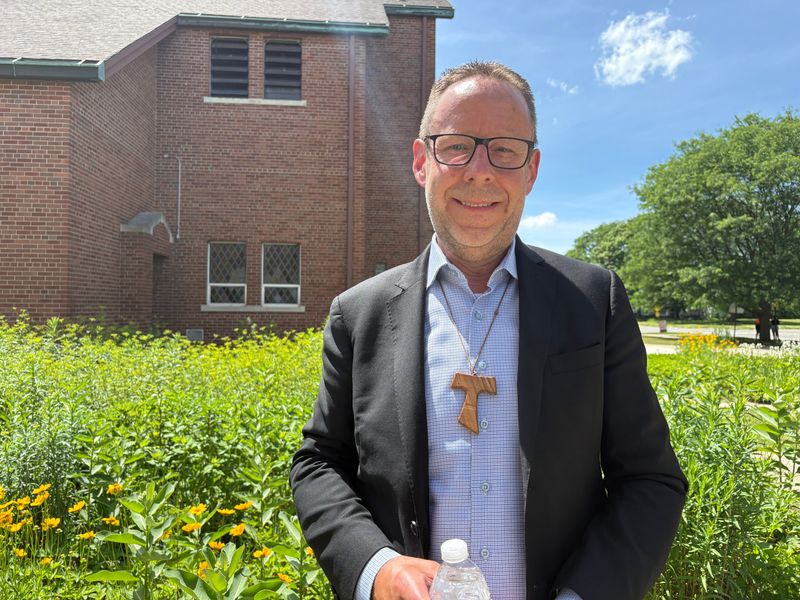
This does not necessarily mean these churches will permanently close, said the Rev. Mario Amore, executive director of parish renewal for the Archdiocese of Detroit. The pastor has the discretion to initially keep the buildings open at designated times for prayer and special liturgies, such as weddings and funerals, he noted.
Leaders at some of these parishes said they are providing the archdiocese with additional information or alternative models in hopes of keeping their weekend Masses. After holding listening sessions about the restructuring this spring, the archdiocese is now allowing parishioners to provide feedback on the models in a survey.
Jennifer Barth, a fifth-generation parishioner at St. Hyacinth Roman Catholic Church in Detroit, said the church is a historic site, and it’s where her “roots are to attend Mass” with her family. The church and its parish were targeted under all three models in its planning area.
“It saddens me,” said Barth of the possibility of the Masses ceasing, “just because of my connection to the church and our family. It’s a terrible thing that there’s the possibility that they won’t have Mass there anymore.”
Amore said last week that he understands “the deep concern and sadness” that many parishioners are feeling, which he noted are “completely valid.”
“A parish is more than a building,” Amore said in a statement. “It is a spiritual home, a community of faith, and a place where people have celebrated the most important moments of their lives. The prospect of change is difficult, and I do not take that lightly. I want to assure parishioners that this process is not predetermined, that their voices are being heard, and that feedback submitted through the listening sessions, the online survey, and direct correspondence is being individually reviewed and considered.”
He said he encourages every parishioner to complete the archdiocese’s online survey by July 31 at restructuring.aod.org and to “continue engaging in this process with us.”
West-side Detroit parish plans to submit new data and an alternative plan
Steve Wasko, a member of the parish council at St. Suzanne – Our Lady Gate of Heaven Parish, said there would be as few as three parishes holding weekend Mass on the west side of Detroit and as many as 10 that wouldn’t under the archdiocese’s draft models. In all three proposals for Planning Area 1, 45 square miles of Detroit would not include a parish with Saturday Vigil or Sunday Mass.
He argued that St. Suzanne – Our Lady Gate of Heaven Parish would be the “ideal site” to fill some of that gap, even though it is proposed to lose Masses under all three draft proposals in the planning area.
“We’re kind of smack dab in the middle of that lower west side” of the city, he said.
Wasko said St. Suzanne – Our Lady Gate of Heaven’s buildings are in “good repair for their age,” and the parish is “financially very stable.”
Wasko said St. Suzanne – Our Lady Gate of Heaven opened a community resource center in its former school building in 2018. The St. Suzanne Cody Rouge Community Resource Center, of which Wasko is the executive director, provides residents with programming and resources such as senior luncheons, food distribution, clothing and youth development programs. The nonprofit that runs the center pays rent to the parish, which contributes to the parish’s financial stability.
He said he was “shocked” and “saddened” when he learned that his parish wouldn’t have a weekend Mass under the all of the draft proposals. But Wasko said he and other parishioners had already been working on a “Model D,” or an alternative proposal.
The parish understands that “change happens,” he said.
“We’re about change …, and we’re about restructuring,” Wasko said. “We just believe it can be done based on some additional factors that may not have been brought to light.”
The parish’s “Model D” provides different metrics for measuring the long-term viability and sustainability of a parish in the city than the archdiocese’s. Some of the metrics in the proposal include “empowered, prepared and trained lay leadership,” “community grounding” and “exciting, spirit-filled, culturally appropriate liturgies.”
Church closures already have resulted in “a further exodus” of people from the Catholic Church, particularly among African Americans in Detroit and other cities, Wasko said.
Wasko said he and other parish leaders aren’t drawing a new map for how parishes should be grouped, but they plan to ask the archdiocese to meet with them to hear their concerns. The parish will also likely share a map with the archdiocese showing the potential 45-square-mile gap where Sunday Masses wouldn’t be offered.
These parishes get targeted under all archdiocese models
Among the 36 parishes targeted for losing weekend Masses under all draft models are St. Charles Lwanga Parish, St. Scholastica Parish, St. Peter Claver Parish and Presentation/Our Lady of Victory Parish in Detroit in Planning Area 1.
The parishes in Planning Area 3 include Our Lady Queen of Heaven in Detroit and Our Lady Queen of Apostles in Hamtramck.
The affected Wayne County parishes in Planning Area 4 are St. Constance in Taylor, St. Alfred in Taylor, St. Cyprian in Riverview and St. Mary Magdalen Parish in Melvindale.
Other high-risk parishes in Wayne County’s Planning Area 6 are St. Sabina in Dearborn Heights, St. Richard in Westland, St. Aloysius in Romulus, St. Linus in Dearborn Heights, St. Mary, Cause of Our Joy in Westland, St. Alphonsus-St. Clement in Dearborn. The parishes in Planning Area 7 include Our Lady of Loretto in Redford Township and St. John XXIII Parish in Redford Township.
In Oakland County, the high-risk parishes are St. Gerald in Farmington in Planning Area 8 and St. Benedict in Waterford in Planning Area 10.
In Macomb County, the parishes targeted in all three draft models include Our Lady of Hope in St. Clair Shores, St. Lucy in St. Clair Shores and St. Basil the Great in Eastpointe in Planning Area 11, as well as St. Jane Frances de Chantal in Sterling Heights and St. Matthias in Sterling Heights in Planning Area 13.
The high-risk parishes in St. Clair County’s Planning Area 14 are Sacred Heart in Yale, Immaculate Conception in Ira Township and St. Christopher in Marysville, while Lapeer County’s Planning Area 15 includes St. Cornelius in Dryden.
In Monroe County’s Planning Area 5, the affected parishes are St. Anne in Monroe and St. Joseph in Erie.
The archdiocese’s priests convened in January to develop draft models for future “pastorates,” or groupings of one or more parishes led by a pastor. These draft models were shared with key parish leaders for feedback and presented to parishioners at the spring listening sessions.
Amore said last week the proposed number of weekend Masses for each draft model was shaped by the number of priests available to serve within a pastorate, the geographic distribution of parishes, Mass attendance, seating capacity and “the overall pastoral needs of the community.” He said the planning guideline is a maximum of three weekend Masses per priest on a given weekend.
“The Archbishop is also carefully considering how the priests assigned to a pastorate would be able to serve all of the Masses within that pastorate if one or more priests were on retreat, vacation, or sick,” he said. “In cases where the number of available priests cannot support weekend Masses at every church within a pastorate, some churches are designated as not having Saturday Vigil or Sunday Masses in the draft models.”
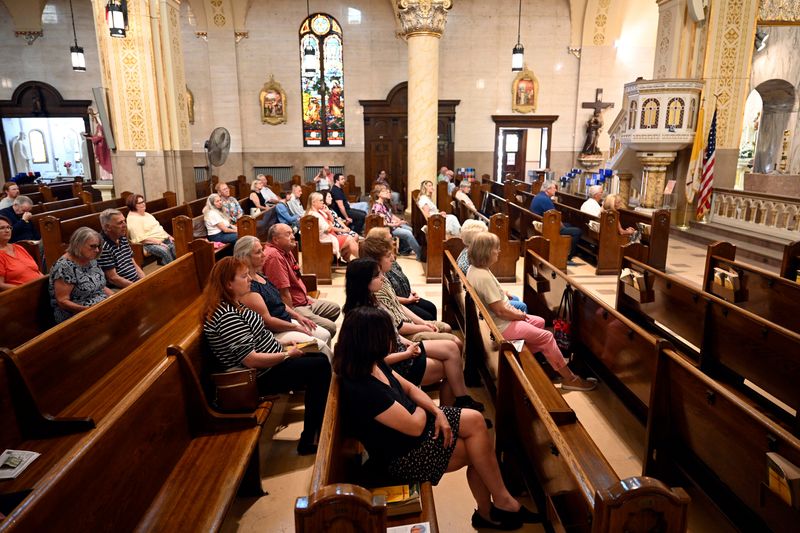
For the 34 high-risk parishes for which information was available, the median was that 28% of their seats were filled during Mass. Seven of these parishes have a seating capacity per Mass of 10% or less.
Detroit church with famed mural merges with another parish
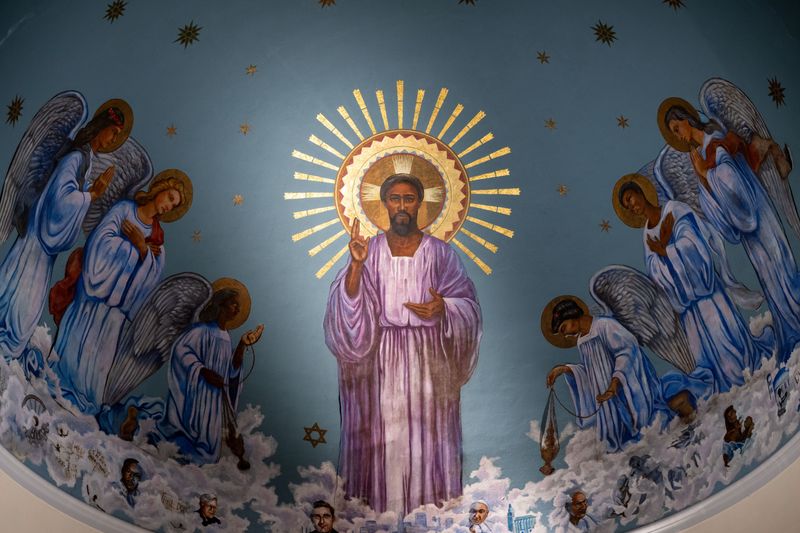
St. Charles Lwanga, formerly known as St. Cecilia, was saved from permanent closure last year after an ad-hoc group fought to keep the parish alive. The parish has a mural depicting Jesus as a Black man.
The parish held what was supposed to be its last Mass in mid-October after the archdiocese said costly building repairs and dwindling membership required its closure.
But the archdiocese reversed course. A decree or formal order was issued last year that merged nearby Christ the King Church on Grand River Avenue and St. Charles Lwanga on Stoepel Street. The merger has been appealed to the Vatican.
Archdiocese spokesperson Holly Fournier said Christ the King Church was designated the official parish church, while St. Cecilia Church, the parish church of St. Charles Lwanga Parish, became an ancillary worship site.
St. Charles Lwanga parishioner Sharon Mitchell said the church has been closed to parishioners since last November.
The parish doesn’t have the money to repair damage and mold exposure in the church, so it’s kept locked “for security, health, and safety reasons,” Fournier said. If a parishioner contacts Christ the King to arrange for entrance and prayer in the church, they should be “given reasonable access,” she said.
St. Charles Lwanga wouldn’t offer weekend Masses under all three models for Planning Area 1, while Christ the King wouldn’t hold weekend Mass under one of the three models.
Mitchell said the stoppage of Sunday Masses at parishes and the moving of beloved priests to other parishes would prompt fewer people to attend Mass.
“You’re going to lose people as Catholics,” she said, “because … you’re not bringing in enough young people, so you have lost people for the future.”
Mitchell said she wants to see her church remain open and for Masses to still be held at both Christ the King and St. Charles Lwanga.
One of the churches that wouldn’t hold weekend Masses under all three models is Our Lady Queen of Heaven in Detroit, which merged in December 2025 with St. Raymond-Our Lady of Good Counsel in Detroit. St. Raymond Church is the parish church, while Our Lady Queen of Heaven Church and St. Jude Church are ancillary churches, according to the archdiocese’s decree.
Dearborn parishioners provide feedback
Thirteen parishes in the parts of Wayne County outside of Detroit wouldn’t offer Saturday Vigil or Sunday Mass under all of the models for their planning areas. One is St. Alphonsus-Clement Parish in Dearborn.
Peter Salamon, a parishioner at St. Alphonsus-St. Clement, said he plans to complete the archdiocese’s survey and is encouraging others as well. He said he and others are helping seniors who don’t or aren’t able to use the internet to complete the survey.
“Choice, not chance, determines your destiny,” Salamon said. “What I mean by that is: If you do nothing, you’ve made a decision. Basically, by not commenting on the models, you’ve endorsed them. … If you do comment, you have a chance to change that.”
St. Hyacinth in Detroit will be celebrating its 120th anniversary next year, where a majority of parishioners are Polish American, Barth said. But people of other backgrounds are part of the parish as well.
Barth said her parish held a community meeting this spring for ideas on how to continue Mass. A few neighborhood non-parishioners attended the meeting and didn’t want the parish to close, she said. Homes are being renovated in the neighborhood near Wayne State University, Barth said.
A St. Hyacinth committee plans to submit information and ideas through the survey in hopes of changing the archdiocese’s mind.
“I feel that the importance of St. Hyacinth’s is huge, like … it’s been there for so many generations,” Barth said, “and that area of the city has had its ups and downs, and I feel like it’s becoming through as a resurgence.”
asnabes@detroitnews.com
This article originally appeared on The Detroit News: These parishes face highest risk of losing Masses in southeast Michigan
Reporting by Anne Snabes, The Detroit News / The Detroit News
USA TODAY Network via Reuters Connect
By Anne Snabes, The Detroit News | USA TODAY Network