

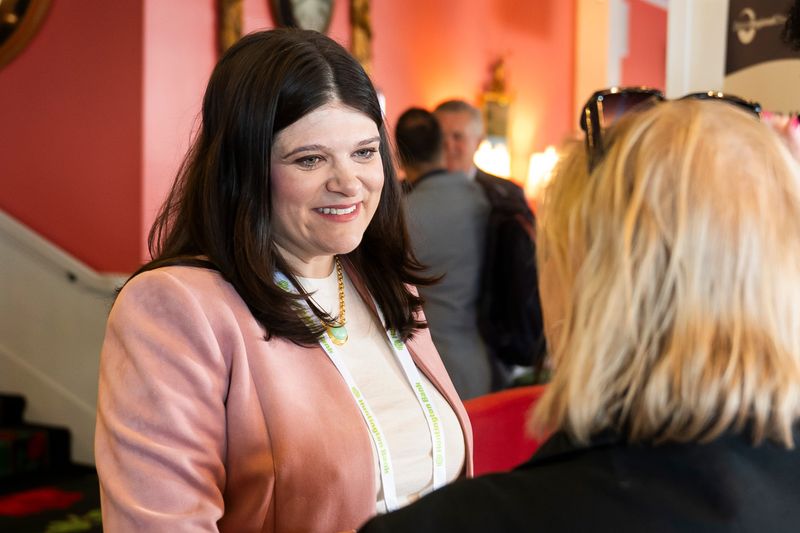
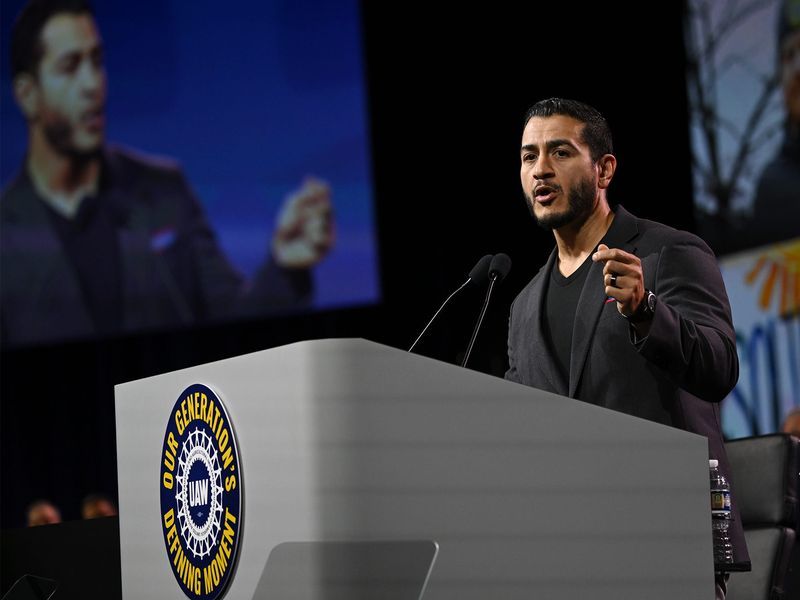
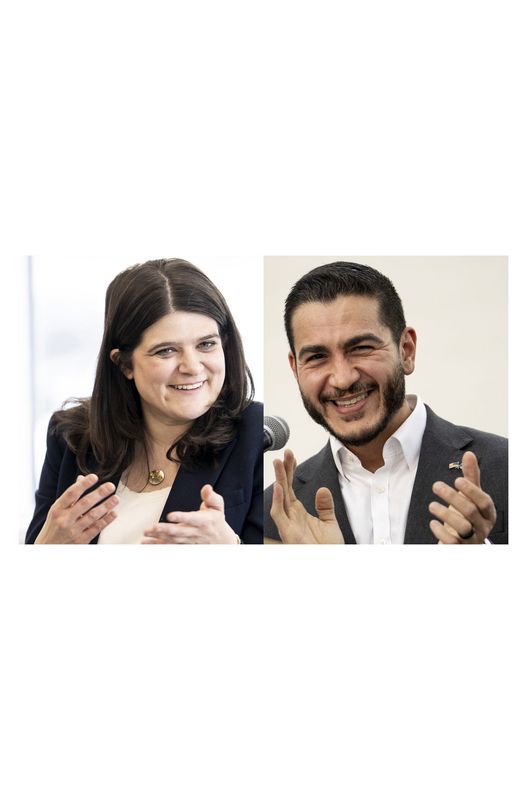
U.S. Senate Democratic hopeful Haley Stevens holds a nearly 7-percentage-point lead over rival Abdul El-Sayed in a new statewide poll of Democratic primary voters, with about 10% of respondents saying they remain undecided three weeks out from the Aug. 4 election.
Stevens received 48% of support compared with 41% for El-Sayed, according to the Detroit News/WDIV-TV (Channel 4) poll of 500 likely Michigan Democratic primary voters conducted last week after their first one-on-one televised debate.

About 0.2% of voters surveyed volunteered that they chose state Sen. Mallory McMorrow of Royal Oak, who dropped out of the race on July 5.
The Stevens-El-Sayed contest tightens to a dead heat when considering primary voters who say they’re definitely committed to voting for one candidate or the other, with 34.1% identifying as “definite” Stevens supporters and 33.7% as “definite” El-Sayed supporters.
Stevens leads in the topline numbers of the survey because of the 14% of poll respondents who will “probably” vote for her, compared with about 8% who said they will “probably” side with El-Sayed, which pollster Richard Czuba said means that neither candidate has “sealed the deal” at this point.
The “probably” voters, together with the nearly 10% of respondents who haven’t decided yet, suggest that 31% are still “movable,” said Czuba, founder of the Lansing-based polling firm Glengariff Group Inc., which conducted the survey for The News and WDIV.
“My assessment of this race is Haley Stevens has an advantage on paper, but when you look at those voters that are definite about who they’re going to vote for, it’s tied,” Czuba said.
“Thirty-one percent of the vote can still move in the final weeks. That’s a huge amount of potential shifting that could take place. That’s why I say this race is wide open because both candidates have so much work to do to nail this down.”
The telephone operator survey of 500 likely Michigan voters was conducted July 8-11 and has a margin of error of plus-minus 4.4 percentage points, with nearly 83% of respondents contacted by cellphone.
“These two candidates have obvious flaws, which is part of the reason there’s a race here,” said consultant Adrian Hemond, a Democrat and CEO of the firm Grassroots Midwest.
“There are a lot of folks who have made their decision, but there’s a lot of folks hanging out there who are like, ‘I don’t know.’ I think that almost 22% saying they are ‘probably’ going to vote indicates that neither one of these candidates is very good at closing the deal.”
Stevens, El-Sayed chart different paths to nomination
The undecided voters in the survey are more traditional Democrats (as opposed to Democratic Socialists) who disproportionately indicated they’re prioritizing a Senate candidate who will “get results” for Michigan or who “represents my values,” according to the poll results.
But the top factor that’s motivating Democratic primary voters to choose a nominee in the Michigan Senate race is who will be a “fighter” who stands up to President Donald Trump (38%), followed by those who said the candidate should be able to win the general election in November and defeat presumptive Republican nominee Mike Rogers (25%).
More El-Sayed supporters prioritized that they want their candidate to “represent my values” and “get results for Michigan,” compared with Stevens backers, who prioritized opposition to Trump and electability in the fall, the poll results showed.
“This entire race feels like the fulcrum point is Abdul El-Sayed wants to make this a race about the direction of the Democratic Party, and Haley Stevens wants to make this a race about the direction of America,” Czuba said.
Stevens, a four-term congresswoman, hasn’t gone on the air herself yet but has benefited from an estimated $49 million worth of TV and streaming advertisements from outside groups this summer, either boosting her bid or attacking El-Sayed, according to the ad-tracking firm AdImpact. That includes the United Democracy Project affiliated with the American Israel Public Affairs Committee (AIPAC) that is on pace to spend $4.6 million just over the next week.
El-Sayed hasn’t seen nearly as much outside spending on his behalf, with an estimated $2.7 million spent on TV by his campaign and a super PAC, Fighting for Michigan, according to an ad-tracking vendor.
Voters weigh candidate strengths
Jesse Mathieson has been a supporter of El-Sayed’s since he ran against Gov. Gretchen Whitmer in the 2018 gubernatorial primary. As the August primary approaches, the 34-year-old Detroit resident is looking to vote for El-Sayed and “the most progressive candidates out there.”
El-Sayed’s focus on universal health care and his commitment to “get money out of politics” are among the policies Mathieson said have drawn him in as a supporter. The fact that El-Sayed is shunned by larger establishment backers, such as the pro-Israel lobby, is all the more reason to trust him, Mathieson said.
“I try not to watch many ads and, if I do, I really try to pick them apart,” Mathieson said. “But when someone’s base stance is, ‘Look, I’m not getting paid by these people, everyone else is,’ it makes it really easy.”
Michelle Broughton was originally a McMorrow supporter. Since McMorrow dropped out of the race, the 63-year-old Detroiter said she’s supporting Stevens, whom she believes has the experience and “brass knuckles” to put up a fight in Washington, D.C.
Stevens understands D.C., Broughton argued, and El-Sayed “just has an idea” of how to govern.
“After listening to him talk, I just think ‘I’ doesn’t belong in Washington; it’s a ‘we’ thing,” Broughton said. “El-Sayed can’t do anything by himself. He’s going to belong in a group.”
Broughton added that she had doubts about El-Sayed’s ability to make it through a general election.
“If he wins the Democratic side, the Republicans are going to beat his pants off. That’s just how it goes,” she said.
Willie Brown, 58, of Detroit, said Stevens has “been through the battle” in D.C. in her four terms in Congress and in 2009, when she was chief of staff of President Barack Obama’s auto industry rescue task force.
“I know very little about Abdul,” Brown said. “I want to go with who’s produced in the past.”
Both candidates have electoral weaknesses
Stevens’ strengths in the poll are with Black voters (67% to El-Sayed’s 21%), non-college-educated voters (56% to El-Sayed’s 34%), voters over age 55, Metro Detroit voters and traditional Democrats.
El-Sayed is getting the most support from White voters (51% to Stevens’ 39%), college-educated voters (48% to Stevens’ 41%), outstate voters, those under age 55 and likely primary voters who identify as Democratic Socialists.
Union households remain a competitive group, with El-Sayed pulling about 44% of support from union members and Stevens 39%. Stevens has largely dominated the race with overall union support, though El-Sayed won the backing of the powerful United Auto Workers.
“There’s union votes out there to be had by these campaigns,” Czuba said.
Stevens of Birmingham has gained support since the last survey in northern Michigan and the Upper Peninsula, while El-Sayed of Ann Arbor appears to be gaining on her in Oakland County, which Czuba said makes sense because it’s dominated by White, college-educated voters.
“That’s where the El-Sayed camp knows what they’re going after. Whereas the Stevens camp is dominating in non-college voters, Black voters and older voters,” Czuba said. “This race is a Jenga game for both of these campaigns: If one piece doesn’t pan out, the whole house comes down on them.”
El-Sayed, for instance, is disproportionately relying on younger voters, especially those under 55 who are White and have a college education, and Czuba questioned whether there’s enough voters in that category to overtake Michigan’s older voter population.
“The difference in Michigan is our electorate is just so much older than, you know, New York,” Czuba said. “He’s got to broaden out his appeal. He’s doing reasonably well in outstate Michigan.”
Stevens is ahead among voters who have already turned in their absentee ballots (52% to 43%), and among those who are still holding on to their absentee ballots (nearly 60% to 33%), according to the survey. El-Sayed is leading among those likely to vote on Election Day (50% to 32%), with nearly 17% of Election Day voters saying they’re undecided.
Breaking down favorability and name ID with voters
Name identification for both candidates came in at almost the same levels, according to the survey.
El-Sayed, who ran unsuccessfully for governor in 2018, has 88.5% name ID, with 51.5% favorable and 15.4% unfavorable. Eleven percent of likely Democratic primary voters said they have never heard of El-Sayed, including 22% of Black voters surveyed.
El-Sayed is viewed favorably in outstate Michigan 59% to 11%, with 13% never having heard of him.
Stevens, who has represented a district based in Oakland County since 2018, has nearly 91% name ID, with 49.5% favorable and 21% unfavorable, with her worst ratings coming from those under age 40 (half of whom hold an unfavorable view of Stevens) and Democratic Socialists (51% of whom view her unfavorably).
About 8.5% of Democratic primary voters haven’t heard of Stevens.
She is viewed favorably in Metro Detroit by a margin of 55% to 22%, with about 6% of Metro Detroit Democrats who said they hadn’t heard of her.
mburke@detroitnews.com
eleblanc@detroitnews.com
This article originally appeared on The Detroit News: Stevens gains edge in Dems’ Senate race that remains ‘wide open,’ poll finds
Reporting by Melissa Nann Burke and Beth LeBlanc, The Detroit News / The Detroit News
USA TODAY Network via Reuters Connect
By Melissa Nann Burke and Beth LeBlanc, The Detroit News | USA TODAY Network
