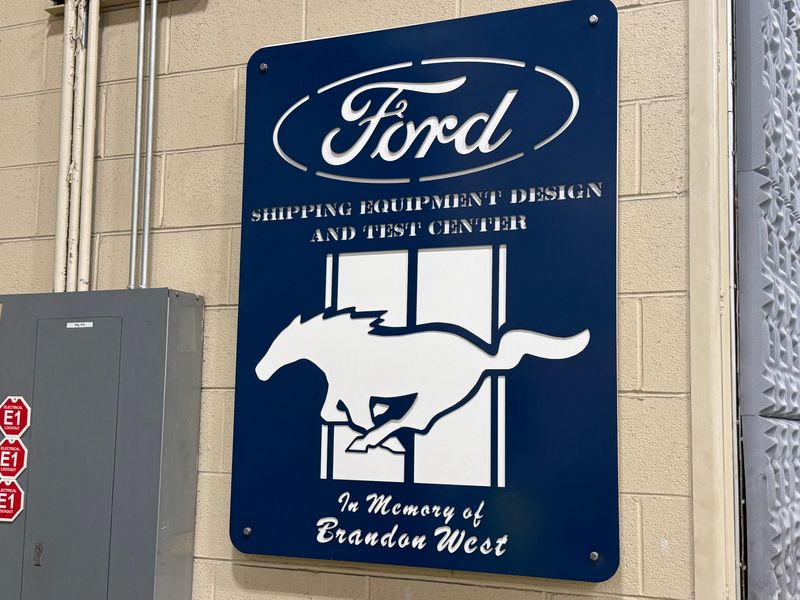
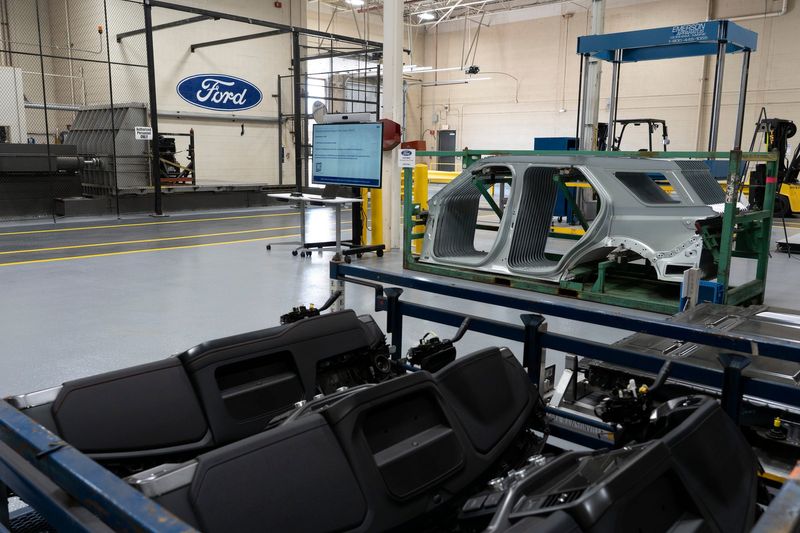
At the end of a quiet residential neighborhood in Dearborn sits a rather unremarkable-looking building with Ford Motor Co.’s blue oval emblem on it. It’s a small facility, called the Ford Shipping Equipment Design and Test Center, but the handful of engineers who work there face a big job.
The rather small team of engineers do the work that Ford relies on to help improve vehicle quality and bring down costs — both cornerstones of the automaker’s promise to Wall Street for a prosperous future.

The team must design and test the shipping equipment Ford uses to ensure that Ford’s engines, sheet side panels, transmissions and thousands of other parts that go into assembling a vehicle all arrive at a factory undamaged from transport and in a cost-efficient way so that the assembly line flows and the cars come off the line perfect.
But there are plenty of obstacles to achieving that goal. For example, your everyday pothole when shipping parts by truck, which is the most common form of transportation Ford uses. When a truck loaded with parts hits such road hazards, the results are alarming. Parts are violently jostled around inside and can be damaged. Even a steel platform loaded with two 1,000-pound-each engines can become briefly airborne when a truck hits a pothole.
Other shipping problems can come from cranes. When cranes are used to lift containers loaded with parts, they often set the containers down with force, which could result in damage to the cargo. Also, railcars being hooked together in a rail yard where even an 8-mph bump between two railcars produces “a heck of an impact” on the goods inside the cars, said Todd Chesna, Ford’s senior manager for packaging engineering for North America.
But at the test center, the team can simulate all of those hazards and if Chesna and the other engineers do their job well, then in the real world those parts will arrive at factories undamaged. That will lead to consistent vehicle quality and cost savings for the company.
“People just don’t realize, you’ve got to test these (shipping) parts to make sure you’re getting quality parts into the assembly plant,” said Bill Strong, Ford’s director of North American logistics. “The delivery process is absolutely key to long-term quality and also our short-term quality, like three months in service.”
More important than ever
Other automakers run similar facilities to test shipping equipment for the same reasons Ford does, but at Ford, the delivery of undamaged parts and quality improvement is more critical than ever.
For one thing, Ford has led the industry in recalls over the past few years, a stigma it looks to shake. This year, through May 5, Ford continues to lead in recalls with 34, according to the National Highway Traffic Safety Administration’s website. It led the industry last year, too, finishing 2025 with 153 recalls, in second place was Stellantis-owned Chrysler brand with 53 recalls.
In recent months, Ford has seen improvement in its initial quality of cars coming off the line as rated by JD Power. Part of that continued improvement relies on what goes on inside the walls of the Shipping Equipment Design and Test Center.
The test center is crucial to Ford for another reason. As Ford prepares to launch a new all-electric midsize pickup off its new Universal Electric Vehicle platform next year — to be followed by several new EVs, as well as new gasoline and hybrid products over the next few years — making sure parts arrive at factories undamaged from transit is critical to successful launches.
“On a major vehicle program you have, on average, about 100 items that are critical to quality,” Chesna said. “They have to be engineered to a level of precision or you’re going to have issues.”
Chesna said over the next two years his team will be “right in the thick of it” to test shipping equipment and design it to make sure those precisely engineered parts arrive at factories intact.
“My job is extremely important,” Chesna told the Detroit Free Press. “I’m responsible for 50,000 parts. Whether we’re conditioned to it, or we’ve just advanced to this point, the turnaround time that’s expected to resolve an issue is hours and days.”
The myth of the pit
The responsibility of testing for shipping problems rests on Stephen Dely, Ford testing specialist.
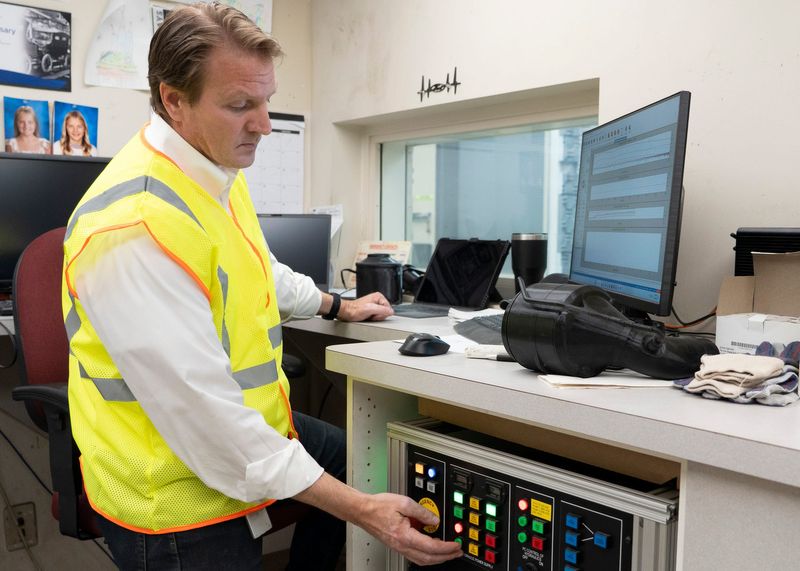
On an afternoon in early May, Dely puts on a pair of plastic eye goggles and shoves styrofoam ear plugs in his ears. He walks into a small room situated behind what Ford dubs its “five-axis vibration table” inside the testing center.
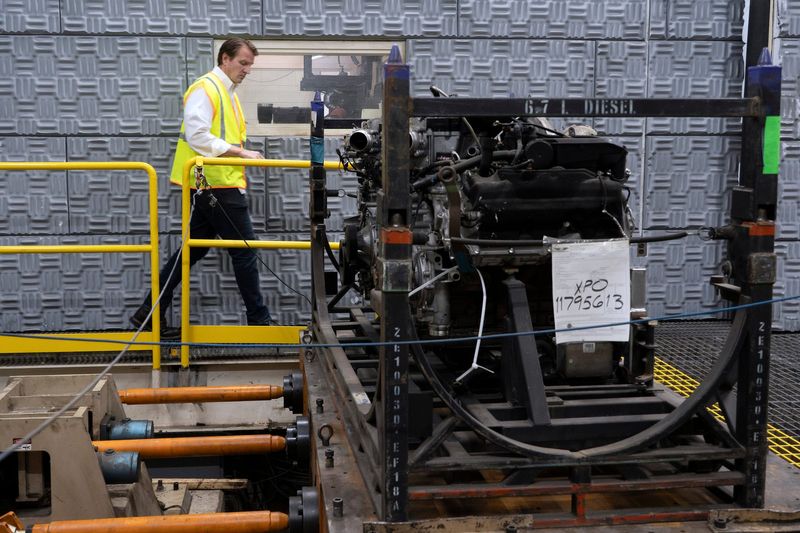
The vibration table is a machine that re-creates road conditions to test how the shipping equipment responds to potholes, curbs or other road hazards. On this day, there are two engines, each weighing about 1,000 pounds, set atop a steel-based shipping cradle, which also weighs about 1,000 pounds. The 3,000-pound load rests on the vibration table, which is set in deep pit that extends down to bedrock.
“The myth over the years is it could be 20 feet, it could be 40 feet. By the time I retire, it’ll probably be 60 feet,” Chesna said. “It just kind of grows with time. But we do believe legitimately there’s probably 20 to 30 feet of concrete underneath here that acts as a mass damper. Partially, it’s so the residential neighborhood doesn’t feel anything we do.”
Also, Chesna explained, that to run the tests it does, which are slow and heavy impacts against heavy objects, “you actually need that amount of mass. So not many labs have that footing.” For that reason, Ford’s vibration table is “probably still top five in terms of capability in the nation,” Chesna said.
Dely starts running the vibration table. First, he programs it to simulate a standard road test to show how the two engines would travel on the steel-base cradle during such a ride. It’s bumpy and loud, but fairly uneventful.
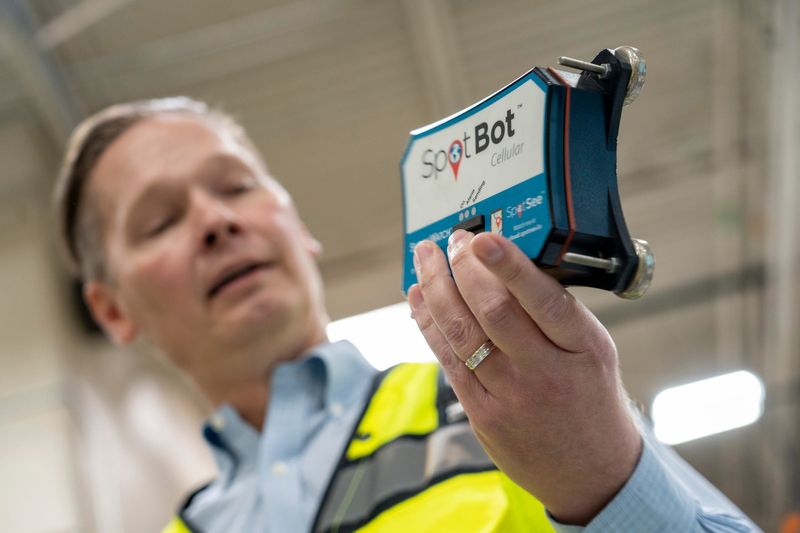
Next, Dely plugs in an actual truck’s road trip lifted from one of the “SpotBot” mobile data recorders that Ford attaches to delivery truck trailers to record routes. The engineers later use those recorded routes, like the one Dely plugged in during the simulation that day, to study the impact of potholes and bumps on the parts being shipped in the vehicle.
In this case, the difference between the standard test compared with the mobile data recorded route is striking. Within 30 seconds, the engines are bouncing around violently and, at one point, all 3,000 pounds of the steel base with both engines on top of it, lifts completely off the vibration table as the truck hit a bump.
“You can imagine how much force it takes to get the engines airborne? That’s based on real data,” Chesna said. “That could be a pothole, could be a curb pop, an unusually sharp turn, undulated pavement.”
The test proved to the engineers they needed to make changes to the steel base cradle that holds the engines during transport to mitigate engine damage in future shipments.
“There’s only so much we can do with the base steel,” Chesna said. “So we actually started putting in a urethane isolation puck that actually damps that motion.”
The team could also suggest the truck driver use routes that contain less bumps and potholes, but the trucking companies are independent contractors and make their own routes. Plus, sometimes there are no other routes as options. So it is up to Ford to redesign its shipping equipment to be extra protective.
Ford had to fix its own roads
But, in some cases, Ford’s team here can change the road being traveled to protect parts.
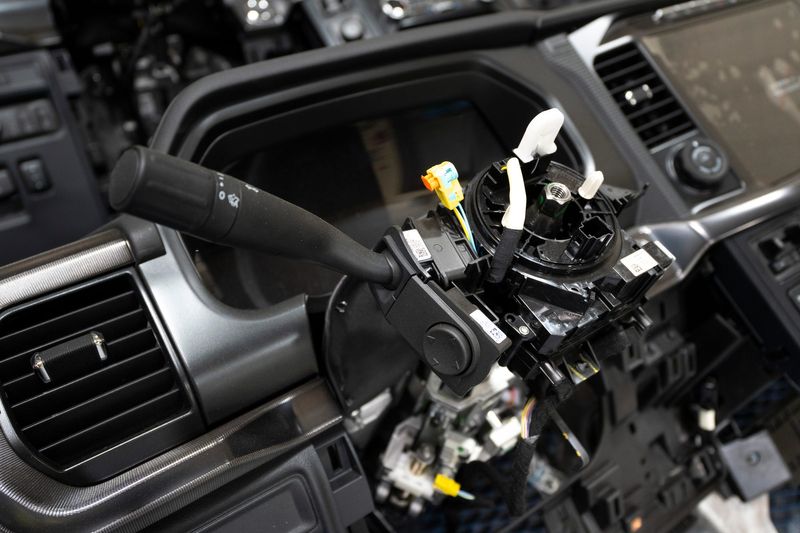
Around Christmas last year, Chesna said his team started getting complaints from workers at Dearborn Truck plant that some of the F-150 instrument panels arriving there had “parts jumping out of pocket” — meaning parts were being dislodged. Ford builds the profitable and top-selling F-150 pickup at Dearborn Truck.
For decades, Ford had shipped the F-150 instrument panels the same way: stacked back-to-back in a special rack. There were no problems with that shipment method, so engineers were perplexed. Then they found out what the culprit was: It was Ford’s own road.
“We’re all scratching our heads, and Steve went to the plant, put a SpotBot on the route and what we found was that some new speed bumps had been added to the site,” Chesna said. “So Steve met with Ford Land, and we changed the speed bump.”
Ford Land is Ford’s commercial real estate arm responsible for Ford’s properties. The engineers also added a reinforcement bracket to the crate that shipped the instrument panels for future protection and Chesna said, “None of this got through to the customer. We did capture it before that.”
Dely said Ford has benchmarked other industries for best practices for shipping. It has drawn from aerospace, food packaging, pharmaceutical, consumer goods and other automakers.
Testing improvements
Last year, Ford assembled more than 2 million vehicles in the United States, making it the top domestic auto producer for the year. All of that production involves a complex shipping schedule from suppliers to Ford’s 28 various plants — including powertrain, stamping, engine and more — across North America.
“Just to build the volume we do in North America, we receive 6,500 truckloads of material every day,” Chesna said. “About 150 railcars, 600 intermodal cans — that would be a mix of rail and truck — and a lowly 50 sea containers from overseas. That’s the amount of volume we get coming into our 28 facilities each year.”
Nearly 80% of the parts Ford ships are relatively small and can travel in standard plastic totes without damage. It is the bigger parts such as preassembled instrument panels, side-sheet panels, transmissions and electric vehicle batteries that require special equipment or processes that offer extra protection during transport.
As a result, Chesna and his team conduct about 400 tests a year on the shipping equipment used for those larger parts. Ford reuses all of its shipping equipment with each run so any tweaks made remain intact.
Ford spokesperson Sharyn Ghacham declined to provide a headcount for the number of people working at the shipping design and test center or share specific metrics on how much efficiency Ford has gained or costs reductions from the tests done at the center, only saying “we have trained our team on more rigorous new testing methods and we’re measuring progress meeting our quality goals and reducing the chances of quality issues.”
To make sure they are catching all problems and getting the most efficiency possible, the automaker has made technology upgrades to the testing center in recent years. About 20 months ago, Ford added compression testing to the site. That is a machine that tests the durability of corrigated boxes to support the shipment of heavy items such as transmissions.
“Any 10-speed transmission that Ford builds for around the globe comes out of Livonia, Michigan. We’re a huge exporter,” Chesna said. “So about 110,000 of those (cardboard) containers leave for overseas every year, and going through a sea container, the crane handling, all of the handling within the plants — compression testing allows us to make sure that over that duration — which can be 60 days, 90 days — that you don’t get any sagging, any loss of strength.”
The team also can test so as to not over-design a corrugated cardboard box either and waste money and resources. To prove that point, Chesna said the corrugated boxes Ford used for shipping in the recent past were “a triple wall sidewall” of corrugated cardboard. But through testing, Ford found it can get the same durability by switching to a less costly “double wall sidewall.”
Additionally, Ford recently installed new state-of-the-art hydraulic controls and other improvements to the vibration table to gain a 35% level of precision over what it had before. Ford also started doing 3D printing of parts, a technology that saves time, Chesna said.
“Before, whenever we had to make a minor change, we would call up one of our design providers, have them make up a part and it might be two, three, four days before we ever see a sample,” Chesna said.
Now his team can immediately make a 3D part and “put it right on the table, test it, and away we go,” he said.
Creative solutions to ship more
Beyond ensuring that parts arrive at factories undamaged, Ford also seeks ways to be more efficient to save money and lower its environmental footprint.
“If we can ship more of them together, we save on freight costs and environmental,” Strong said. “Fewer trucks, less diesel, less corrugated paper, all those things. These guys, their efficiency goal every year is: First, let’s get quality and then let’s help the environment and reduce costs for Ford.”
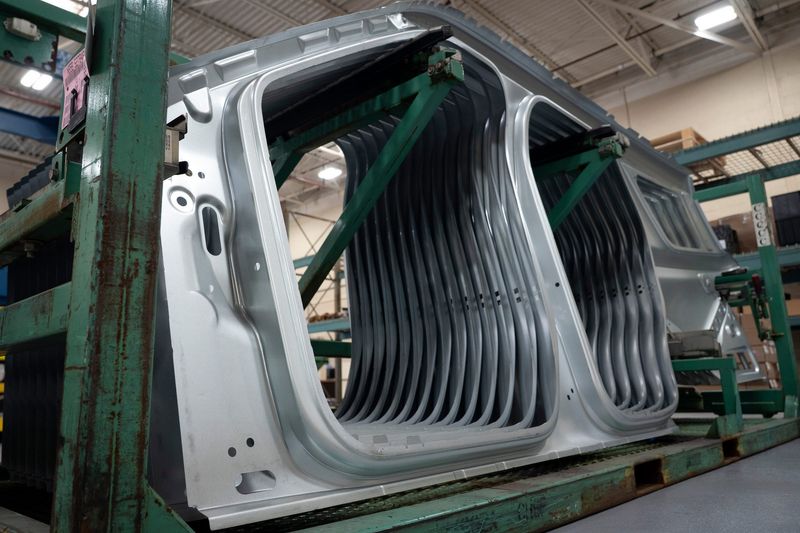
As an example, Chesna showed a rack loaded with body side outer panels for the Explorer SUV. A few years ago, the rack could fit eight panels per rack, but through testing and redesigning the rack, now a rack can fit 14 panels.
“So, for the business, we were moving 225 trucks a week from Chicago Heights Stamping plant over to Chicago Assembly,” where Ford makes the Explorer, Chesna said. “We now move 70. That’s 145 trucks less each week that need fuel, that never need a driver. We’ve cut the deliveries by almost two-thirds.”
Similarly, Ford’s team figured out how to move more of the high voltage batteries used for the all-electric E-Transit more efficiently and cheaply.
“Some of our past vehicles we would have used a steel fixer like you see over here,” Chesna said, pointing to flat cage-like bed supporting the giant battery. “This one happens to be aluminum, and because of the drastic weight difference, instead of getting 19 on a truck, we can get 25. So that’s a 30% improvement.”
Chesna explained that a truck can hold, by law, about 44,000 pounds of net contents whether it’s racks, parts or cargo. So the more that Ford can use that weight for parts, and the less of it that is rack, Ford gains efficiency.
“We load trucks and try to cube them out, which means you get as much in as you possibly can,” Strong said. “So you either space out or you weight out. And in this case, we were not spaced out. We weighted out. So these guys came up with a creative solution to switch to an aluminum rack.”
Chesna said the steel rack weighed about 700 pounds and the aluminum rack is 313 pounds.
“It’s 30% more batteries per truck,” Chesna said. “We will be replicating this on programs going forward because it’s been successful.”
The impact of rails
Ford has tightened its supply chain in recent years and shifted away from rail for most shipping.
“You or I could drive to Chicago right now and be there in five hours,” Chesna said. “If you go by rail, you’re looking at three days in and maybe five days back. That’s a huge pipeline you have to fill, and it just becomes a challenge today’s environment. So we’ve really shifted heavily toward truck.”
But Ford still uses rail to transport truck frames and some sheet metal, Chesna said. To test how shipping equipment endures those journeys, the test center uses its horizontal impact sled.
Dely is back in his control room starting up a demonstration on the impact sled of two railcars coming together in a rail yard at 8 mph with diesel engines in them. The test shows how the slow bump is catastrophic to the cargo inside, requiring extra securing parts on the racks that hold Ford’s products.
Factory safety also a responsibility
This test center is also responsible for ensuring the safety of Ford’s 56,000 hourly workers at its U.S. factories because it does all the pilot tests for everything from the safety vests plant workers wear, to the markings on the factory floor showing safety zones and the interactive signage in the plants.
“Anytime we’re debuting something new for pedistrian safety, we’re going to bring it here first,” Chesna said. “We’re getting a new dock lock — some new technologies there, LED signage that interacts so if a human enters the area, it’ll light up ‘Human.’ “
A dock lock is a safety device designed to immobilize a truck so that it does not move while it is being loaded or unloaded by forklifts.
“We take this stuff really seriously,” Strong said. “Saturday, Todd and I are on the phone and there was an issue at a plant. It didn’t get to the customer, but we didn’t understand what it was. He said, ‘I want to put a guy on a plane, get to the plant.’ So a guy was there Sunday night before the third crew started, and then we figured out what the problem was. This stuff is really serious toward Ford’s quality objective, making sure everything is is good and correct.”
With that, this small group of engineers at this nondescript outpost turn off the test equipment for the night to head home. But they remain ready to jump on a plane and go to a factory if needed to assess, test and resolve any future problems.
Jamie L. LaReau is the senior autos writer for USA TODAY Co. who covers Ford Motor Co. for the Detroit Free Press. Contact Jamie at jlareau@freepress.com. Follow her on Twitter @jlareauan. To sign up for our autos newsletter. Become a subscriber.
This article originally appeared on Detroit Free Press: Small Ford lab makes sure bumps don’t damage parts during shipping
Reporting by Jamie L. LaReau, Detroit Free Press / Detroit Free Press
USA TODAY Network via Reuters Connect