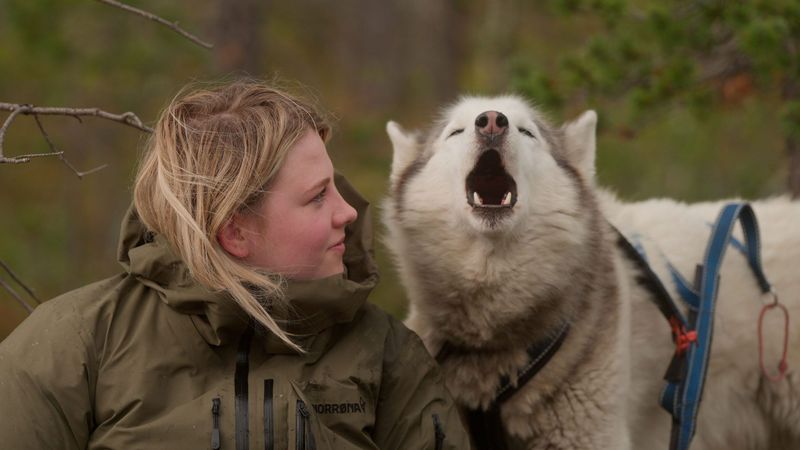
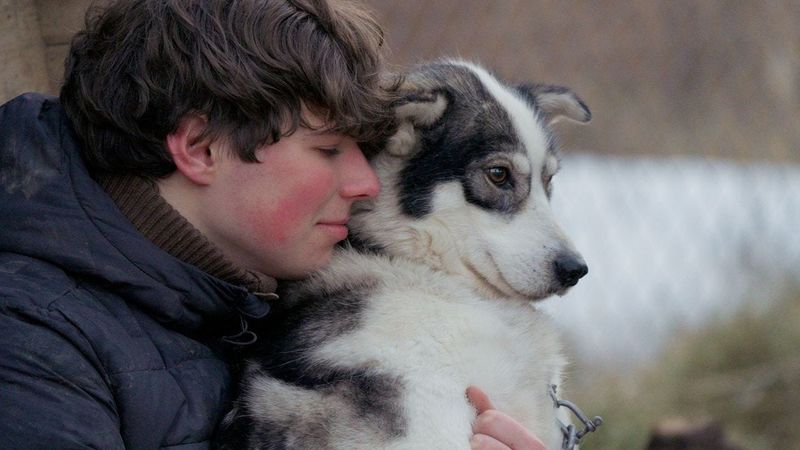
Before beginning her personal journey in a cold, remote area of Norway with a sled dog, Hege, a 19-year-old student, describes being a young woman on the cusp of adulthood this way: “Of course, it’s chaos. You’re trying to figure out your life.”
If that sounds like a universal struggle for teenagers in 2025, “Folktales” feels like a counterbalancing message of hope.

The latest documentary from Oscar-nominated filmmakers Heidi Ewing and Rachel Grady focuses on teens from around the world who spend a different kind of gap year at a traditional folk high school 200 miles above the Arctic Circle.
The students at Pasvik Folk High learn how to survive in the wild and build community as they discover more about themselves. Helping them along the way? A pack of Alaskan huskies that shares their energy and potential.
“Folktales,” which had its world premiere at the Sundance Film Festival, will be screened four times this weekend at the Detroit Film Theatre at the Detroit Institute of Arts. Ewing, who grew up in Farmington Hills, will be attending question-and-answer sessions at two of the screenings, the 7 p.m. show on Aug. 2 and the 2 p.m. matinee on Aug. 3.
Ewing and Grady earned an Oscar nomination for the 2007 documentary “Jesus Camp.” Their 2012 collaboration “Detropia” put a spotlight on the Motor City, offering a beautiful yet unflinching look at its fight to stay financially afloat in the new global economy.
Ewing also is known for directing 2021’s “I Carry You With Me,” her first narrative feature. It’s about two gay immigrants from Mexico and their decades-long love story, and weaves a fictionalized account with documentary footage of the real couple.
Although “Folktales” is different from any other project that Ewing has tackled, its sensitivity to its subjects and its beautiful visual style are, like her other works, life-affirming for viewers of any age. Ewing spoke to the Free Press this week about making the documentary and her own takeaway from time spent at Pasvik Folk High. The following is edited for length and clarity.
QUESTION: How did you learn about the Pasvik Folk High School?
ANSWER: During March or April 2020, I heard the last four minutes of a podcast. It was an interview with Blair Braverman, an American dog sledder, and she was talking about the power of the dogs and when you’re out with them alone. I got intrigued and bought her book, an autobiography called “Welcome to the Goddam Ice Cube.” In the second chapter, she talks about when she was 17, dreaming of the north, and she signed up for a folk high school in Norway for a year. And it changed her life.
I said to Rachel, “Have you heard of a folk high school?” And she said, “No, what’s that?” I thought for sure it was a tradition that was no longer around. But instead I found out there are 400 of them. They’re all over Scandinavia. They’ve been going for over 100 years. And the ones in Norway are especially interesting because a lot of them in the north focus on outdoor living, Arctic survival and the use of Alaskan huskies to teach bravery, self-confidence.
We started researching. In March 2023, we visited five of them. When we hit Pasvik, it was so punishing and barren and beautiful and mystical. We met the two teachers, and we knew there was a great movie there.
Q: How much time did you spend filming in Norway and did you use any strategies to not interfere with the student experience during the process?
A: It was very, very tricky because, first of all, Gen Z is used to controlling its own image. They like to do the selfies. We hadn’t made a film about Gen Z, and they’re not used to other people telling their story. So that was the biggest challenge of all.
We filmed over the course of one year. We went about 14 times between the two of us. We’d take turns going. We had a Norwegian crew that was in Oslo, so they could go at the drop of the hat if something were to happen. We used especially long lenses. It was a lot of challenges, especially during the solo night sequences. They were supposed to be out there alone. We had to really make sure we weren’t interfering in any way and only approach the students when the teachers did.
It was, production-wise, the biggest challenge of my career because it was 30 below. The drone kept falling out of the sky. The batteries kept dying. Dog sledding is especially hard to photograph because you can’t put your cinematographer on the sled. It’s just too heavy for the dogs. It was just a series of “trial and failure,” we called it jokingly. In the end, I think we finally nailed it, but it took a long, long time.
Q: Can you talk about the sled dogs and their relationship with the students, which is amazing?
A: I would say that there is hardly anyone that would argue with the statement that the husky is probably the most challenging breed. When I see people with huskies in cities, I have no idea how they’re coping. They’re meant to be outdoors. They’re a handful. They’re large. They’re strong. They have all the wonderful qualities of dogs. They’re affectionate, loving, but they’re also very demanding. They have to run. They have to exercise. They’ll stare you in the face until you blink first.
It’s the perfect animal to put with a teenager. You can’t be on your phone, you can’t be in your head when you’re dealing with an Alaskan husky. You’ve got to be 100% present at all times, and I think that’s part of the point, right? They have to take care of the dogs, feed the dogs, train the dogs, and it really takes up their time and all their mental space.
I really saw young people get right out of their comfort zone by training these dogs. It’s all part of the folk high school method to teach growth and nurturing and also to get someone to think about someone outside of themselves. And it really worked.
Q: What most impressed you about the method of the high school? It seemed very challenging, yet very compassionate.
A: All the folk high schools have something in common, which is they focus on the group over the individual. They focus on community and what’s best for all of us. I think in this day and age of hyper-individualism, that came as a real shock to some of the students.
There are kids from all over the world, United States, England, France, Iceland, Norway. We all are victims of our own self-obsession. We can be very, very selfish as human beings right now. The folk high school really does not promote that. It’s about talking things out, helping one another. When you see it in action, you really start believing that people should be living in communities the way we used to in the Stone Age times, as they say in the school.
Q: What do the students take home from their year that really struck you?
A: A lot of students really did find a new version of themselves, a new way to describe themselves and a different context to view themselves and their future. They accomplished things they never thought they could ever do. When you have to be out there in Arctic temperatures by yourself with just a dog and you have to build a fire and cook for yourself and survive, that does something to a person.
It seems so simple, but you have to rely on yourself to survive. We don’t have to do that anymore. We’re not taught these skills anymore. I found they walked taller; they walked stronger. They were all infused with this new self-confidence and this glint in their eye by the end. I saw major changes in the subjects we followed.
Q: How were you affected by your stay there?
A: I have to say that I don’t have kids. I have, like many people, taken sometimes a critical view of Gen Z. You know: “Why are they always on their phones? Why do they seem so soft?” And all the things that people say about Gen Z.
But honestly, after spending a year with this cohort, I really changed my mind. This is a very tender group of people that’s been given a hard lot in so many ways. These are COVID kids. And you know what? They want to have adventures, they want to grow, they want to have friends, they want a future, they want to fall in love. They want all the same things that we did growing up.
I really grew to be fond of and empathetic with this group of teenagers that have a very uncertain future. I really embrace this age group in a way I didn’t before.
Contact Detroit Free Press pop culture critic Julie Hinds at jhinds@freepress.com.
‘Folktales’
7 p.m. Aug. 1, 3 and 7 p.m. Aug. 2, 2 p.m. Aug. 3 (Director Heidi Ewing will be present for Q&A sessions after the 7 p.m, Aug. 2 and 2 p.m., Aug. 3 screenings.)
Detroit Film Theatre at the Detroit Institute of Arts, Detroit Film Theatre
5200 Woodward, Detroit
$11.50 for non-members; $9.50 for members (with card), seniors and students (with ID).
For tickets, go to https://dia.org/events/detroit-film-theatre
This article originally appeared on Detroit Free Press: Sled dogs help Gen Z teens cope with growing up in documentary from ‘Detropia’ filmmakers
Reporting by Julie Hinds, Detroit Free Press / Detroit Free Press
USA TODAY Network via Reuters Connect