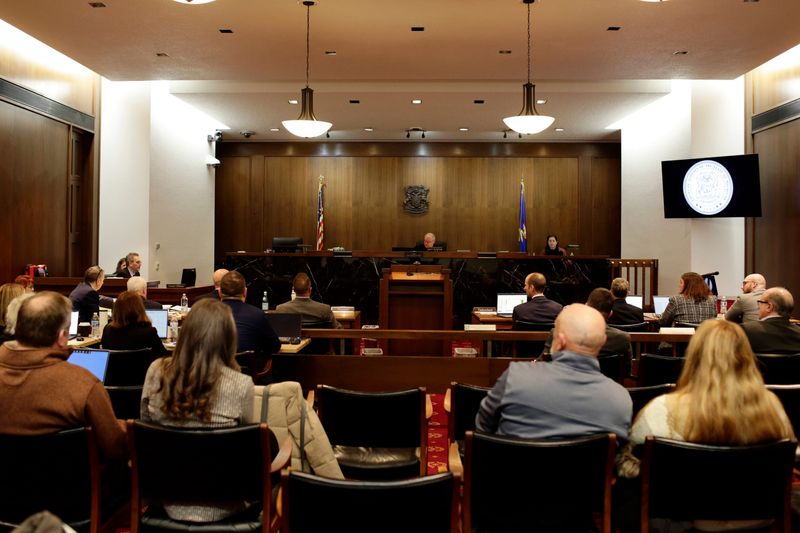
A judge sided against Sanford-area residents pursuing a lawsuit against the state of Michigan, determining they didn’t prove the state was liable for damages caused by the 2020 Edenville and Sanford Dam failures.
Thousands of Gratiot and Midland County residents who lived near the dams accused the Michigan departments of Natural Resources and Environment, Great Lakes and Energy of causing their properties to be destroyed by the dam failures.

The state was aware of problems at the Edenville Dam, such as the lack of spillway capacity, they argued, yet still allowed the dams’ then-owner Boyce Hydro to return Wixom Lake to its normal level instead of ordering it to be lowered to “run-of-river.”
The residents had argued those actions constituted an inverse condemnation of their property, meaning Michigan recovered the value of their property without a formal eminent domain process. Residents had to prove the state took overt action specifically toward their properties, abused its governmental power and substantially caused their permanent property loss.
In a Thursday order, Court of Claims Judge James Robert Redford ruled the state is not liable for their property damages. He said negligence in licensing and enforcement does not count as inverse condemnation of property.
In his order, Redford pointed to findings from a 2022 independent forensic report that determined the Edenville Dam failed because of “numerous physical and human factors,” including the rain, the dam’s outdated design, poor analysis of the dam’s stability and the dam’s owners not paying for expensive spillway upgrades.
The report indicated that lower lake levels may not have prevented the failure, Redford said.
Residents’ attorneys said they will continue to pursue legal claims on behalf of flood victims.
“We appreciate the time and careful consideration Judge James Robert Redford devoted to this case,” attorneys Kevin Carlson and Megan Bonanni of Pitt McGehee Palmer Bonanni & Rivers and Sharon S. Almonrode of The Miller Law Firm said in an emailed statement. “While we are disappointed by this decision, our commitment to the residents impacted by the Edenville Dam failure remains unwavering. We will investigate all available avenues to hold responsible parties accountable and pursue justice for our clients.”
EGLE spokesman Dale George described the dam failure as “a devastating tragedy.”
“Recent flooding events continue to highlight the importance of modernizing dam‑safety oversight, strengthening inspection and planning requirements, and ensuring the state has the tools needed to identify and address high‑risk structures,” George said in an emailed statement. “EGLE remains committed to working with partners and communities to strengthen protections and prevent another disaster.”
Attorney General Dana Nessel said Redford’s ruling was decisively in the state’s favor on every key legal issue.
“The Edenville Dam failure was tragic, and while the evidence has always shown the state was not responsible, we have taken decisive action against those who were,” Nessel said in a press release, referring to the state’s lawsuit against then-dam owner Boyce Hydro. “We acknowledge the lasting impact this has on mid-Michigan, and our thoughts remain with those affected.”
Dam failures not caused by mussel fight, judge rules
The Edenville and Sanford dams failed after heavy rains poured onto central Michigan in May 2020. The dams released two lakes’ worth of water downstream, wiping away properties and causing hundreds of millions of dollars of damage.
The dams were owned and operated by Boyce Hydro, a private company that filed for bankruptcy after a federal judge ruled it was liable for $120 million in damages. In that case, Boyce Hydro’s operator Lee Mueller acknowledged the company had not implemented a planned cutoff wall that would likely have prevented the failure, Nessel’s office said Thursday.
Boyce Hydro had lost its federal permit to generate power from Edenville Dam in 2018, which put enforcement of dam safety standards into the state’s hands.
Although he did not side with the residents, Redford acknowledged the immensely difficulty and heavy burden they suffered because of the dam failures.
“The court recognizes these losses,” he wrote. “They are real and lasting.”
In arguments in Redford’s Grand Rapids courtroom early this year, residents’ attorneys said the state was pressured to allow the higher Wixom Lake levels because of the DNR’s interest in protecting a species of native mussel and by the Four Lakes Task Force, a nonprofit homeowners’ association set to become the dams’ owner and fund repairs.
Four Lakes Task Force now owns and is repairing the Edenville, Sanford, Secord and Smallwood dams in Gladwin and Midland counties. The Sanford Lake dam is now operational and the lake is being refilled, the organization said on April 15.
Lower lake levels may not have staved off a failure, Redford said. Although it granted a lake level permit, the state was not in direct control of lake levels.
He ruled the DNR did not abuse its authority in seeking more than $300 million in monetary damages to protect mussels in Wixom Lake. Redford said residents didn’t prove the mussel protection efforts had a direct causal effect on Boyce’s application to raise the lake level.
“Numerous experts testified that a modest investment in adding support or drainage in the left embankment may have averted its breach,” Redford wrote, “but the record does not support a finding that this governmental action influenced Boyce’s failure to make this investment, or its decision to return the water level to the summer level or its failure to build an auxiliary spillway.”
ckthompson@detroitnews.com
This article originally appeared on The Detroit News: Residents lose bid to hold Michigan liable after 2020 dam failures
Reporting by Carol Thompson, The Detroit News / The Detroit News
USA TODAY Network via Reuters Connect