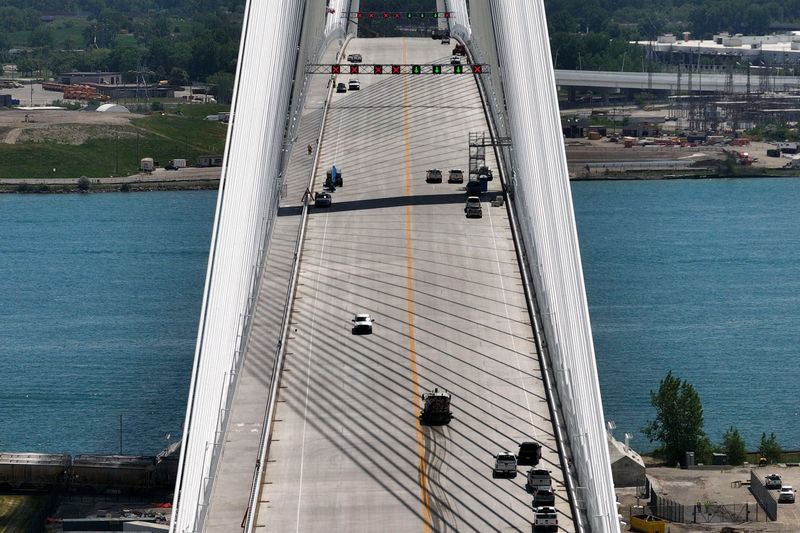
Windsor — When the long-awaited Gordie Howe International Bridge finally opens to truck and passenger vehicle traffic, it also will be open to people crossing on foot or by bicycle.
The 1.5-mile-long, six-lane span contains a dedicated bike and pedestrian lane facing upriver with views of the Detroit and Windsor skylines and each city’s respective riverfronts.

As the new bridge remains entangled in an unspecified political dispute between Washington and Ottawa, Windsor leaders are anxiously awaiting the opportunity to showcase their city to Michigan residents in ways the aging 97-year-old Ambassador Bridge or Detroit-Windsor Tunnel have never been able to.
Windsor Mayor Drew Dilkens recently sat down with Detroit News Politics Editor Chad Livengood to talk about the new $4.7 billion bridge and how it will change the way Americans and Canadians cross back and forth along the border.
This partial transcript has been edited for clarity.
Question: How is this new bridge going to change how people are accustomed to interacting with the U.S.-Canadian border?
Answer: On the human connection side, the fact that you’ll actually be able to ride a bike or walk across the bridge, that’s a different experience than just driving across and getting on a highway, right? And I think in both directions, you’ll have a lot of Windsorites who are interested in going to Detroit and getting on the pathway that leads to the waterfront in Detroit, which is now remarkable. They’ve done a huge amount of work and spent a lot of money there improving the waterfront. We look forward to seeing that — and, I think, vice versa. You know, a lot of folks from Michigan, Detroit will want to come over and just try the Gordie Howe Bridge.
Q: For folks who are not familiar with the area where the bridge lands, do you call it downriver Windsor?
A: Where the bridge lands, we would just call it West Windsor. It’s actually the oldest part of the city. It was formerly known as Sandwich Town.
Q: When people bike over, where are they going to go from there?
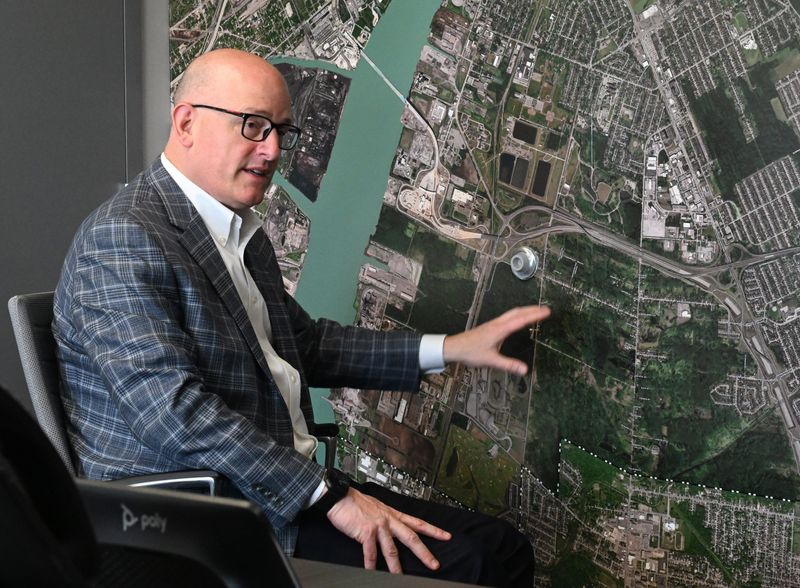
A: So when you get off the bridge, you’ll be able to get on basically Sandwich Street on industrial waterfront. This whole roadway, Sandwich Street, has been entirely rebuilt, and there are bike lanes on both sides, and you’ll be able to get right to the waterfront. … And then, once you bike to the Ambassador Bridge, you are on waterfront trails. It’ll take you from the Ambassador Bridge all the way to Hiram Walker, which is the distillery and (there are) several miles of trails there.
If you didn’t want to drive and ride your bike along the waterfront right here, we’re just in the process of building a national urban park (the Ojibway Prairie Provincial Nature Reserve). … This is a very beautiful place, protected area in the city of Windsor, and it’s going to become a federal national urban park, and you’ll be very close to that, and so if you wanted to experience that, you could.
And then, of course, there is the Herb Gray Parkway (that connects the Gordie Howe bridge to the Ontario 401 provincial highway). All along this Herb Gray Parkway is a trail that runs on both sides, which is several miles long, and it’s absolutely remarkable. And so people will be able to choose their own adventure here, and whatever you choose, it’s going to be a great experience.
Q: Is there anything cyclists need to know about crossing the border on two wheels?
A: The funny thing is, well, I have a pedal-assist bike.
Q: We won’t judge here.
A: I thought for years about buying one, thinking, OK, I’m going to be old if I buy one and someone, who’s a cyclist who doesn’t use pedal assist, they said to me, “Drew, if it gets you out riding … and you get 80% of the exercise, then that’s a good thing, right? So I said, ‘OK, I like the way you’re phrasing it.'” So there was an issue most recently about the standards in the United States versus Canada, because we do have different standards. The maximum speed for a pedal-assist bike in Canada nationally is 32 kilometers per hour (about 20 miles per hour). In the United States, the same bike is calibrated to go 45 kilometers an hour (about 28 miles per hour). So we had to sort of amend things here to be able to allow (faster American pedal-assist bikes). We just passed everything we needed to approve at our last City Council meeting, so it’s good from our end. There will be no hiccups.
Q: So you can go 45 kilometers now?
A: Yeah, we’re not going to restrict. The expectation is that people will follow the law in Canada.
Q: Do you think this is going to change the way Canadians and Americans interact or visit each other’s side of the river?
A: I think it just presents more opportunities. We’ve not been able to ride a bike or walk across the Ambassador Bridge since the late 1970s, if I’m correct. So it’s been 50 years, basically. So people haven’t been able to do that — short of the marathon.
We’re the two closest urban areas on, you know, either side of the U.S.-Canada border. We share the world’s longest undefended border, and we’re the two closest cities, so we have a unique relationship vis-à-vis any other communities on either side of the border. Our relationship’s unique. It’s unique in terms of the economics that play out in the way we’ve built supply chains, and I think it’s unique in many different ways.
I went to Wayne State and did a degree at Wayne State, you know, my brother did a program, respiratory therapy, over in Michigan, met someone, fell in love, married him, and he’s built his whole family over there. Living here allows you to have the best of Canada and the best of the United States. A lot of people have said to me over the years, “I can’t believe he stayed in Windsor, I thought you’d move to Toronto, you could do better in Toronto, more in Toronto.” I said, “Well, why would I want to live in Toronto with all that chaos?” If I want good dining, shopping, theater, concerts, and sports, it’s 10 minutes away. I don’t need to go to Toronto and go through that chaos. I already live in the best community. I’ve always just considered Detroit to be my backyard. It’s like a great place to live, and I think a lot of Detroiters think the same thing about Windsor. And this (new bridge) just gives people another way and another reason to go across the border.
Q: You’d have to become a Leafs fan if you moved to Toronto, though.
A: Well, that’s a sad story. If you’re a Leafs fan, you’re never happy. It’s been a long dry spell.
This article originally appeared on The Detroit News: Q&A: Windsor mayor on how new Gordie Howe bridge will open up areas for walkers, cyclists
Reporting by Chad Livengood, The Detroit News / The Detroit News
USA TODAY Network via Reuters Connect
By Chad Livengood, The Detroit News | USA TODAY Network