As local motorists gas up to travel this Memorial Day weekend, they may be glad to leave the headaches of driving in Metro Detroit behind, at least temporarily.
From potholes to construction to confusing roundabouts to sky-high auto insurance rates, motoring in and around the Motor City comes with a high frustration factor.

Why does it feel like driving in Metro Detroit is such a drag? You’re not imagining it — the data backs it up.
Researchers at WalletHub, for example, ranked Detroit 94th out of the 100 biggest cities in America for drivers last year.
The personal finance website ranked the 100 largest U.S. cities to find the best and worst places to drive, comparing cities across four broad areas: costs, traffic and infrastructure, safety, and access to vehicles and services.
Using 2025 data from government and industry sources, the researchers assigned cities a score out of 100 in each category, then combined the results into an overall ranking.
“While road quality is a concern, the biggest area in which Detroit did not do well was in safety,” according to Chip Lupo, a WalletHub analyst, referring to the city’s frequent crashes and high rate of car theft.
Poor road quality and frequent crashes make for a dangerous mix, Lupo said, especially with Michigan winter weather: “There’s probably some lifelong Detroiters or Michiganders in Detroit who think that they’re above the elements.”
“People will readily admit to you that they can’t sing, they can’t dance, they’re terrible golfers. No one will readily admit to being a bad driver,” Lupo added.
For Detroit resident April Milton, “crazy drivers” are the biggest frustration. She said she has stopped taking the John C. Lodge Freeway to work to avoid them, but hasn’t had much luck.
“They’re even crazy on Woodward,” she said, “so it’s like a lose-lose situation, you can’t escape them.”
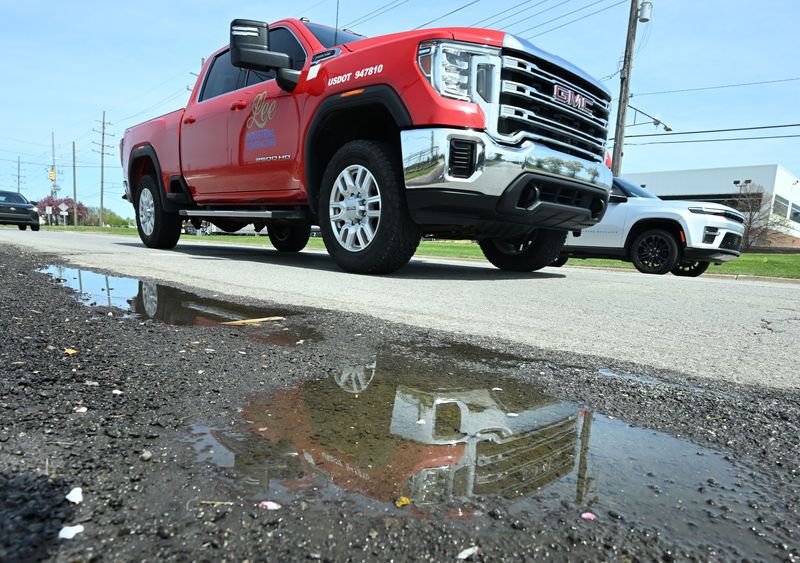
Known pothole hotspots also alter Milton’s routes when she’s driving in Detroit. She said she avoids Meyers Rd. between Six Mile and Curtis St., she said.
‘Fix the damn roads’
Gov. Gretchen Whitmer made “fix the damn roads” her rallying cry, though the origin of the phrase is contested. Former Michigan Senate Majority Leader Randy Richardville, a Republican, claims he coined the phrase in 2014, four years before Whitmer, a Democrat, made it her 2018 campaign slogan.
Whoever coined the phrase, nearly eight years after Whitmer was elected, most drivers would likely agree that the roads still aren’t fixed.
With just about every major Metro Detroit interstate under construction this summer — including 696, 94, 75 and key interchanges like M-14 at 275 — almost nobody is getting anywhere quickly.
And what are the conditions of the roads to begin with?
They’re certainly not good, according to data on pavement conditions collected by the Southeast Michigan Council of Governments.
Across the three counties that make up Metro Detroit, 16% of lane miles were in “good” condition, using a common pavement rating system. The average road in the region barely managed a “fair” rating.
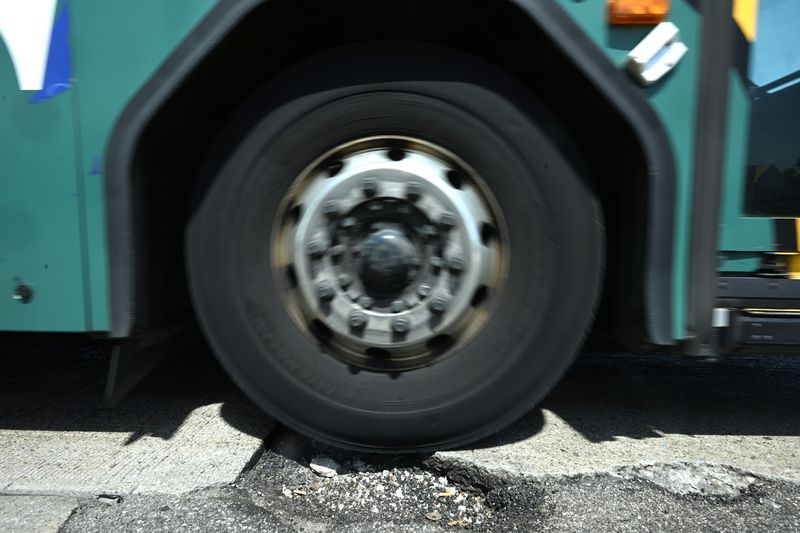
About 7,000 road segments, amounting to 440 miles, share the worst possible road rating at 1 out of 10. That includes more than 25 cumulative miles of Eight Mile.
The culprits, according to Michele Fedorowicz, SEMCOG’s manager of transportation planning, are mainly harsh winter weather and heavy traffic volume along the region’s main roads.
Fedrowicz said many roads in Metro Detroit have to be completely resurfaced every five to seven years, which can make drivers feel like the maintenance is constant.
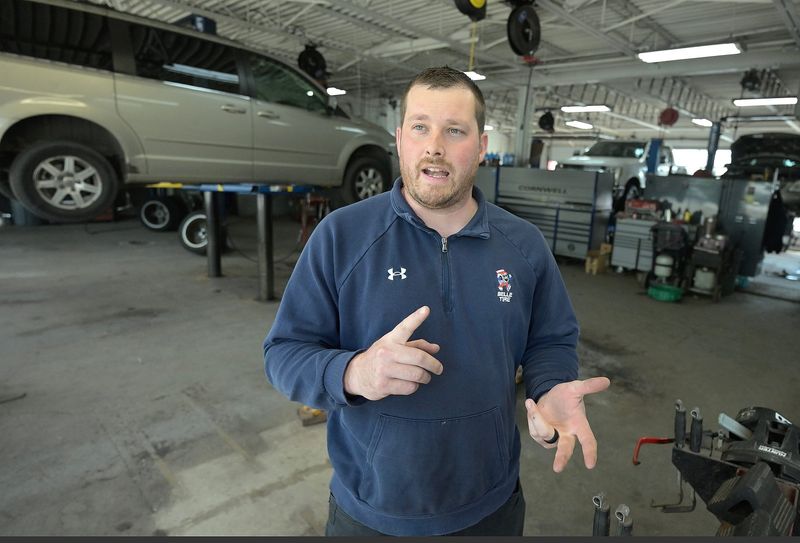
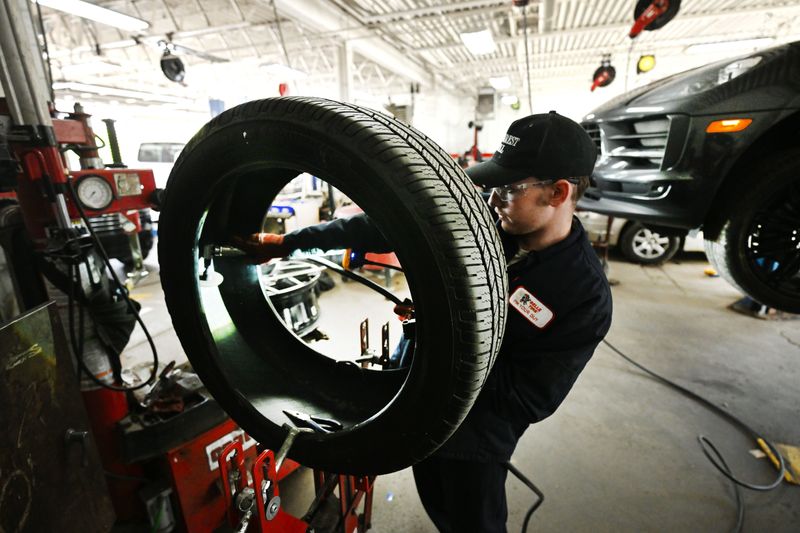
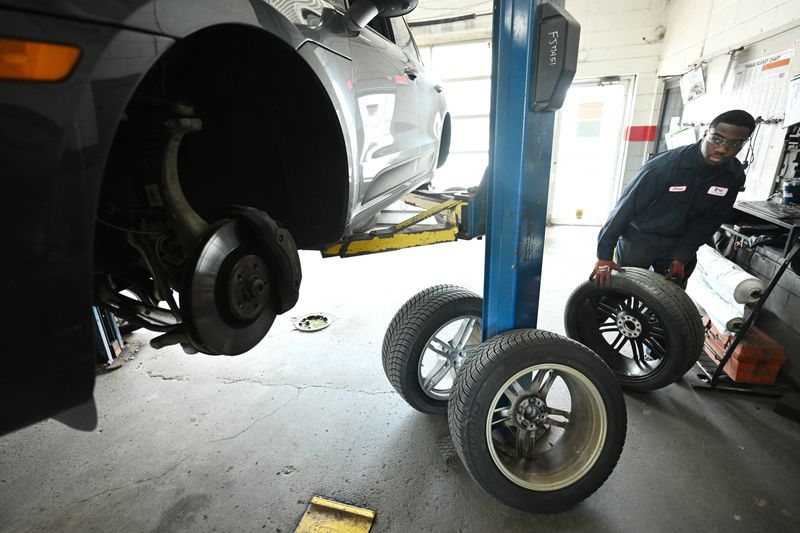
Mechanics at Metro Detroit’s many Belle Tire locations see the carnage of pothole-riddled roads firsthand.
“You get someone almost every day,” said Ryan Finley, who manages Belle Tire in Grosse Pointe Farms. “You always get a handful of customers coming in, getting potholes around the Metro Detroit area.”
Finley, who has worked at Belle Tire for more than a decade, said the freeze-thaw season of spring is the worst time of the year for potholes.
“It’s definitely very bad. I don’t know if it’s how the roads are done, but definitely around this time, potholes appear more than they do in (other seasons),” he said.
The vehicles Finley most often sees with tire damage are cars like Cadillacs or BMWs, which have “low-profile” tires. Drivers who opt for an SUV or a truck tend to be more protected from treacherous roads, he said.
“The biggest thing is trying to avoid them,” Finley advised. “There is nothing you can do. You can get the most expensive tire, the cheapest tire, it’s going to happen.”
100,000 crashes a year
Unfortunately, the risk on Metro Detroit roadways goes beyond a flat tire.
There are a lot of crashes on Michigan roads — including more than half a million in Metro Detroit from 2020 through 2024.
Both the city of Detroit and the region as a whole have higher crash rates than the U.S. as a whole, according to data from the National Highway Traffic Safety Administration and the University of Michigan Transportation Research Institute.
The city’s rate of 37.7 crashes per 1,000 residents was twice the U.S. rate of 18.2 crashes per 1,000 residents in 2024. When all of Wayne, Oakland and Macomb counties are included, the crash rate was slightly lower — 27.4 crashes per 1,000 residents — but remained 50% higher than the U.S. rate.
While the most densely populated part of the state naturally produces the most crashes, there’s more to it than the sheer number of people.
“On some of the roadways, the speed limit is a ceiling, but it seems like in Metro Detroit, it’s often treated as the bottom line,” said Shan Bao, a research associate professor at the University of Michigan’s Transportation Research Institute.
A few Metro Detroit communities stand out in the Michigan crash data:
When the personal-injury law firm Michigan Auto Law recently released its rankings of the most dangerous cities for car crashes in the state, Metro Detroit communities like Auburn Hills, Romulus and Southfield also ranked highly.
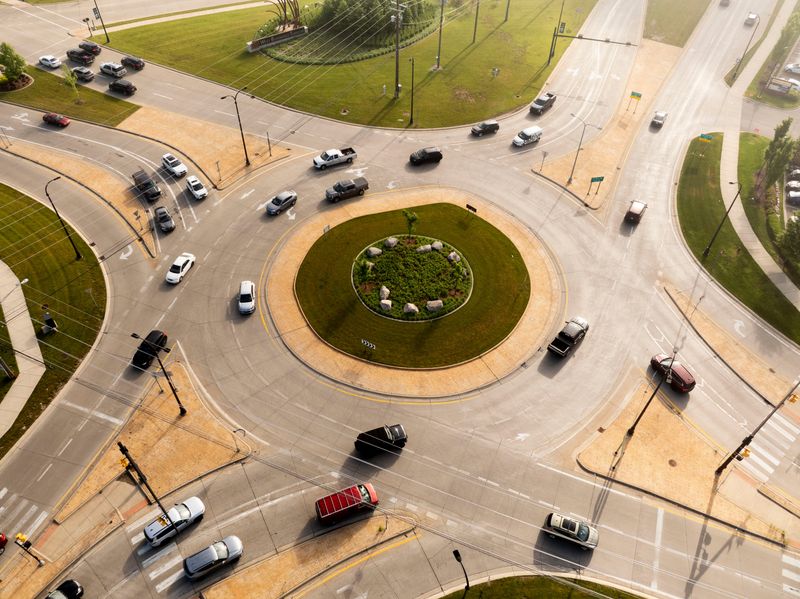
Many of the intersections where the most crashes occur in and around Detroit are roundabouts, which have become more common in Michigan during the last decade. Despite relatively high overall crash rates, roundabouts can actually reduce dangerous and fatal crashes, according to transportation safety experts.
David Harkey, president of the Insurance Institute for Highway Safety, told The News last month that roundabouts can reduce fatalities at an intersection by 80%.
Bao’s research at UM goes beyond the raw number of crashes to investigate why they occur: She studies both the human and environmental factors that cause accidents.
According to Bao, the major environmental issues that cause crashes are lighting, road infrastructure, traffic and weather conditions.
That last factor is especially relevant in Michigan, with its freezing temperatures and heavy precipitation throughout the winter.
Speeding-related crashes are significantly higher during the winter in Michigan, with three to four times as many people involved in that type of crash from December through February as in June through August from 2020 through 2024, according to Bao.
Who’s in the car matters too. Factors like age — teenage and elderly drivers are more likely to crash — and behaviors like seatbelt use impact driving safety.
“The teenager’s crash risk is way higher than the middle-aged cohort, because they lack experience,” Bao said.
“They tend to do more risky things, and they are so good with their smartphones compared to other ages, so a lot of them, they’re overconfident about their skills,” she explained.
In Michigan in 2024, young drivers 15 to 20 years old made up 6.3% of the driving population, but accounted for 10% of drivers in all crashes, according to Michigan Traffic Crash Facts, an initiative at the University of Michigan Transportation Research Institute.
Why is car insurance so expensive?
As if shoddy roads and frequent crashes weren’t enough, Detroit drivers face some of the highest car insurance premiums anywhere in the country.
Between 2022 and 2024, the cost of car insurance in the U.S. increased at an “unprecedented” rate, though it leveled off in 2025, according to Matt Brannon, an insurance analyst at Insurify.
Michiganians weren’t so lucky, as the average premium rose 12% last year, making Michigan the fourth-most expensive state in the United States for full-coverage insurance.
It’s an outlier in the Midwest too: Neighboring states like Wisconsin and Ohio are among the top 10 cheapest states for car insurance in the nation. Most states with comparable insurance costs — Nevada, Florida, Georgia, and South Carolina — have the one-two punch of high dangerous driving rates and severe weather risks.
Brannon said both regulatory and individual risk factors, along with high uninsured rates, are to blame for the inflated costs.
Michigan is a “no-fault” insurance state, which means each driver’s policy covers their own medical bills, regardless of who caused the accident. That means insured drivers must have Personal Injury Protection on their car insurance.
Brannon said this usually adds an extra $10,000 in coverage (and risk for insurers), leading to higher premiums.
About 22% of drivers in Michigan are uninsured, according to Brannon, the fourth-highest rate in the U.S. and the highest in the Midwest. Higher rates of uninsured drivers drive up premiums for everyone else.
The weather doesn’t help, either. In 2023 and 2024, there were more than 100 hail events across Michigan, damaging vehicles and causing still more insurance claims, according to Insurify data.
“For every $100 that the insurer makes in premiums, in Michigan, they pay out $70 in claims,” Brannon said. That’s the eighth-highest loss ratio in the country.
Brannon explained that urban areas tend to bear the brunt of high insurance costs in any state, because more people means more congestion, more crashes and more claims to pay out.
The city of Detroit takes that to an extreme. The average annual full-coverage premium at the end of 2025 was $5,701, according to Insurify’s proprietary database. That’s roughly double the Michigan average and triple the national average.
Despite those depressing numbers, Detroiters might get some relief from rising costs this year, according to Brannon.
“Michigan may have passed through like the worst of the big car insurance spike, so we could see a little bit of optimism in 2026,” he said.
Road work in southeast Michigan is ‘never really done’
The state of southeast Michigan roads isn’t a secret. And fixing those roads accounts for a sizable share of the Michigan Department of Transportation’s annual budget, with some help from the federal government.
Still, as MDOT spokesperson Diane Cross told The News, “it’s never really done, right?”
“These freeways that we’ve redone in the last 10 years, we’re not going to be out here for another couple decades. … But the moment it’s done, the clock’s ticking,” Cross said.
The department prioritizes funding projects that will have the greatest impact, such as an extensive reconstruction of I-94 that began earlier this year, she said. Dubbed “Restore 94,” the project will ultimately cover 13 miles of I-94 from Wayne Road, near I-275, to the Dearborn-Detroit border at Michigan Avenue.
Lane closures and detours along the route started affecting drivers at the beginning of March.
Cross’s MDOT colleague, Rob Morosi, said the agency has come to expect the frustration that accompanies major road work.
“You know that people are being inconvenienced. However, in terms of safety, that work needs to be done. … We know that the safety elements of the improvements outweigh the frustration that people feel,” Morosi said.
bwarren@detroitnews.com
This article originally appeared on The Detroit News: Potholes, crashes, sky-high insurance make driving in SE Michigan a drag
Reporting by Ben Warren, The Detroit News / The Detroit News
USA TODAY Network via Reuters Connect