At the Bloomfield Township Senior Center, pets are part of the draw in an adult day program for people with dementia.
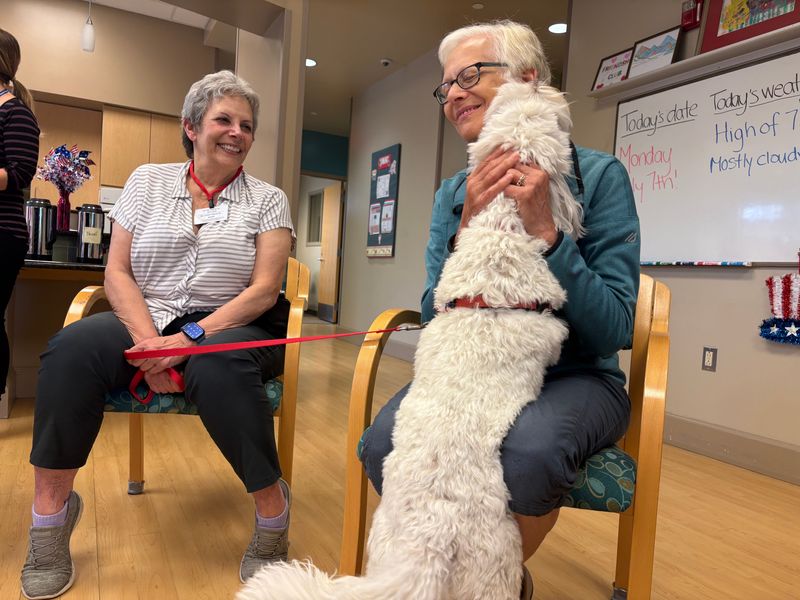
Kay Presby didn’t mind when Raffi, an Australian labradoodle, eagerly licked her neck during a visit last summer. A woman sitting nearby, Nancy Carvey, joked that Presby got “a good face wash” from the dog.

Presby and Carvey participate in a service in which people with dementia or other cognitive challenges can be dropped off at the senior center for four hours to participate in various activities, giving their caregivers a break. Pets visit the program, called the Friendship Club, a couple of times a month.
The programming, funded by a special millage in Bloomfield Township to bolster senior services, represents an effort by local government to provide a specialized service that one expert calls a “strong first step” in managing memory loss. The township is among a number of Metro Detroit communities that are dedicating more funding and resources to address the needs of Michigan’s growing senior population.
Presby, 74, a Bloomfield Township resident whose husband cares for her, told The News that dogs are “great.”
“We begged as kids to get a dog, and my parents finally did, and they would never let him come in the house,” she recalled, adding that the pet had a dog house.
Bloomfield Township is one of just a few cities and townships that run adult day programs in Metro Detroit, said Christine Tvaroha, the township’s former director of senior services, who retired earlier this month.
The OPC Social and Activity Center — a senior center that serves Rochester, Rochester Hills and Oakland Township — and the city of Farmington Hills also offer the service, according to Tvaroha.
Tvaroha said she thinks the need for these programs is growing because people are living longer and dementia is common, affecting over 6 million Americans, according to the National Institutes of Health. Tvaroha said adult day service is well-positioned to be the “best first round” of intervention.
“There’s all kinds of research that shows that staying active, staying engaged, learning new things, meeting new people help our neuroplasticity, right?” she said. “So we’re helping to grow our brains while we’re doing all these new things, and you don’t get that when you’re sitting at home going through your same paces or watching TV for eight hours a day and that sort of thing.”
A look at Bloomfield Township’s program
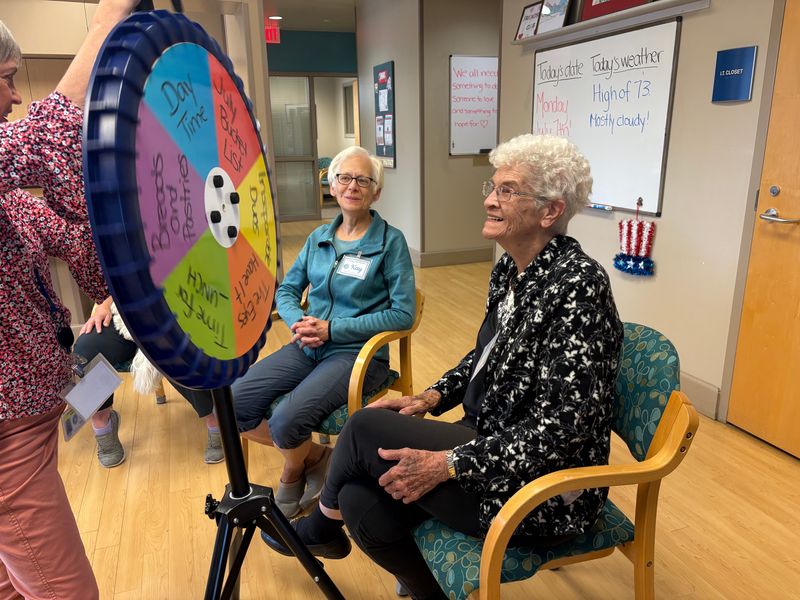
While the dogs were visiting on July 7 last year, Presby and the other participants in the Friendship Club also played trivia. They took turns spinning a big, multi-colored wheel, which determined the category of the next question they would answer. Fourth of July decorations hung from windows and were propped on tables in the room, adding to the celebratory atmosphere.
Presby told The News that the adult-day program is “really nice.”
“It’s a nice space, a lot of good activities, good food,” she said.
Bloomfield Township’s program includes lunch and is offered two days a week, but the township will add another day to the program starting in June. Participants enjoy activities such as listening to music, exercising, and decorating cookies. The service started in the mid-2000s, stopped running in 2020 because of the COVID-19 pandemic and resumed in January 2025.
Tvaroha, the former director of senior services for Bloomfield Township, said adult day service is more cost-effective than staying in an assisted living facility or paying for companion care.
It costs Bloomfield Township residents $80 a day to attend the program and non-residents $90 a day. Tvaroha said those fees pay only part of the cost of running the program. It’s also funded by a senior service millage, first approved in 2004, that will raise $1.85 million for the township’s senior services in the current fiscal year at a cost of $94 for an average homeowner.
She said the cost of running the adult day service, including wages, supplies, meals and specialty programs, is $250 per hour. The program can serve up to 14 people at a time. That dollar amount doesn’t include building costs, which are paid by the millage.
“It is also important to note that residents are paying $20 per hour for a much more structured and engaging program than in-home health care, which runs $30 or more per hour,” Tvaroha said in an email. “We believe that we offer a better value and a better experience.”
Kim Davidson, the adult day services coordinator for Bloomfield Township, said the program is designed for people with dementia, but participants don’t need to have a formal diagnosis. The individual may just be showing minor cognitive changes or memory changes.
Davidson said that caregiving can be challenging and stressful. Caregivers can benefit from having a break, which allows them to do things that they may put “lower on the do-list,” she said.
“During the time that our program operates, you might see some caregivers booking their own personal medical appointments or spa appointments, like getting their hair done, stuff like that,” she said, adding that they may do errands, such as grocery shopping or banking.
Steve Presby, Kay Presby’s husband, said the respite service provides him a short break that he uses to run errands and do chores such as laundry and vacuuming.
“Just kind of catching up, in a way,” he said.
He said the program is beneficial for his wife because it provides structure for the day and includes different activities.
Meanwhile, The Helm, a senior center in Grosse Pointe Farms, plans to launch an adult day program. The program will be funded by a millage that voters passed in four of the Grosse Pointes and Harper Woods. Krista Siddall, the executive director of The Helm, said participants in the program will do art therapy, music therapy and other activities.
The program is being piloted this spring and will be fully open by mid-summer. The initial cost to attend is $79 per day for most residents, but it’s $200 per day for Grosse Pointe Shores residents, who did not pass the millage.
“We see more and more people taking care of an aunt, a mom, a dad, a whoever, and not only do they have to leave their job early to do that or they have to, like, really make a lot of accommodations, but they’re exhausted, and their health outcomes are way worse than people that aren’t caregivers,” she said.
asnabes@detroitnews.com
This article originally appeared on The Detroit News: Pet visits, music enliven seniors’ day while caregivers get a break
Reporting by Anne Snabes, The Detroit News / The Detroit News
USA TODAY Network via Reuters Connect