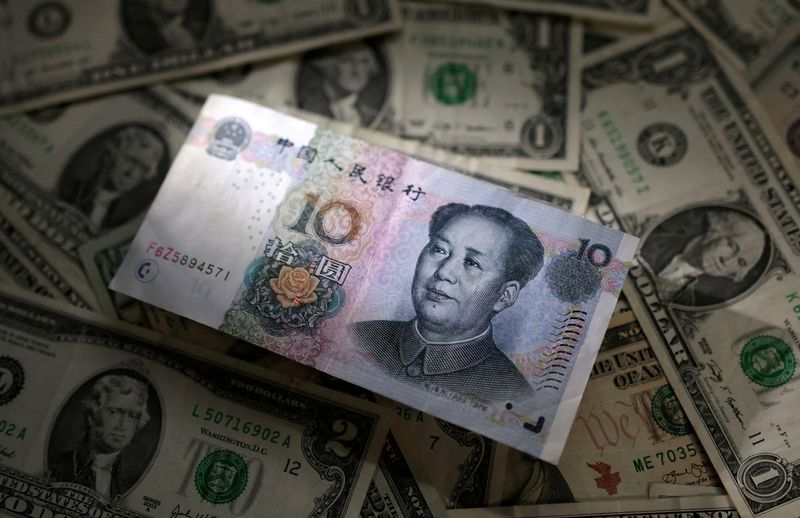
SHANGHAI, May 14 (Reuters) – China’s yuan edged up to a three-year high against the dollar on Thursday, while key stock indexes pulled away from recent peaks, as investors awaited more news from a summit between the leaders of the world’s two largest economies.
China’s President Xi Jinping on Thursday hailed a “new positioning” of ties with the United States after his summit with President Donald Trump in Beijing, according to Chinese state broadcaster CCTV.

Xi said both leaders agreed that building a constructive, strategically stable relationship will provide guidance for bilateral relations in the next three years and beyond, CCTV said, though initial details of the talks were sparse.
“Beijing is adopting a wait-and-see mode, given the ‘better than expected’ first-quarter (economic) growth … Beijing’s focus for the summit is not on deliverables but on optics, aiming to project stability and predictability to both international and domestic audiences,” said Larry Hu, chief China economist at Macquarie.
The Chinese currency, traded both onshore and offshore, touched its strongest levels in more than three years after the central bank lifted its official guidance rate.
The People’s Bank of China (PBOC) set the midpoint rate at 6.8401 per dollar, its strongest since March 24, 2023. However, the official fixing was 513 pips weaker than a Reuters’ estimate of 6.7888, the largest deviation since March 2.
The central bank has been setting weaker-than-expected midpoints since November, a move that market participants believed was to prevent excess yuan gains and maintain currency stability.
The onshore yuan last fetched 6.7858 per dollar as of 0616 GMT, while its offshore counterpart traded at 6.7837.
The currency has been grinding higher this year, thanks largely to China’s robust exports and massive trade surplus. It has gained about 3% against the dollar and is up 2.15% versus its major trading partners year-to-date.
However, in equity markets, the benchmark Shanghai Composite index slid 0.5% after hitting an 11-year high a day earlier, while the blue-chip CSI300 Index lost 0.65%.
“Market expectations are low,” said Ritesh Ganeriwal, group head of investments & advisory at digital investment platform Syfe.
“Investors aren’t positioned for a positive surprise – meaning even a modest outcome could boost sentiment. The next major U.S.-China trade event isn’t until November, when existing rare earth and tariff curbs pause. A constructive meeting could create a window of stability for the next six months.”
Investors largely expect Trump and Xi to keep trade tensions on the backburner during their talks and say they are focused on the booming AI sector.
The U.S. has cleared around 10 Chinese firms to buy Nvidia’s second-most powerful AI chip, the H200, but not a single delivery has been made so far, sources told Reuters, leaving a major technology deal in limbo as CEO Jensen Huang seeks a breakthrough in China this week.
Richard Pan, fund manager at China Asset Management Co, said that capital markets are becoming less and less sensitive to news around Sino-U.S. trade talks, focusing instead on rapid technology advancement.
“The development of the trade war shows that China and the U.S. cannot afford to enter a real big conflict,” he said.
“The competition between China and the U.S. in AI big models will stimulate each other and eventually improve AI capabilities for both.”
Pan added that China’s growing economic resilience has also shielded its markets from volatility in Sino-U.S. ties.
The U.S. and China are expected to inch toward a managed trade mechanism for non-sensitive goods this week, with each side possibly identifying some $30 billion worth of goods on which they could reduce tariffs and sell to each other without crossing national security red lines.
(Reporting by Shanghai Newsroom; Editing by Kim Coghill)