LANSING — The Michigan Civil Service Commission will create a task force to address union concerns about state employee jobs being replaced — both by private contractors and artificial intelligence software.
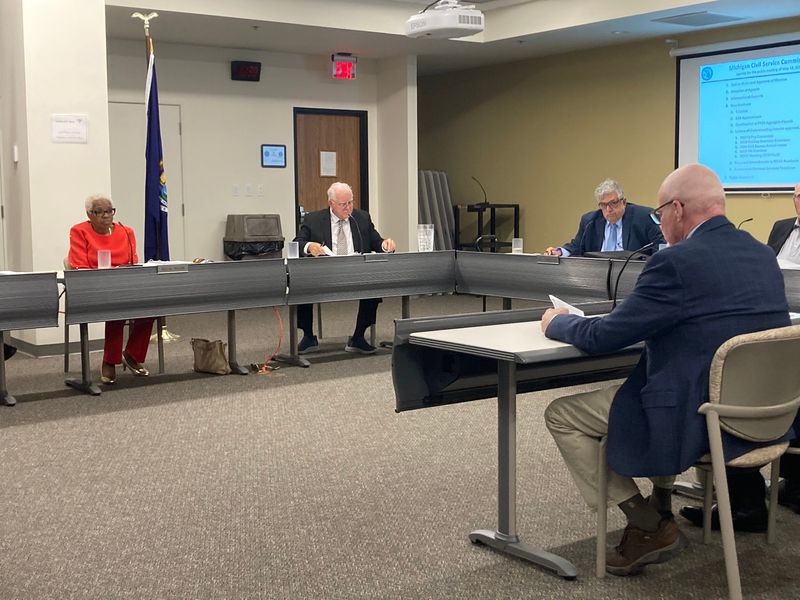
The commission’s four members, all but one appointed by Gov. Gretchen Whitmer, voted unanimously to take the action at its Wednesday, May 13 meeting in Lansing.

Under the resolution, the task force will be chaired by the state personnel director and include representatives of state employee unions, non-union employees, and state agencies. It will look at the history and pros and cons of state contracting through the use of personal service contracts and how such contracts get approved, and prepare a report recommending improvements, according to the resolution.
“It needs to be done,” said Commissioner Jeff Steffel, who was appointed by former Gov. Rick Snyder, and we “want it to be meaningful.”
Creation of a task force marks a direction change for the commission, which can have no more than two members from the same political party and which, during the Republican Snyder administration, declined to act on longstanding union concerns about state employees being replaced by private consultants and contractors that unions argued were costing the state more money while reducing public oversight.
But the task force will go beyond traditional subcontracting and also examine the state’s use of artificial intelligence, officials said.
“When an AI system performs work that would otherwise be done by a classified employee, that is subcontracting,” and should be subject to the same scrutiny and rules, Joseph Bellgowan, a labor relations specialist with Service Employees International Union Local 517M, told the commission May 13.
SEIU Local 517M represents about 1,000 technicians and inspectors across several state departments. UAW Local 6000, the largest state employee union, also supports the creation of a task force, according to Gail Wilson, the commission chair.
Though AI can be useful in handling certain mind-numbing tasks, helping the public find information more quickly, and leaving state employees with more time to perform essential work, Michigan has already seen what can happen “when an automated system stands in for human judgment,” Bellgowan said, referencing the state’s costly disaster of a decade ago when, using a system called MIDAS (Michigan Integrated Data Automated System), it falsely accused thousands of unemployment insurance recipients of committing fraud. Those false allegations led to a successful class-action lawsuit and a $20-million state settlement.
Bellgowan said the state has no uniform approach to the use of AI technology. Some state employees are using it to be more efficient, others won’t touch it because they’re not sure it’s permitted, he said. Some department directors are encouraging its use, others discouraging it, he said.
Meanwhile, a current state system, SIGMA (Statewide Integrated Governmental Management Application), which handles procurement and state employee timekeeping for payroll, is quietly being upgraded to include advanced analytics and decision-making capabilities, he said.
“The tools are arriving faster than the training can keep up,” he said.
Kevin Karpinski, a senior labor relations specialist with SEIU Local 517M, told the Detroit Free Press last August that at the Michigan Department of Transportation, the union’s numbers shrank by 16% from 416 in 2015 to 350 in 2025, as MDOT employees left for better-paying jobs with state contractors and were not replaced.
That “brain drain” contributes to a vicious spiral in which the state becomes increasingly dependent on contractors as it has fewer state employees capable of doing the work, according to a 28-page report Karpinski presented to the commission May 13.
“The increasing reliance on subcontracted technical and inspection services within … state infrastructure agencies poses significant risks to public safety, fiscal responsibility, and workforce sustainability,” the report says.
A spokesman for MITA, a Lansing-based association representing road contractors, did not immediately respond to a request for comment on the commission’s action.
Meanwhile, the union hasn’t even been able to get complete data from MDOT about its use of contractors and consultants, which would help provide complete cost comparisons, Karpinski said.
Commissioner David Berridge said claims by MDOT that the data provided by contractors is not compatible with state data seem “disingenuous” with respect to multi-million-dollar contracts and that’s “been a frustration for me for many years.”
Jocelyn Garza, a spokeswoman for MDOT, did not respond to the concerns expressed at the May 13 meeting about MDOT providing requested data related to its use of contractors. But Garza said it’s difficult for MDOT to hire for transportation technician positions because the pay, which is set by the commission, is lower than in the private sector.
“One may argue that keeping department staffing lean, when sustainable road funding remains an ongoing challenge, is in fact very fiscally responsible,” Garza said in an email.
The union report said changing the state’s approach to use of contractors could “appeal to fiscal conservatives with transparency and accountability measures,” while drawing support from “labor-friendly legislators with fair compensation provisions.”
Union officials believe contracting the work costs about twice as much, when overhead costs and profit margins are included.
They say their position is supported by a 2018 U-M study that found that MDOT would have saved more than $90 million between 2015 and 2017 if certain work had been performed by state employees, rather than contractors.
Another result is a “dangerous accountability gap,” the union said.
“When inspectors and technical engineers are contracted out, the State of Michigan retains ultimate liability for project failures while simultaneously losing direct oversight capacity and institutional knowledge necessary to identify and prevent safety hazards,” the report said.
Proponents of contracting say it provides the state with greater flexibility and avoids the need to add permanent staff for short-term projects. The union says that has validity in certain cases but not when the contracting replaces MDOT core functions, as it says is now happening.
Commissioner Nick Ciaramitaro, who in his former role as director of legislation and policy for AFSCME Council 25 frequently complained to the commission about state contracting practices, said he was “very happy” with the task force plan.
“This has been an issue for probably 30 years,” Ciaramitaro said.
Editor’s note: This story has been updated to correct information about when the current commissioners were appointed.
Contact Paul Egan: 517-372-8660 or pegan@freepress.com.
This article originally appeared on Detroit Free Press: Panel OKs study on how contractors and AI replace state workers
Reporting by Paul Egan, Detroit Free Press / Detroit Free Press
USA TODAY Network via Reuters Connect