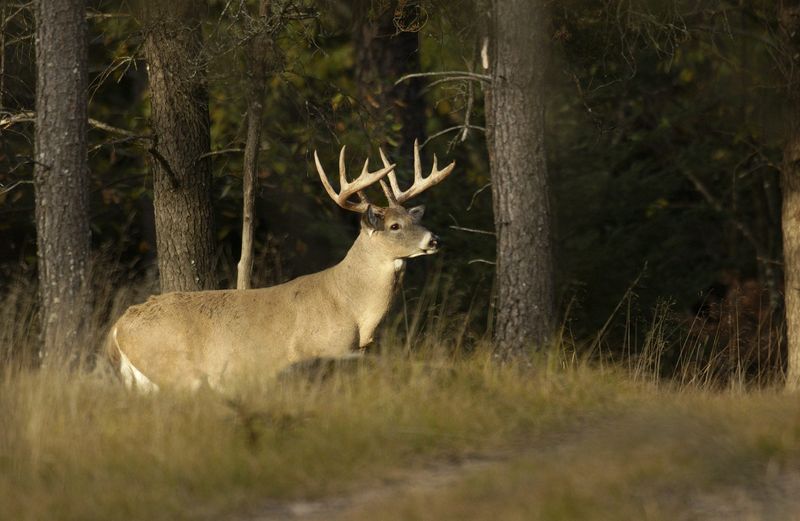
Hunters in the Lower Peninsula will be limited to one buck starting with the 2027 deer hunting season, after the Michigan Natural Resources Commission approved the move in a marathon meeting on Wednesday, May 13, in Gaylord.
The changes, approved by the Natural Resources Commission, a seven-member public body appointed by the governor that oversees the state’s hunting and fishing policies, following a more than 9-and-a-half-hour meeting on Wednesday, include the following for the 2027 deer hunt:

The commission also approved changes that will take place with this fall’s deer hunt, including:
Changes designed to bolster increasingly lackluster Michigan deer hunts
The changes have been in discussion for years and are designed to boost a lagging Michigan deer hunt. Michigan’s hunt is uniquely skewed toward bagging a buck in comparison to other Midwest states around the Great Lakes, where does are more often harvested. It’s led to a disruption of natural male-female ratios of Michigan’s deer that some say contributes to overpopulation and crop damage in southern Michigan and an underabundance of deer in parts of the U.P. Many hunters report finding fewer and fewer older, quality trophy bucks.
The commission amended DNR staff’s recommendations, notably in excluding the Upper Peninsula from the one-buck limit.
Natural Resources Commissioner David Nyberg of Marquette noted that the U.P. deer population features unique challenges such as cold, heavy snow winters and predation from wolves, cougars, bears and other animals. Restrictions on buck harvest in the U.P. could lead to a worsening economic impact beyond that already occurring from the struggling hunt. And of U.P. hunters with the opportunity to take more than one buck, only about 2% do so, Nyberg noted.
“It’s less about the desire or expectation of harvesting two bucks; it’s more about the opportunity to participate in hunting traditions that may be somewhat unique to the U.P.,” he said.
Many − but not all − hunters support the changes
Thumb-area resident Rashel Hubbard told commissioners the one-buck limit was appropriate “so that we don’t see year-in and year-out a deer herd that is imbalanced, that doesn’t look anything close to what it biologically should.”
“The mentality of ‘give two doe tags but keep two buck tags’ is what we have been doing for decades, and how has it worked?” she said.
Hunter Justin Root of Howell cited the success of a one-buck policy in Pennsylvania, a state whose deer and hunter densities closely mirror Michigan’s. In the 2025 season, 22 years after Pennsylvania adopted a one-buck limit with antler point restrictions, some 320,000 does were harvested in the state, compared to 142,000 does in Michigan. Pennsylvania, during that season, harvested 185,000 bucks compared to Michigan’s 152,000 − meaning the doe-to-buck ratio in Michigan was 0.9 compared to 1.7 in Pennsylvania.
“In 2003, 85% of Pennsylvania’s buck harvest was less than a year-and-a-half old; last year it was under 35%,” Root said. “What more do we need for an example of how to manage populations, sex ratios and age structure than those numbers?”
But not all hunters who spoke to the commission on Wednesday were in favor of the changes. Hunter Roger Thorman of Croswell noted that of the hundreds of thousands of Michigan deer hunters who had bought combo licenses, only about 6% took a second buck.
“So basically, we have been doing the one-buck rule now for years, other than a minor little percentage,” he said. “I haven’t seen a change. I don’t know why we would want to force it on people.”
Lower Peninsula pilot program could allow hunters to earn a second buck
The Natural Resources Commission also called on the DNR to develop a pilot “earn a second buck” program for the southern Lower Peninsula. Under this new rule, hunters would have to harvest an antlerless deer before being permitted to harvest a second buck with an antler requirement of at least four points on one side.
Commissioners called for DNR staff to assess deer populations and breakdowns in the pilot area of at least two Lower Peninsula counties in size, set up a comparable control area; and then assess how the second-buck path affected the deer herds.
“We need to be able to measure results,” Commissioner Mark Eyster of Williamston said.
Contact Keith Matheny: kmatheny@freepress.com.
This article originally appeared on Detroit Free Press: ‘One buck rule’ approved in Michigan’s Lower Peninsula for 2027
Reporting by Keith Matheny, Detroit Free Press / Detroit Free Press
USA TODAY Network via Reuters Connect