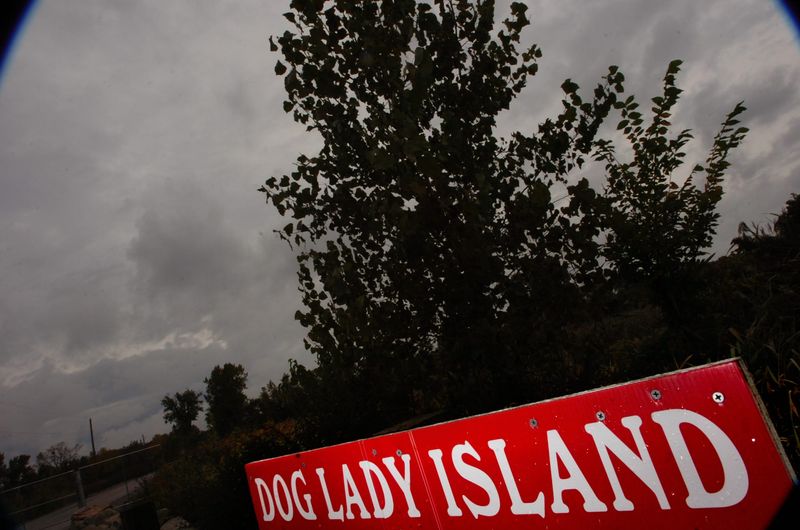
Three local monster legends have captivated Monroe County residents for more than 60 years: Dog Lady Island, Monroe Monster and Whiteford Waterheads.
Now, they’re the subjects of an academic paper.

“Michigan’s Monsters: Hybridised Humanoid Legends” was recently published in Revenant, a peer-reviewed, e-journal that says it’s dedicated to “academic and creative explorations of the supernatural, the uncanny and the weird.”
You can read the paper here.
Author Daniel P. Compora said his article “examines Michigan’s hybridised humanoid legends by identifying recurring elements and motifs.”
Compora, a lifelong Monroe County resident and Ida High School graduate, is an English professor at the University of Toledo. One of his specialties is folklore. He said he’s considered an expert on Monroe Township’s Dog Lady Island.
“When I became a part-time instructor at Monroe County Community College in 1989 or ’90, Dr. James DeVries encouraged me to give my research to the Monroe County Museum. From there, word started to get out and people began reaching out to me to find out what I knew,” Compora said.
He’s been fascinated with folklore for years.
“The undergraduate folklore course I took with Dr. Thomas Barden at the University of Toledo got me started on this path. He let me conduct several independent studies as a graduate student on (Dog Lady) Island and we became good friends,” Compora said. “When he became a dean in 2004, I took over the course. I share the Dog Lady tales with every section I teach.”
Dog Lady Island
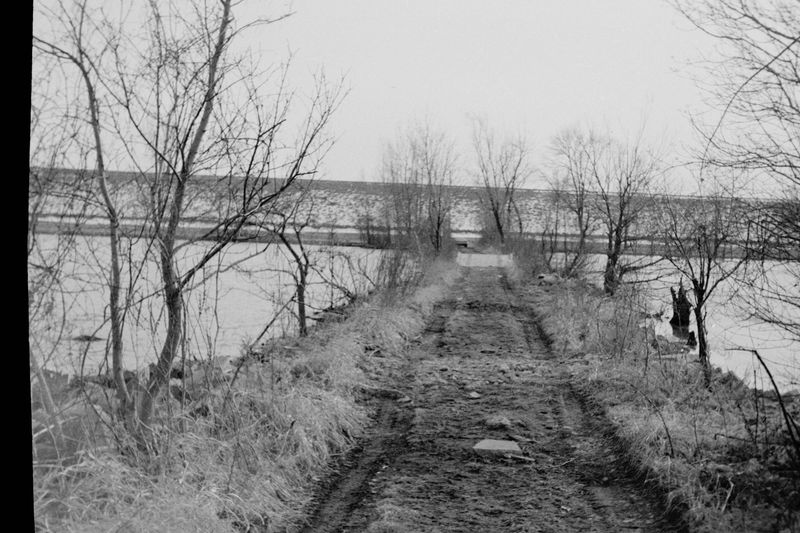
A large portion of Compora’s new paper focuses on Dog Lady Island, a small island located in an inlet of Lake Erie. The tale has been part of local oral tradition since the 1960s.
A dog-like woman is said to live on the eight-acre wooded area on Dunbar Road near LaPlaisance Road. Some accounts say she was attacked by teenagers in the 1960s. She lived alone surrounded by Doberman Pinschers for protection. The legend is similar to others, such as Michigan Dog Man from the Traverse City area.
“The centerpiece of the legend—Dog Lady herself—is unique to Monroe, Michigan,” Compora wrote.
Compora visited the island in 1988.
“As a graduate student, I took a trip to the island, snapped some photographs and got away as quickly as possible. I dragged my poor mother with me back then. She was quite a good sport,” Compora said. “I have driven by it since, but have not ventured onto the island since.”
His paper goes into some detail about the island, including a legend about a coffin lid and an alleged connection with a motorcycle club. Compora also talks about a purported phone number for Dog Lady that even he called in his youth.
“The story has transitioned from a strictly local legend to a regular entry on cryptozoological websites, a regular feature in local newspapers and a full-length movie. These iterations ensure that the legend of Dog Lady Island remains an ever-present element of Michigan and American folklore,” Compora wrote.
Monroe Monster
Dog Lady “briefly shares space in Monroe County with the Monroe Monster,” Compora wrote in the paper.
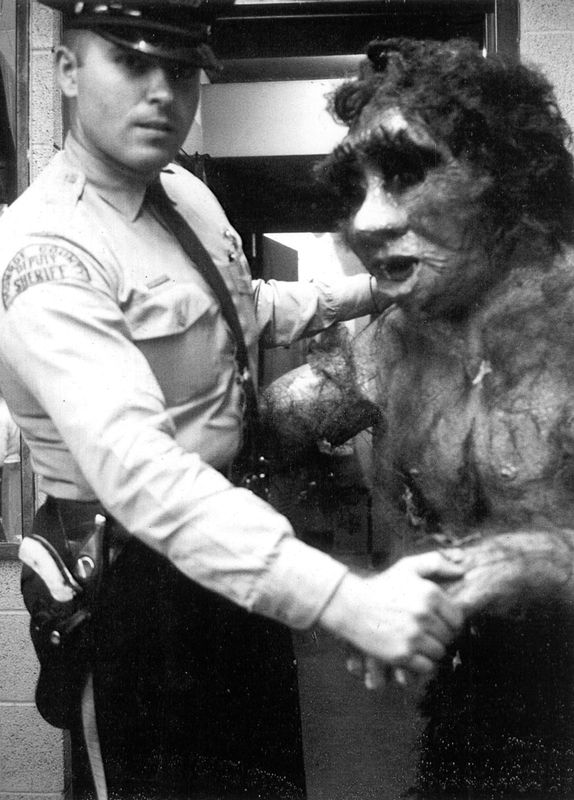
The Monroe Monster was reportedly spotted Aug. 13, 1965, on Mentel Road near the Detroit Beach community.
Christine Van Acker, then 17, and her mother reported to police that they saw a large, hairy figure while driving. It was at least seven-feet tall, weighed about 400 pounds and was covered in long black hair. The figure reportedly reached into the women’s vehicle. The mother left to find help. When she returned, Christine was unconscious and the monster was gone.
Some local theories about the monster are explored in Compora’s paper. Accounts of the monster were published in newspapers and magazines nationwide.
Later, the Monroe Monster was revealed to be a hoax. According to Monroe News archives, around the same time as the sighting, a Neanderthal Man costume had been taken from The Prehistoric Village in Michigan’s Irish Hills.
Samples taken from the scene were said to be from a paintbrush.
Still, “the Monroe Monster remains a recurring topic of paranormal, Bigfoot and cryptozoological message boards,” Compora wrote.
Whiteford Waterheads
Compora said the local legend of the Whiteford Waterheads centers around a family described to have hydrocephalus, a neurological condition involving buildup of fluid in the brain.
“Legends involving medical conditions such as hydrocephalus illustrate how disability is frequently misunderstood and, at times, sensationalized with vernacular tradition, transforming real diagnoses into markers of perceived monstrosity,” Compora wrote in the paper.
In the paper’s conclusion, Compora wrote, “Michigan hybridised figures thus function as contemporary variations of longstanding narratives, preserving established motifs while reshaping them to align with local contexts, modern life and enduring concerns about differences.”
Compora is a member of the International Society for Contemporary Legend Research.
“I first published the Dog Lady legend in this organization’s newsletter in 2005 and presented on it at their 2013 conference,” Compora said.
“I published my first folklore academic piece in 2006 and have published various pop culture/folklore articles since,” he added.
Got a folklore story for Compora?
“I am always open to having people share their Monroe tales and hauntings with me. I believe Monroe has several interesting traditions that are being lost over time,” Compora said. “Few people today know that a movie was filmed in Monroe, ‘The Flaming Urge’ (1953), and I would love to speak with anyone who can share stories about the filming. I also attended the Hall of the Divine Child during the 1970s, and many of the boarding students talked about ghosts and haunted areas.”
Readers can email Compora at daniel.compora@utoledo.edu.
— Contact reporter Suzanne Nolan Wisler at swisler@monroenews.com.
This article originally appeared on The Monroe News: New paper covers Dog Lady Island, Monroe Monster, Whiteford Waterheads
Reporting by Suzanne Nolan Wisler, The Monroe News / The Monroe News
USA TODAY Network via Reuters Connect