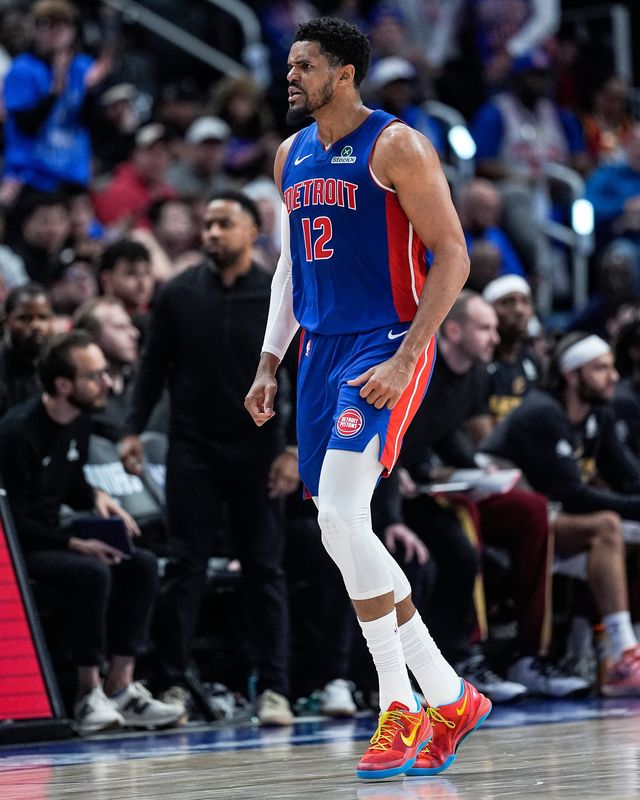
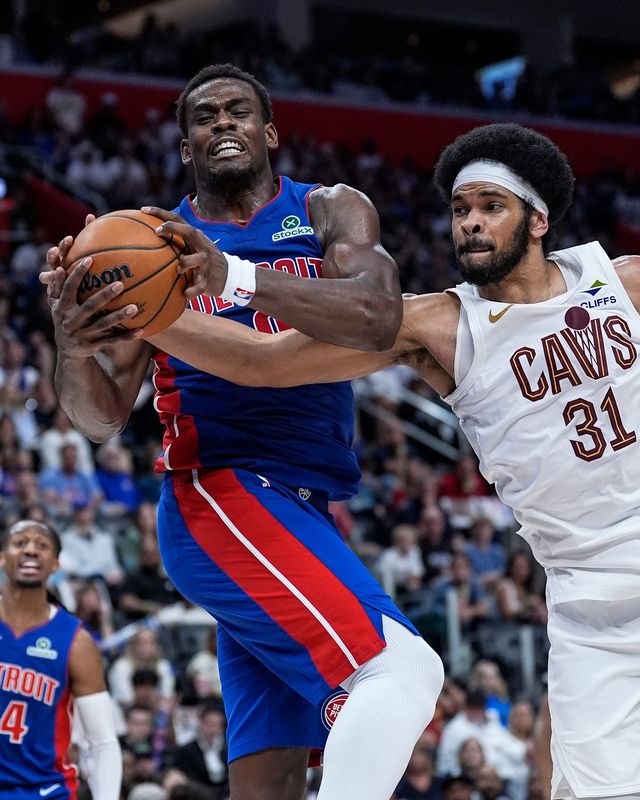
NBA salary cap expert Keith Smith, of Spotrac, joined the “Pistons Pulse” podcast on Tuesday, June 2, to break down the Detroit Pistons’ finances and options this offseason. Here’s how they could approach free agency, re-signing Jalen Duren and extending Ausar Thompson.
Pistons likely to operate above cap, rather than create space

The Pistons can pursue two pathways this summer, each with their own advantages and tradeoffs. Smith said the more likely path is that they operate over the cap, which would allow them to re-sign their own unrestricted free agents (Tobias Harris, Javonte Green and Kevin Huerter), pick up Daniss Jenkins and Tolu Smith’s team options and retain Duncan Robinson and Paul Reed. Only $2 million of Robinson’s roughly $16 million next season is guaranteed, and Reed’s $5.6 contract is fully unguaranteed.
They don’t need cap space to re-sign Duren since he’s a restricted free agent, or to re-sign Harris or Huerter since they have their Bird rights. Additionally, they would have the $15 million non-taxpayer exception to lure outside free agents with.
The other path is the cap space path, which would force significant roster change. Smith said they could generate up to $30 million while factoring in Duren’s $19.4 million cap hold and Jenkins’ $4 million team option. However, they would have to part ways with Harris, Robinson, Reed and Tolu Smith to create that space.
Smith said if they waive Robinson and Reed in the weeks leading up to free agency, it would indicate they’re planning on making a big outside signing. They also would have the $9.4 million room exception to use in free agency.
All things considered, operating above the cap makes more sense if a big free agency signing isn’t in the cards. Smith also made a case for re-signing Huerter to a reasonable contract, as the Pistons stack capital leading up to the February trade deadline.
“You’re keeping Harris’ cap hold on the books and keeping your rights to re-sign him,” he said. “You’re doing the same with Kevin Huerter. I know it’s very easy for people to be like, why would they re-sign Kevin Huerter? He didn’t do anything for the team, he hasn’t really done anything in a year. Part of why you may re-sign him for is let’s say they gave him $10 million. People will say, that’s crazy, $10 million, what are you doing? It’s $10 million in tradeable salary that you might not have had otherwise.”
If they stay over the cap, they’d otherwise be limited to signing players using the veteran minimum after their $15 non-taxpayer exception is exhausted. But Smith said the caliber of player they can get on a minimum deal is better than it would be in the past, now that they are a contending team. As a point of comparison, the Knicks have two rotation players on minimum contracts – Landry Shamet and Jordan Clarkson.
“How you reframe your thinking on this is when the Pistons were bad, minimum contracts were, you take a flier on this guy and see if he pops,” Smith said. “Now it is, we’re good. We’re in the mix to be a contender. Now it’s, what veteran can we add that can give us 10 to 15 minutes a night on a minimum contract?
“They’re going to be shopping on a different level of player on the minimum than they have been in the past. These are guys who can actually play. You’re not betting on potential and upside. You’re really just getting somebody pretty good.”
Duren contract likely will be well short of max
Smith, a long-time booster for Duren, projects a contract extension worth five years and $185 million – an average of $37 million per year. It’s the same extension Houston Rockets All-Star center Alperen Sengun signed two years ago, but well short of the five-year, $287 million maximum extension Duren is eligible for after earning All-NBA third-team honors last month. It’s also below the five-year, $239 million extension he previously was eligible for.
Duren’s poor playoff performance is still fresh after the Pistons’ exit on May 17, but it doesn’t undo the breakout season that preceded it – 19.5 points and 10.5 rebounds on 65% shooting – or his overall upward trajectory through four seasons. A $185 million offer would narrowly beat the maximum four-year, roughly $177 million that outside teams can offer in total value, but an outside max offer – averaging $44.3 million a season – would force the Pistons to pay more to retain Duren.
Smith mentioned the Los Angeles Lakers, Brooklyn Nets and Chicago Bulls as three teams with the means to make the Pistons offer more than $40 million annually. Rather than let his restricted free agency play late into the summer, Smith suggested, the Pistons should get a deal done sooner rather than later.
“I think you have to go in that direction, too, of, somebody could make this really difficult on us,” Smith said. “I would try to get this done before that process even happens and $37 million a year feels right to me.”
Thompson’s extension could be reasonable
The Pistons have a big decision to make regarding Thompson, who is eligible for an extension after completing the third season of his rookie contract.
It was a breakout season and postseason for Thompson, who finished third in Defensive Player of the Year voting, behind Oklahoma City’s Chet Holmgren and San Antonio’s Victor Wembanyama, the winner. Thompson later earned All-Defensive first-team honors, becoming the first Pistons player to do so since Ben Wallace in 2005-06.
Through 14 playoff games, Thompson averaged 8.2 points, 7.9 rebounds, 3.1 assists, two steals and 1.8 blocks per game. His defensive impact is irreplaceable, but the Pistons will have to weigh it against his offensive shortcomings. Thompson’s a non-shooter and also has room for growth making plays with the ball in his hands. Smith pointed out that with Thompson and Duren under contract, the Pistons will have two non-shooters in the starting lineup – which can hurt them in the playoffs.
A point of comparison for Smith is Atlanta Hawks guard Dyson Daniels, who profiles similarly to Thompson and signed a four-year extension worth $100 million last October.
“$27 million’s about where I feel pretty comfortable because that puts you in a place where, even if he becomes nothing more than he is right now, which is a super high-end defensive player who basically on offense is gonna have to score off cuts and fastbreaks and putbacks and those kinds of things with the very occasional jumper mixed in, that still feels OK to me because you’re paying for, at that point, first team-level All-Defense play,” he said. “Anything more than that starts to be, if he can’t be on the floor at the end of crucial playoff games because of the offense, I don’t know that I can pay him more than that.”
[ MUST WATCH: Make “The Pistons Pulse” your go-to Pistons podcast, listen available anywhere you listen to podcasts (Apple, Spotify) or watch live on YouTube. ]
Contact Omari Sankofa II at osankofa@freepress.com. Follow him on X and/or Bluesky.
This article originally appeared on Detroit Free Press: NBA salary cap expert breaks down Detroit Pistons’ potential spending
Reporting by Omari Sankofa II, Detroit Free Press / Detroit Free Press
USA TODAY Network via Reuters Connect