

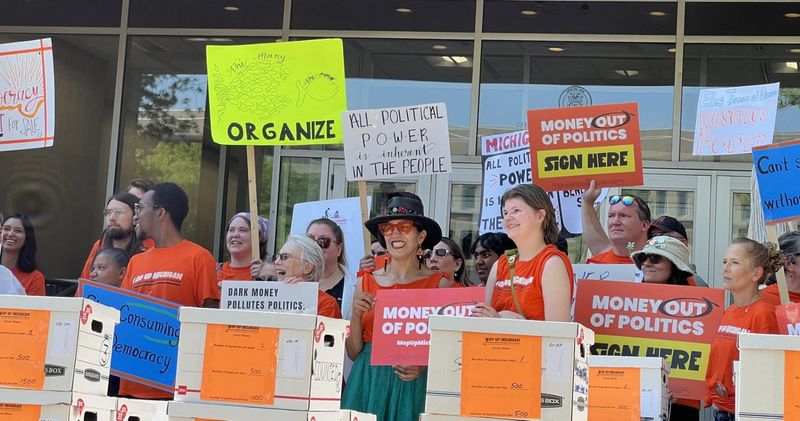
Lansing — A group fighting a petition initiative that would bar state-regulated and state-contracted corporations from political spending in Michigan has filed a lawsuit asking the Michigan Supreme Court to bar the proposal from appearing on the November ballot.
Protect MI Free Speech is asking the high court to find that the petition initiative submitted by Michiganders for Money Out of Politics fell short of the number of valid signatures needed for certification.

The suit argues that the Bureau of Elections used a faulty formula to determine how many signatures from a 1,000-signature sample were needed to prove Michiganders for Money Out of Politics had met its required collection of 356,958 valid signatures.
“The petition failed to meet the threshold required under its own methodology,” said John Sellek, a spokesman for the group. “It’s sloppy math and a failure to follow its own standards. The Michigan Supreme Court must correct this error to prevent an improperly certified proposal from appearing on the ballot.”
The group also argued the Board of State Canvassers should have thrown out 12 signatures that listed nonexistent street addresses.
Christy McGillivray, co-chair for the Michiganders for Money out of Politics steering committee, said the group was fully confident justices would dismiss the claims. The Michigan Supreme Court has a 6-1 Democratic-nominated or Democratic-appointed majority.
“This legal challenge comes as no surprise,” McGillivray said in a statement. “We have said it before, it’s the easiest and cheapest path to trying to stop this initiative before facing Michigan voters at the ballot box, where we know this people-powered initiative has overwhelming support.”
If adopted by the Legislature or approved by voters in November, the initiative would amend the state’s campaign finance law to prohibit contributions from monopoly utilities and companies with state government contracts worth more than $250,000. Additionally, the initiative would ban entities and people connected to utilities and large government contractors from giving to political campaigns in Michigan.
The initiative also attempts to expand transparency around so-called dark money groups. Under current law, only groups that run ads expressly telling people how to vote have to report their donors. The initiative would expand the disclosure requirements to ads that clearly identify candidates, which would encompass those ads run by dark money groups that do not usually disclose their donors.
In a 2010 decision, the U.S. Supreme Court ruled that restricting independent spending by corporations and unions violated the First Amendment’s Free Speech Clause.
The Board of State Canvassers, after an hours-long meeting on July 24, voted 3-1 to certify the petition initiative, finding it had enough valid signatures because a 1,000-signature sample produced 645 valid signatures, nine signatures above the 636-signature threshold necessary for certification.
Under state law, the petition initiative requires 356,958 valid signatures to be certified for advancement to the Legislature or the November ballot. The Board of State Canvassers, in order to ease the review of those signatures, relies on a 1,000-signature sample to determine whether the petition initiative has a valid minimum number. Under that sample formula, MMOP needed at least 636 valid signatures within the 1,000-signature sample.
But Protect MI Free Speech, during the July 24 meeting and in its lawsuit, argued the Bureau of Elections erred in setting the threshold at 636 and that the 90% confidence level required under its formula would instead result in a 661-signature threshold.
Additionally, the opposition group argued that, while signers can write the wrong address down while signing a petition, they cannot make an address up out of thin air. There were about 12 signatures that may have contained fabricated addresses, according to the group.
Canvassers debated the issue for some time but ultimately overruled the concerns brought by Protect MI Free Speech in certifying the proposal.
eleblanc@detroitnews.com
This article originally appeared on The Detroit News: Michigan Supreme Court asked to block ‘money out of politics’ proposal
Reporting by Beth LeBlanc, The Detroit News / The Detroit News
USA TODAY Network via Reuters Connect
By Beth LeBlanc, The Detroit News | USA TODAY Network
