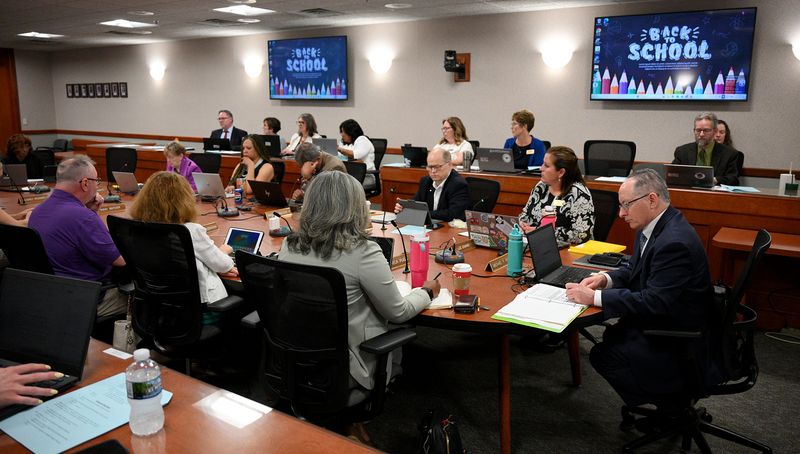
Earlier this month, the State Board of Education passed a resolution opposing any effort by the state of Michigan to opt in to the federal “Education Freedom Tax Credit Program.” The program would allow tax credits for taxpayers who donate up to $1,700 to “Scholarship Granting Organizations” (SGOs), which would in turn be responsible for redistributing the funds to “eligible” students, a form of education voucher, and one that could open the door to unlimited expansion.
The state board was right to sound the alarm. Issues of fairness and funding, legality and logistics abound.

Public schools have a legal responsibility to educate all children: students with and without disabilities; English learners and those who are not; poor children, working class, middle class or wealthy; students who are indigenous, White, Black, Latino, Asian and multiracial; children of different religions and children without religion; and students who are LGBTQ+ and those who are not. By contrast, nonpublic schools often choose the children that they will educate — and those they will not.
Additionally, vouchers in other states often subsidize those families already paying nonpublic school tuition. For example, according to the Arkansas 2023-24 Education Freedom Account Annual Report, 95% of participants in Arkansas’s universal voucher program were already enrolled in private school or were incoming kindergarten students. Indeed, households with incomes up to 300% of an area’s median gross income would currently qualify for scholarships through the Education Freedom Tax Credit Program.
According to the U.S. Census, in 2024, the national median household income was $83,730, and triple that median was $251,190. But as is often the case with voucher programs, these programs may start with limitations that are subsequently removed.
The current impact of the program on the federal budget has been estimated at just under $1 billion up to just over $24 billion annually, the latter more than the federal government allocates to either of its largest educational programs ― Title I, Part A and the Individuals with Disabilities in Education Act (IDEA). Putting at risk even a portion of these and other underfunded federal education programs is ill-advised at best. Chipping away at a public good such as public education undermines the vast majority of students and their families who are served by public schools. It also creates diseconomies of scale that serve neither students nor taxpayers well.
Federal law makes the governor of each state the sole decision maker on whether a state opts in or out of this program. Not surprising, since when the decision is left to actual voters, these efforts fail. According to Ballotpedia, U.S. voters rarely approve statewide education choice ballot initiatives and have never approved a statewide education voucher plan.
Opting into this program also sidesteps the will of Michigan voters who have long and overwhelmingly rejected voucher proposals.
In 1970, Michigan voters opposed a laundry list of uses of public funds for nonpublic schools, including vouchers, and in 1978 and 2000, voted down voucher referenda of one form or another. Michiganians want their public schools supported, not undermined or chipped away.
The U.S. Department of the Treasury ― not the U.S. Department of Education ― is responsible for developing the rules that will ultimately govern this program. Currently, it’s unclear what authority states will have to regulate SGOs, including ensuring non-discrimination policies, reporting requirements or even the tracking of results. Moreover, with the federal definition of an SGO being “a charity that uses at least 90 percent of its income on scholarships for education choice options for eligible K-12 students,” it will be necessary for SGOs to form prior to the program getting off the ground. One can imagine a whole cottage industry being established to support this new program and its outgrowth.
Given issues of fairness, funding, legality and logistics, Gov. Gretchen Whitmer would do well to heed the state’s electoral history and not opt in to this ill-conceived program.
Casandra E. Ulbrich, Ph.D., is former president of the Michigan State Board of Education. Michael F. Rice, Ph.D., is a retired State Superintendent and Chairperson of the Michigan State Board of Education.
This article originally appeared on The Detroit News: Michigan shouldn’t opt in to Education Freedom Tax Credit Program | Opinion
Reporting by Casandra Ulbrich and Michael Rice / The Detroit News
USA TODAY Network via Reuters Connect